How to Fine-Tune Large Language Models Efficiently
TL;DR
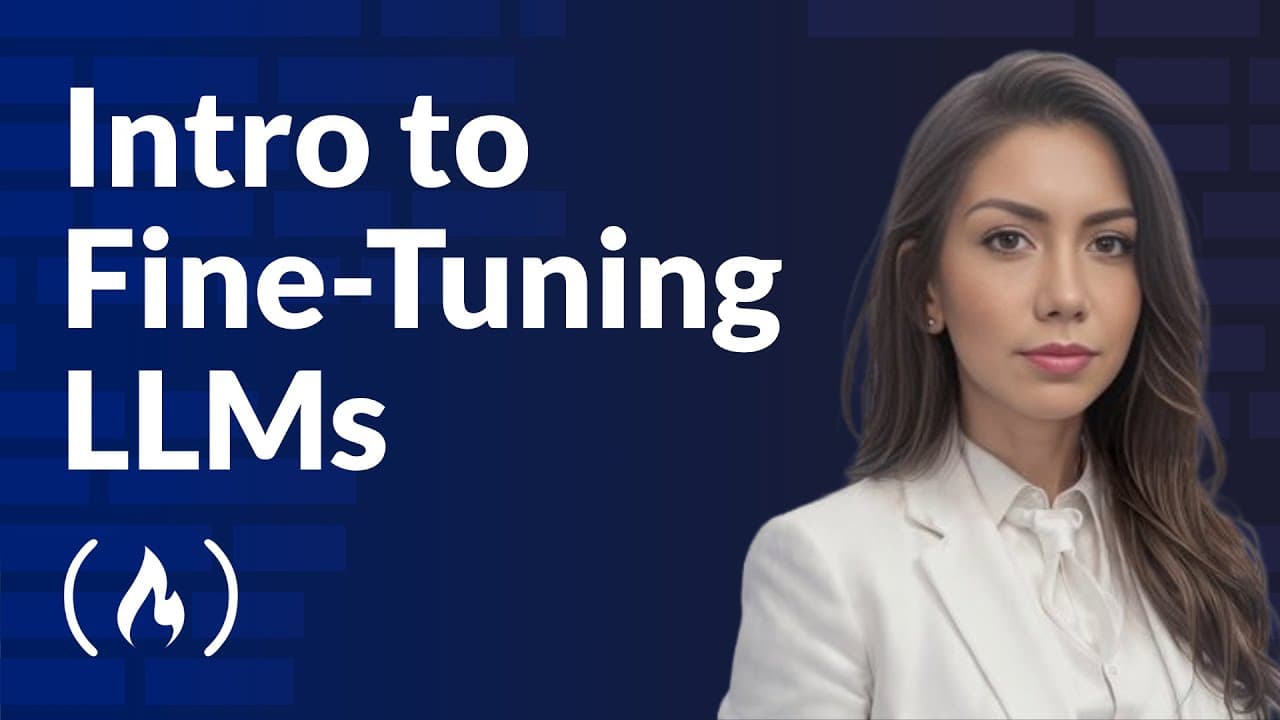
Fine-tuning efficiently means tailoring a pre-trained large language model to specific tasks while using parameter-efficient methods such as QLoRA when appropriate. The course covers supervised and semi-supervised fine-tuning, reinforcement learning with human feedback, data curation, hardware and code setup, and an end-to-end implementation using tools including Python, PyTorch, TensorFlow, and Hugging Face. Read on to understand the methods, workflow, and practical tools involved.
Transcript
This course takes you from the basics to the advanced practical applications of fine-tuning large language models. Tada teaches this course. She is an industry leader and CEO of Lunar Tech. You'll start by understanding what fine-tuning tuning is and how it differs from pre-training and prompt engineering. Then you will learn about hands-on methodo... Read More
Key Insights
- Fine-tuning adapts pre-trained models for specific tasks, enhancing accuracy and efficiency.
- Supervised fine-tuning uses labeled data to guide model adjustments.
- Reinforcement learning with human feedback aligns model outputs with human preferences.
- QLoRA enables parameter-efficient fine-tuning, suitable for home workstations.
- Prompt engineering involves crafting inputs for desired model responses without retraining.
- Fine-tuning requires computational resources, such as GPUs or TPUs.
- Overfitting can be mitigated through techniques like early stopping and regularization.
- Evaluation of fine-tuned models involves using separate test sets for accurate performance assessment.
Install to Summarize YouTube Videos and Get Transcripts
Explore YouTube Video Summarizer or Get YouTube Transcript Extractor
Questions & Answers
Q: What is fine-tuning in large language models?
Fine-tuning is a technique for tailoring large language models to specific tasks and improving their performance. The course places it within the broader LLM development process and explains what fine-tuning does to a model.
Q: How does fine-tuning differ from pre-training and prompt engineering?
The course treats pre-training, fine-tuning, and prompt engineering as distinct parts of working with large language models. It formally defines fine-tuning, compares it with pre-training, and explains how it differs from prompt engineering before moving into implementation.
Q: What fine-tuning methods does the course cover?
The course covers supervised fine-tuning, semi-supervised fine-tuning, and reinforcement learning with human feedback. It also examines parameter-efficient fine-tuning and low-rank adaptation, or LoRA.
Q: What is QLoRA, and why is it useful for fine-tuning?
QLoRA combines quantization and LoRA as a parameter-efficient fine-tuning method. According to the course, it can make it possible to fine-tune a model such as Llama 70B on a home workstation without a billion-dollar setup.
Q: What steps are involved in fine-tuning a large language model?
The course provides a step-by-step fine-tuning process that includes preparing instruments, curating data, and setting up the hardware and code environment. It then moves from the underlying theory to practical, end-to-end case studies.
Q: Which models and tools are used in the practical fine-tuning examples?
The practical case studies use Python, PyTorch, TensorFlow, and off-the-shelf pre-trained models from Hugging Face. The course also looks specifically at Llama models and how to fine-tune them.
Q: What is parameter-efficient fine-tuning?
Parameter-efficient fine-tuning, identified in the course as PEFT, is presented as a popular approach for fine-tuning large language models. The module examines three options for parameter fine-tuning and then focuses on techniques including LoRA and QLoRA.
Q: Who teaches the fine-tuning course, and what experience does she bring?
The course is taught by the co-founder and CEO of Lunar Tech, who reports more than seven and a half years of real-world experience with Fortune 500 companies. Her background spans data science, data engineering, AI engineering, technology leadership, hands-on development, and research in NLP, AI, and data science.
Summary & Key Takeaways
-
Fine-tuning large language models involves adapting pre-trained models to perform specific tasks with greater accuracy and efficiency. This process is crucial for specialized applications, allowing models to excel in niche areas by adjusting internal parameters based on new, often smaller datasets.
-
Supervised fine-tuning involves using labeled data to guide model adjustments, while reinforcement learning with human feedback uses human evaluations to align model outputs with human preferences. These techniques enhance model performance in tasks like sentiment analysis and question answering.
-
QLoRA is a parameter-efficient fine-tuning technique that allows for the tuning of massive models like Llama 70B on home workstations. It combines quantization and low-rank adaptation, making fine-tuning accessible without the need for extensive computational resources.
Read in Other Languages (beta)
Share This Summary 📚
Summarize YouTube Videos and Get Video Transcripts with 1-Click
Try YouTube Summary with ChatGPT & Claude or YouTube Transcript Generator
Explore More Summaries from freeCodeCamp.org 📚
![The Most Important Skills Going Forward with CTO + Homebrew Maintainer Mike McQuaid [Podcast #204] thumbnail](/_next/image?url=https%3A%2F%2Fi.ytimg.com%2Fvi%2F58Tn2xB8kIE%2Fhqdefault.jpg&w=750&q=75)

Summarize YouTube Videos and Get Video Transcripts with 1-Click
Try YouTube Summary with ChatGPT & Claude or YouTube Transcript Generator