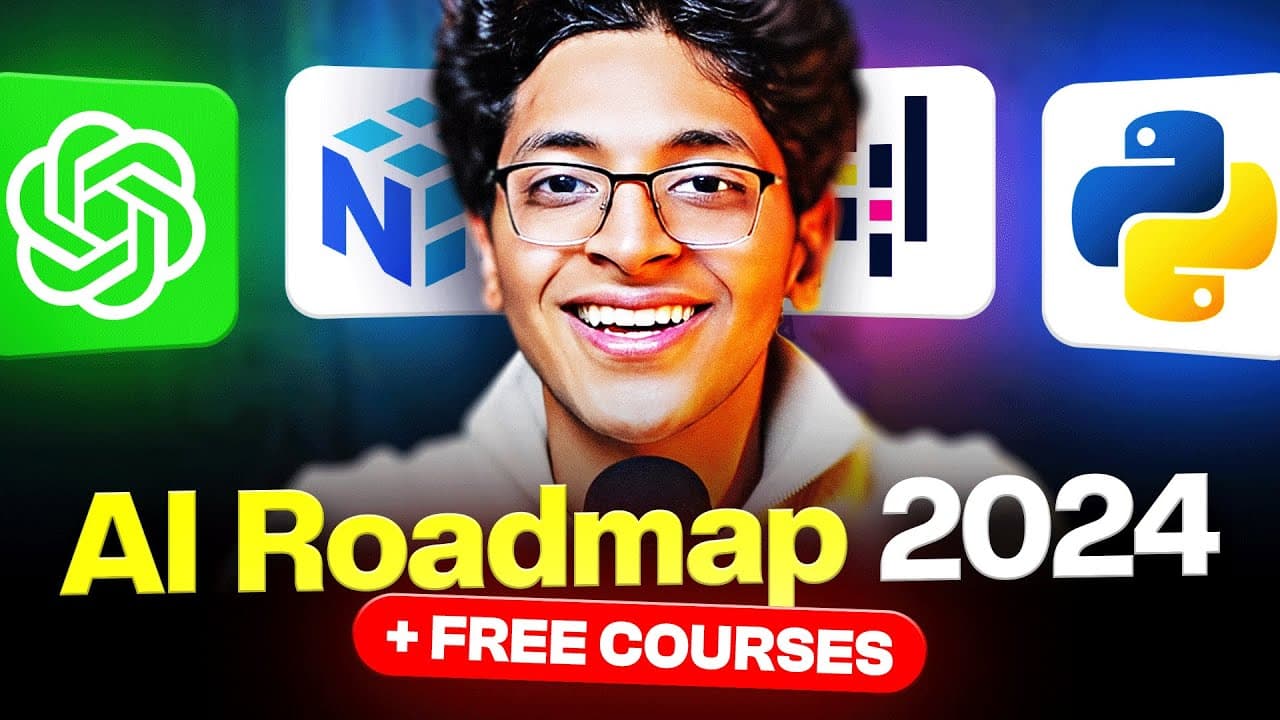
How I'd Learn AI in 2024 (If I Could Start Over) | Machine Learning Roadmap
TL;DR
To learn AI and machine learning from scratch, build a foundation in calculus, linear algebra and probability, then study Python, data analysis, machine learning models, neural networks, NLP and generative AI. Practice Python through simple projects and use NumPy, pandas and matplotlib for data work. Read on for a step-by-step roadmap from core concepts to building AI applications.
Transcript
here is my prediction AI is going to be the biggest trend of 2024 and going forward in this decade hi everyone I'm asan Sharma I started learning about machine learning and AI back in 2019 and 2020 and today this field is booming like never before with the launch of chat GPT and other generative AI applications there is so much demand for AI engine... Read More
Key Insights
- "machine learning is a process through which a system can recognize patterns and predict future outcomes" (1:12)
- "maths will be the foundation upon which you'll build all of your learnings" (2:01)
- "the most important thing to learn in maths will be calculus differentiation and integration understanding about linear algebra and lastly probability" (2:06)
- "the second step is to learn about python" (3:32)
- "the next step after learning python is to learn about data analysis" (5:41)
Install to Summarize YouTube Videos and Get Transcripts
Explore YouTube Video Summarizer or Get YouTube Transcript Extractor
Questions & Answers
Q: What is machine learning?
Machine learning is a process through which a system recognizes patterns and predicts future outcomes. It learns relationships between inputs and outputs from training data, then returns an outcome and a probability for that outcome.
Q: What should I learn first to become an AI engineer?
Start with mathematics because it provides the foundation for building and training machine learning models. Focus on calculus, differentiation and integration, linear algebra and probability.
Q: Why is probability important in machine learning?
A machine learning model gives probabilities rather than simple yes-or-no results. For example, it can estimate the probability that a photo looks like a dog.
Q: Which programming language should I learn for AI engineering?
Learn Python because it is used to build machine learning models and is described as simple and similar to English. Begin with data types, conditional statements, loops, functions and object-oriented programming concepts.
Q: How much Python do I need to know before learning AI?
You do not need to learn every Python library, package or application before moving forward. Understand the basics, build simple projects such as games, and look up errors or unfamiliar concepts when needed.
Q: Which Python libraries should I learn for data analysis?
Learn NumPy, pandas and matplotlib. NumPy supports numerical work with arrays and multidimensional arrays, pandas works with tabular data, and matplotlib is used for data visualization.
Q: What types of machine learning models should I study?
Study supervised learning, which uses labeled data, unsupervised learning, which uses unlabeled data, and reinforcement learning, which learns through incentives. These are the three main types identified in the roadmap.
Q: What should I learn after Python and data analysis?
Move into machine learning frameworks such as PyTorch and scikit-learn, then study neural networks, convolutional neural networks and natural language processing. The roadmap also recommends generative AI and tools such as chat GPT for building AI applications.
Summary & Key Takeaways
-
Understand the foundations of AI and machine learning, which involve recognizing patterns and predicting outcomes based on training data.
-
Start by learning mathematics, including calculus, linear algebra, and probability, to build a strong foundation.
-
Learn Python programming, focusing on data types, conditional statements, loops, functions, and libraries like NumPy, pandas, and matplotlib for data analysis.
-
Explore machine learning frameworks like PyTorch and scikit-learn, and understand supervised learning, unsupervised learning, and reinforcement learning.
-
Dive deeper into neural networks, convolutional neural networks (CNN), natural language processing (NLP), and generative AI using tools like chat GPT.
Read in Other Languages (beta)
Share This Summary 📚
Summarize YouTube Videos and Get Video Transcripts with 1-Click
Try YouTube Summary with ChatGPT & Claude or YouTube Transcript Generator
Explore More Summaries from Ishan Sharma 📚
Summarize YouTube Videos and Get Video Transcripts with 1-Click
Try YouTube Summary with ChatGPT & Claude or YouTube Transcript Generator