How to Choose Your Next Business Priority
TL;DR
Choose the next business priority by identifying risks that could produce multiple returns, then separate asymmetric opportunities from symmetric work. Founders should concentrate on asymmetric risks with potential outcomes of 5X, 10X, or 15X, while eliminating or delegating lower-impact symmetric tasks that consume founder time without multiplying the company’s growth.
Transcript
The work I'll do, the risk I'll take, is X. But the output that return can generate is 5X, 10X, or even 15X. [music] And once you understand that, you also need to understand that whenever a multiple return has come on to your [music] business, it has always come because of taking a Was it because you meet someone? Was it because you hired someone?... Read More
Key Insights
- The recurring question of what to do next can trap entrepreneurs in a loop of random advice and disconnected execution. A clear strategy replaces this uncertainty with a deliberate process for choosing work that creates forward momentum and has the potential to multiply business results.
- The next major business priority should target a multiple return rather than a small improvement. In the example, a business earning 80 lakhs per month should prepare for 1.2 CR, 1.6 CR, or 2 CR instead of making 85 lakhs the central objective.
- Multiple returns are connected to taking risks involving time, money, people, or other resources. Examples include hiring an expensive team member, increasing advertising spending, opening a new location, or purchasing an expensive camera, although a large risk can also fail to produce results.
- The first decision step is to list risks that could generate a twofold or tenfold result. A cafe owner earning 1 lakh in monthly profit might consider another location, a new chef, additional marketing, menu changes, pricing changes, or CRM software.
- Symmetric risk produces a return that is roughly proportional to the input. Eating is presented as an example because spending money and half an hour on food provides approximately six to eight hours of energy, creating a limited and relatively predictable benefit.
- Asymmetric risk can generate 5X, 10X, or 15X output from an input of X. Reading a 200-page book for four or five hours and applying one principle over 30 years illustrates how a modest investment can potentially create a much larger long-term return.
- Every proposed risk should be labeled symmetric or asymmetric and accompanied by a written reason. The explanation matters because an opportunity may initially appear asymmetric even when its likely effect is merely proportional and insufficient to change the company’s revenue substantially.
- Founders should delegate symmetric activities and personally focus on asymmetric opportunities. If no team exists, symmetric items should be removed from the founder’s priority list. If a team exists, those items should be marked for delegation and assigned to team members.
Install to Summarize YouTube Videos and Get Transcripts
Explore YouTube Video Summarizer or Get YouTube Transcript Extractor
Questions & Answers
Q: How can entrepreneurs decide what to do next?
Entrepreneurs can decide what to do next by listing the risks available to the business and identifying which ones could produce a multiple return. Each option should then be classified as symmetric or asymmetric, with the reason written beside it. The founder should prioritize asymmetric opportunities that create forward momentum and delegate or remove work with merely proportional returns.
Q: What is asymmetric risk in business?
Asymmetric risk is an action where the potential output is much larger than the required input. The transcript describes possibilities of 5X, 10X, or 15X output from an input of X. Business examples include opening another location or spending an entire month’s profit on marketing when success could double or triple revenue, even though failure remains possible.
Q: What is symmetric risk in business?
Symmetric risk is an action whose return is roughly equal or proportional to what is invested, with a risk-to-reward ratio of one or less. Hiring a chef for 30,000 rupees to add four or five dishes is treated as symmetric when those additions are unlikely to change the cafe’s revenue meaningfully, despite improving its menu.
Q: Why should founders focus on multiple returns?
Founders should focus on multiple returns because their main priority must propel the company forward rather than create only a small improvement. The transcript contrasts moving monthly business volume from 80 lakhs to 85 lakhs with preparing it for 1.2 CR, 1.6 CR, or 2 CR. The founder’s attention should therefore go toward opportunities capable of materially changing results.
Q: How should a founder evaluate possible business risks?
A founder should write down every risk that could potentially produce a twofold or tenfold result, then classify each one as symmetric or asymmetric. The founder should also record why each classification applies. This written reasoning creates clarity and helps prevent an opportunity from being labeled asymmetric merely because it feels exciting or appears valuable at first glance.
Q: What risks could help a cafe increase its profit?
A hypothetical cafe earning 3 lakhs in revenue and 1 lakh in monthly profit could consider opening another location, hiring another chef, investing heavily in marketing, changing its menu, adjusting prices, or installing CRM software. These options must still be evaluated individually because some may only create proportional improvements, while others could double or triple revenue.
Q: Why can increased marketing be an asymmetric risk?
Increased marketing can be asymmetric when a cafe invests a large amount, such as its entire profit for one month, and the campaign has the potential to generate substantial footfall and returning customers. The investment might produce no meaningful result, but if it works, it could create an outcome equal to two or three times current revenue.
Q: What should founders do with symmetric work?
Founders should avoid making symmetric work their personal priority because proportional returns will not propel the company to multiple levels of growth. A solo founder should remove symmetric items from the central priority list. A founder with a team should mark those items for delegation, assign them to team members, and preserve personal attention for asymmetric opportunities.
Summary & Key Takeaways
-
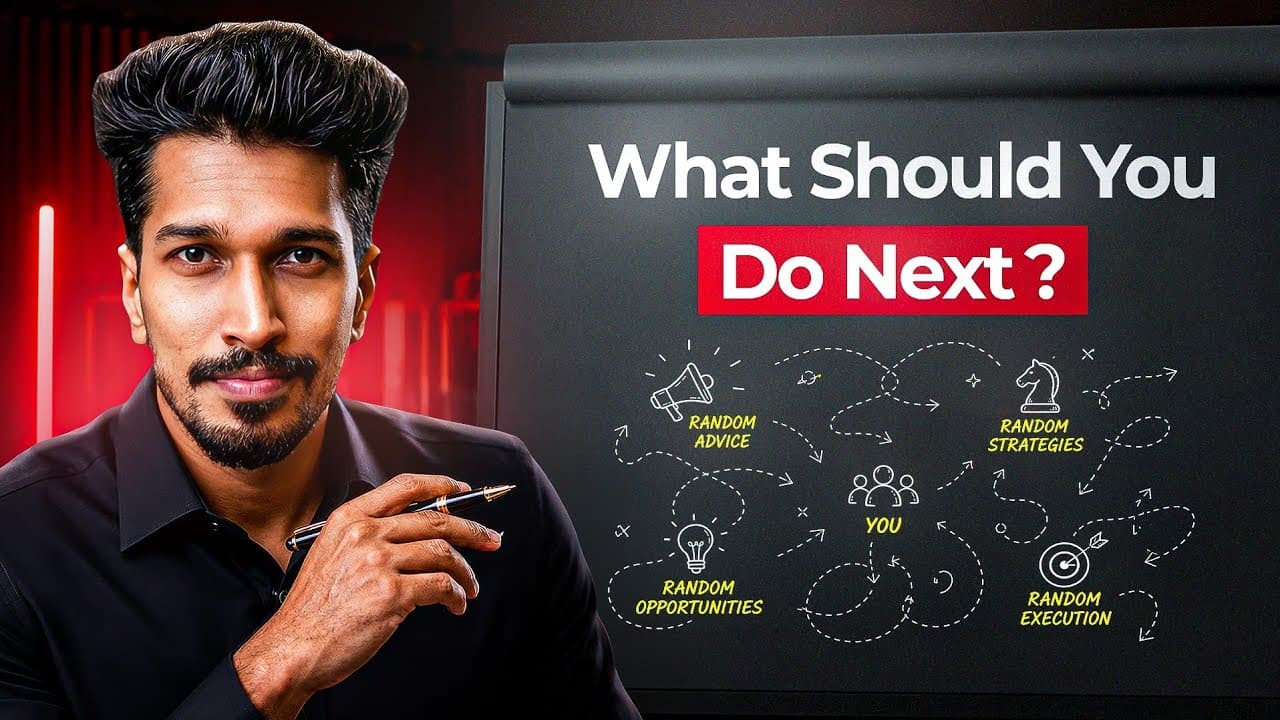
Entrepreneurs often become trapped in a recurring question about what to do next, moving between sales, marketing, systems, hiring, networking, and new opportunities. Acting on random advice does not create a coherent strategy. The next priority should instead generate forward momentum and prepare the business for a multiple return.
-
The first step is to list every risk that could potentially double, triple, or otherwise multiply business results. For a hypothetical cafe, possibilities include opening another location, hiring a chef, increasing marketing spending, changing the menu or pricing, and installing CRM software to collect customer and ordering data.
-
Each option should be classified as symmetric or asymmetric, with a written explanation for that classification. Symmetric work produces a roughly proportional return, while asymmetric risk can produce an outcome several times larger than its input. Founders should focus on asymmetric opportunities and delegate symmetric responsibilities to their teams.
Read in Other Languages (beta)
Share This Summary 📚
Summarize YouTube Videos and Get Video Transcripts with 1-Click
Try YouTube Summary with ChatGPT & Claude or YouTube Transcript Generator
Explore More Summaries from Himanshu Agrawaal 📚

Summarize YouTube Videos and Get Video Transcripts with 1-Click
Try YouTube Summary with ChatGPT & Claude or YouTube Transcript Generator