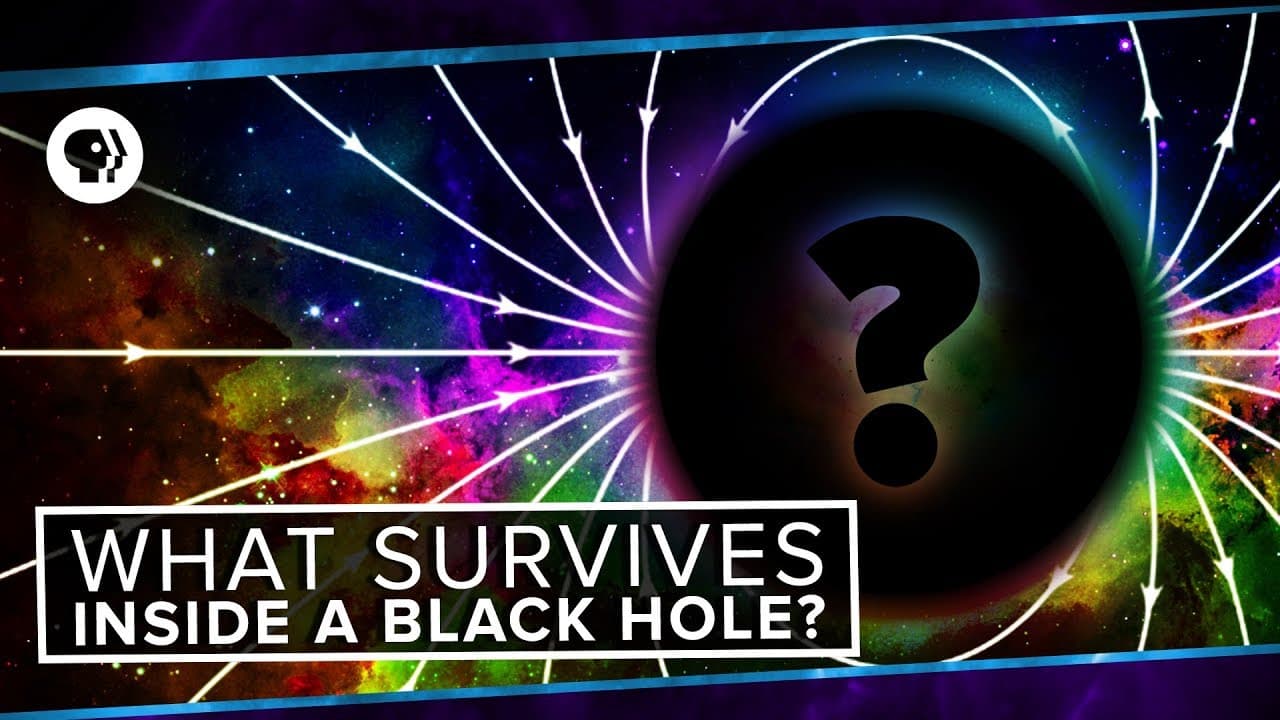
What Happens to Information Inside a Black Hole?
TL;DR
Inside a black hole, nothing can escape past the event horizon, leading to the no-hair theorem, which states that only mass, electric charge, and angular momentum can be known. The conservation of quantum information complicates this, creating the information paradox, as it's argued that information might still be retained in some form despite being hidden from outside observers.
Transcript
MATT O'DOWD: Thanks to the Great Courses Plus for supporting PBS Digital Studios. I've got a physics joke for you. A proton, an electron, and an antineutrino walk into a black hole. That's it. [MUSIC PLAYING] We've established by now that black holes are weird, the result of absolute gravitational collapse of a massive body, a point of hypothetical... Read More
Key Insights
- Black holes are defined by three properties: mass, electric charge, and angular momentum, as per the no-hair theorem.
- The event horizon of a black hole is a boundary beyond which nothing can escape, not even light or information.
- The gravitational and electromagnetic forces have infinite range, allowing mass and charge to be remembered outside a black hole.
- Gauss's law explains how gravitational and electric fields remember the mass and charge inside a black hole.
- Angular momentum is preserved in a black hole through frame dragging, affecting surrounding spacetime.
- Quantum mechanics demands the conservation of quantum information, posing the information paradox for black holes.
- The information paradox suggests that black holes might retain more information than previously thought.
- Black holes may emit Hawking radiation, potentially releasing information over vast timescales.
Install to Summarize YouTube Videos and Get Transcripts
Explore YouTube Video Summarizer or Get YouTube Transcript Extractor
Questions & Answers
Q: What is the no-hair theorem?
The no-hair theorem posits that black holes can be fully described by only three properties: mass, electric charge, and angular momentum. This means that all other information about the material that formed the black hole is not observable from the outside, making black holes appear 'bald' or featureless.
Q: How do gravitational and electric fields relate to black holes?
Gravitational and electric fields have infinite range, allowing them to communicate the mass and charge of a black hole across the event horizon. Gauss's law explains how these fields remember the contents of a region of space, ensuring that the mass and charge of a black hole are reflected in the surrounding fields.
Q: What is frame dragging in the context of black holes?
Frame dragging is a phenomenon where a rotating mass, like a black hole, drags the surrounding spacetime along with it. This effect is significant around black holes, altering the shape of the event horizon and influencing the orbits of nearby objects. It is a prediction of Einstein's general relativity and has been observed around Earth, albeit subtly.
Q: What is the information paradox related to black holes?
The information paradox arises from the conflict between quantum mechanics and the classical description of black holes. Quantum mechanics insists on the conservation of quantum information, but black holes seem to destroy information once it crosses the event horizon. This paradox challenges our understanding of how information is preserved in the universe and suggests that black holes might be more 'hairy' than previously thought.
Q: How does Hawking radiation relate to black holes?
Hawking radiation is a theoretical prediction that black holes emit radiation due to quantum effects near the event horizon. This radiation could potentially allow black holes to lose mass and eventually evaporate. Importantly, Hawking radiation might carry away information, providing a possible resolution to the information paradox by suggesting that information is not lost but slowly released over time.
Q: Why are black holes considered simple objects?
Black holes are considered simple because they can be described by only three properties: mass, electric charge, and angular momentum. Despite the complex processes that lead to their formation, once a black hole is formed, all other details about the material that created it are irrelevant to its external appearance, making it a 'simple' object in theoretical terms.
Q: What role does Gauss's law play in understanding black holes?
Gauss's law helps explain how the gravitational and electric fields of a black hole can remember the mass and charge that fell into it. The law states that the total field passing through a closed surface depends on the amount of mass or charge inside, allowing these properties to be reflected in the fields surrounding a black hole despite being beyond the event horizon.
Q: Can black holes have a net electric charge?
In theory, black holes can have a net electric charge, but in reality, they are unlikely to maintain it. A charged black hole would quickly attract particles with the opposite charge, neutralizing itself. As a result, most black holes are expected to be electrically neutral in practice.
Summary & Key Takeaways
-
Black holes, despite their complexity, are fundamentally simple objects defined by mass, charge, and angular momentum. The no-hair theorem encapsulates this simplicity, suggesting that these three properties are all that can be known about a black hole.
-
The event horizon marks the boundary of a black hole, beyond which nothing can escape. Gravitational and electromagnetic forces, with their infinite range, allow mass and charge to be remembered outside the event horizon.
-
The conservation of quantum information is crucial in quantum mechanics, leading to the information paradox when considering black holes. This paradox challenges our understanding of how information is preserved in the universe.
Read in Other Languages (beta)
Share This Summary 📚
Summarize YouTube Videos and Get Video Transcripts with 1-Click
Try YouTube Summary with ChatGPT & Claude or YouTube Transcript Generator
Explore More Summaries from PBS Space Time 📚

Summarize YouTube Videos and Get Video Transcripts with 1-Click
Try YouTube Summary with ChatGPT & Claude or YouTube Transcript Generator