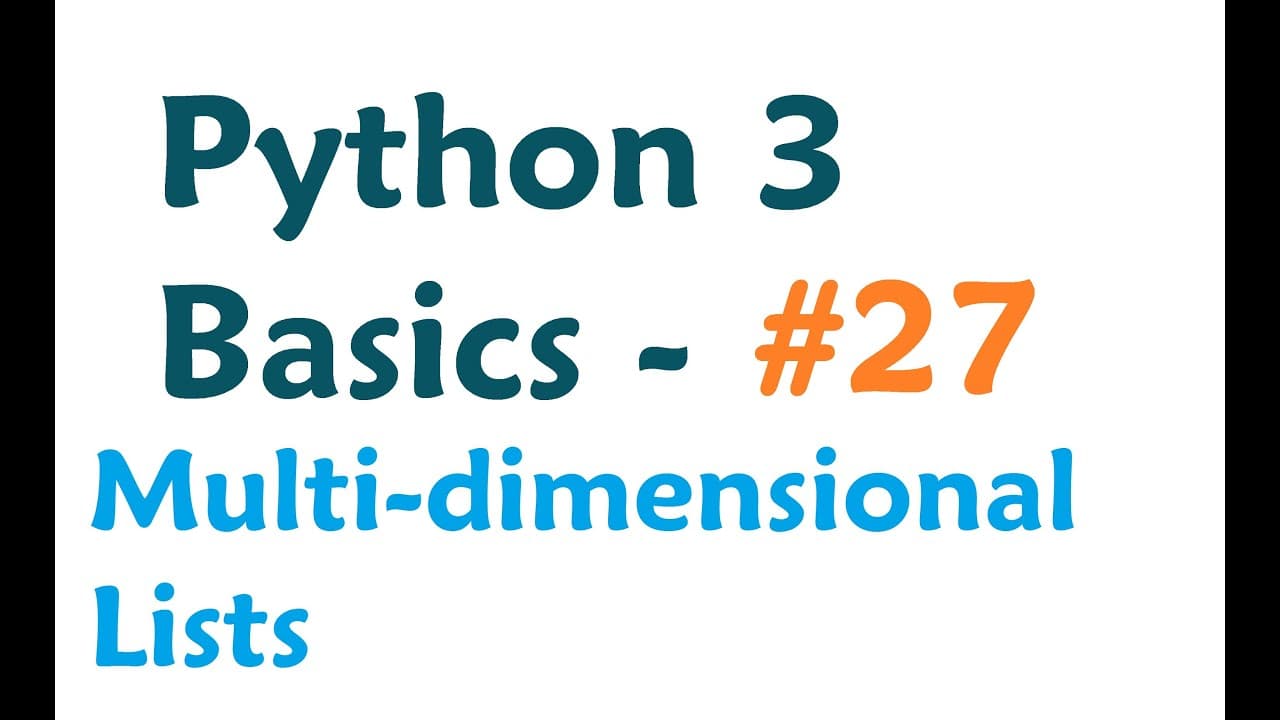
How to Create and Use Multi-Dimensional Lists in Python
TL;DR
To create multi-dimensional lists in Python, define a list where each element is another list. You can access data using multiple indices, allowing for complex hierarchical structures. Organizing your lists enhances readability, but deeper nesting can make management and visualization more challenging.
Transcript
what's going on everybody welcome to another Python 3 Basics tutorial video in this video what we're going to be talking about is multi-dimensional lists so all the lists that we've covered so far have been a singular Dimension right so there's just for each um bit of data in the list it's only one bit of data but actually you can have lists within... Read More
Key Insights
- 👂 Multi-dimensional lists in Python allow for nesting lists within lists, creating complex data structures.
- 👂 Accessing elements in multi-dimensional lists requires multiple indices, each corresponding to a nested list.
- 👂 Organizing multi-dimensional lists can improve the readability and organization of code.
- 🪆 As the depth of nesting increases, managing and visualizing the data structure becomes more challenging.
- 👂 Multi-dimensional lists provide a powerful tool for representing and manipulating hierarchical data.
- 👂 Python enforces some degree of organization and readability through its syntax for lists.
- 👂 Multi-dimensional lists are useful in various applications, such as representing matrices, grids, and nested data.
Install to Summarize YouTube Videos and Get Transcripts
Explore YouTube Video Summarizer or Get YouTube Transcript Extractor
Questions & Answers
Q: What is a multi-dimensional list in Python?
A multi-dimensional list is a list that contains other lists as its elements. This allows for creating complex data structures with hierarchical relationships.
Q: How do you access elements in a multi-dimensional list?
You can access elements in a multi-dimensional list using multiple indices, where each index corresponds to a nested list. For example, list[0][1] would retrieve the element at the first index of the outer list and the second index of the inner list.
Q: How can multi-dimensional lists help with organizing data?
Multi-dimensional lists provide a way to organize data in a hierarchical structure, making it easier to represent complex relationships between different elements. It allows for efficient storage and retrieval of data.
Q: Can the depth of nesting in a multi-dimensional list be unlimited?
Yes, the depth of nesting in a multi-dimensional list can be as deep as you want. However, as the depth increases, it can become more difficult to manage and visualize the data structure.
Summary & Key Takeaways
-
Multi-dimensional lists in Python allow for nested lists within lists.
-
Each element in a multi-dimensional list is another list, creating a hierarchical structure.
-
The syntax for accessing elements in multi-dimensional lists is similar to accessing elements in single-dimensional lists.
Read in Other Languages (beta)
Share This Summary 📚
Summarize YouTube Videos and Get Video Transcripts with 1-Click
Try YouTube Summary with ChatGPT & Claude or YouTube Transcript Generator
Explore More Summaries from sentdex 📚





Summarize YouTube Videos and Get Video Transcripts with 1-Click
Try YouTube Summary with ChatGPT & Claude or YouTube Transcript Generator