The Crisis in Physics: Why the Higgs Boson Should NOT Exist!
TL;DR
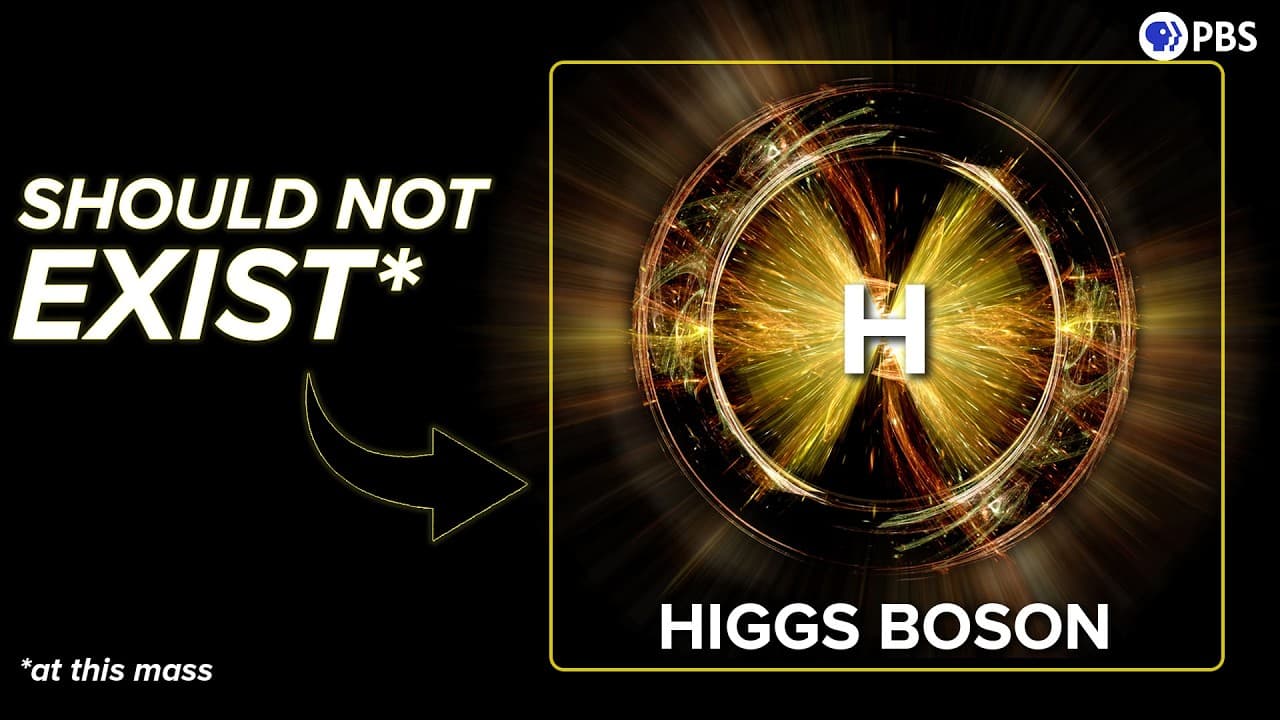
The Higgs boson's light mass poses a major physics mystery.
Transcript
Thank you to Anydesk for sponsoring PBS. According to quantum physics, the universe should have collapsed on itself in the instant after the Big Bang due to all particles being 100 million billion times heavier. But recent observations of the universe existing suggest that this may not have happened. Even more recent observations at the Large Ha... Read More
Key Insights
- The universe's existence contradicts quantum physics predictions that it should have collapsed post-Big Bang due to particle mass anomalies.
- The discovery of the Higgs boson at the LHC confirmed the Standard Model but left unexplained why the Higgs has such a small mass.
- The hierarchy problem questions why the Higgs boson's mass is significantly smaller than predicted, posing a major physics mystery.
- Supersymmetry (SUSY) was proposed to explain the Higgs mass, suggesting every particle has a supersymmetric counterpart to cancel quantum corrections.
- Despite the LHC's extensive searches, no SUSY particles have been found, challenging the theory's predictions and leaving the hierarchy problem unsolved.
- Alternative theories like technicolor suggest the Higgs is a composite particle, potentially solving the hierarchy problem through different mass interactions.
- The anthropic principle posits that the universe's conditions, including the Higgs mass, are finely tuned for life, though this idea is controversial.
- The hierarchy problem extends to other physics areas, like gravity's weakness compared to quantum forces, hinting at deeper physics yet to be discovered.
Install to Summarize YouTube Videos and Get Transcripts
Explore YouTube Video Summarizer or Get YouTube Transcript Extractor
Questions & Answers
Q: Why is the Higgs boson's mass considered a crisis in physics?
The Higgs boson's mass is much smaller than predicted by the Standard Model, posing a significant mystery known as the hierarchy problem. This discrepancy suggests that the current understanding of particle physics is incomplete, as the expected quantum corrections should have made the Higgs much heavier. The unresolved nature of this issue challenges the completeness of the Standard Model and indicates the need for new physics.
Q: What is supersymmetry and how does it relate to the Higgs boson?
Supersymmetry (SUSY) is a theoretical framework proposing that every particle has a supersymmetric counterpart. This concept was introduced to address the hierarchy problem by suggesting that these counterparts could cancel out the quantum corrections that would otherwise make the Higgs boson's mass much larger. Despite extensive searches at the LHC, no evidence of supersymmetric particles has been found, challenging this theory's validity.
Q: What alternative theories exist for explaining the Higgs boson's mass?
Besides supersymmetry, alternative theories like technicolor propose that the Higgs boson is a composite particle. This theory suggests the Higgs arises from interactions within a more complex quantum field, offering a different mechanism for its mass. These interactions could protect the Higgs from large quantum corrections, potentially solving the hierarchy problem. However, many technicolor models have been ruled out, and the search for viable solutions continues.
Q: How does the anthropic principle relate to the Higgs boson?
The anthropic principle suggests that the universe's physical constants, including the Higgs boson's mass, are finely tuned to allow for life. This principle posits that among many possible universes, we exist in one where conditions are just right for life to develop. While this idea offers a potential explanation for the Higgs's small mass, it is controversial because it implies that the universe's properties are a result of chance rather than underlying physical laws.
Q: What broader implications does the hierarchy problem have in physics?
The hierarchy problem extends beyond the Higgs boson, highlighting discrepancies in the scales of natural forces and energies. It questions why gravity is much weaker than quantum forces and why dark energy is less potent than predicted. These issues suggest that current physics models are incomplete, pointing to the potential for new theories that could unify these forces and provide a deeper understanding of the universe's fundamental structure.
Q: Why hasn't the Large Hadron Collider found supersymmetric particles?
The Large Hadron Collider (LHC) has searched extensively for supersymmetric particles within the energy ranges predicted by the most straightforward SUSY models. However, no such particles have been detected, leading to questions about the validity of these models. It's possible that if supersymmetry exists, its particles have masses higher than the LHC's current reach, which would require new or upgraded facilities to explore further.
Q: What is the significance of the Higgs boson being a spin-0 particle?
The Higgs boson's status as the only spin-0 particle in the Standard Model makes it particularly susceptible to quantum corrections that could inflate its mass. Unlike other particles with additional symmetries that offer protection, the Higgs lacks such natural safeguards, making the hierarchy problem more pronounced. This unique characteristic underscores the need for new physics to explain its unexpectedly low mass and maintain the model's consistency.
Q: What role does quantum field theory play in the hierarchy problem?
Quantum field theory underpins the Standard Model, describing how particles interact and acquire mass. It predicts that particles like the Higgs boson should receive mass contributions from quantum fluctuations, potentially leading to infinite mass. The hierarchy problem arises from the discrepancy between these predictions and the observed small mass of the Higgs, suggesting that unknown mechanisms or new physics are needed to reconcile theory with observation.
Summary & Key Takeaways
-
The Higgs boson's discovery confirmed the Standard Model, yet its unexpectedly low mass presents a significant physics mystery known as the hierarchy problem. Supersymmetry was proposed as a solution, suggesting every particle has a counterpart to cancel quantum corrections. However, the LHC has yet to find evidence supporting this theory.
-
Alternative theories, such as technicolor, propose the Higgs as a composite particle, potentially explaining its mass through different interactions. The anthropic principle suggests the universe's conditions, including the Higgs mass, are finely tuned for life, though this remains a controversial perspective.
-
The hierarchy problem highlights a broader issue in physics, questioning the extreme differences in natural forces and energy scales. This ongoing mystery suggests the potential for deeper physics beyond current understanding, with implications for gravity, dark energy, and the universe's fundamental structure.
Read in Other Languages (beta)
Share This Summary 📚
Summarize YouTube Videos and Get Video Transcripts with 1-Click
Try YouTube Summary with ChatGPT & Claude or YouTube Transcript Generator
Explore More Summaries from PBS Space Time 📚



Summarize YouTube Videos and Get Video Transcripts with 1-Click
Try YouTube Summary with ChatGPT & Claude or YouTube Transcript Generator