GPT-3 is a major advance in AI | Scott Aaronson and Lex Fridman
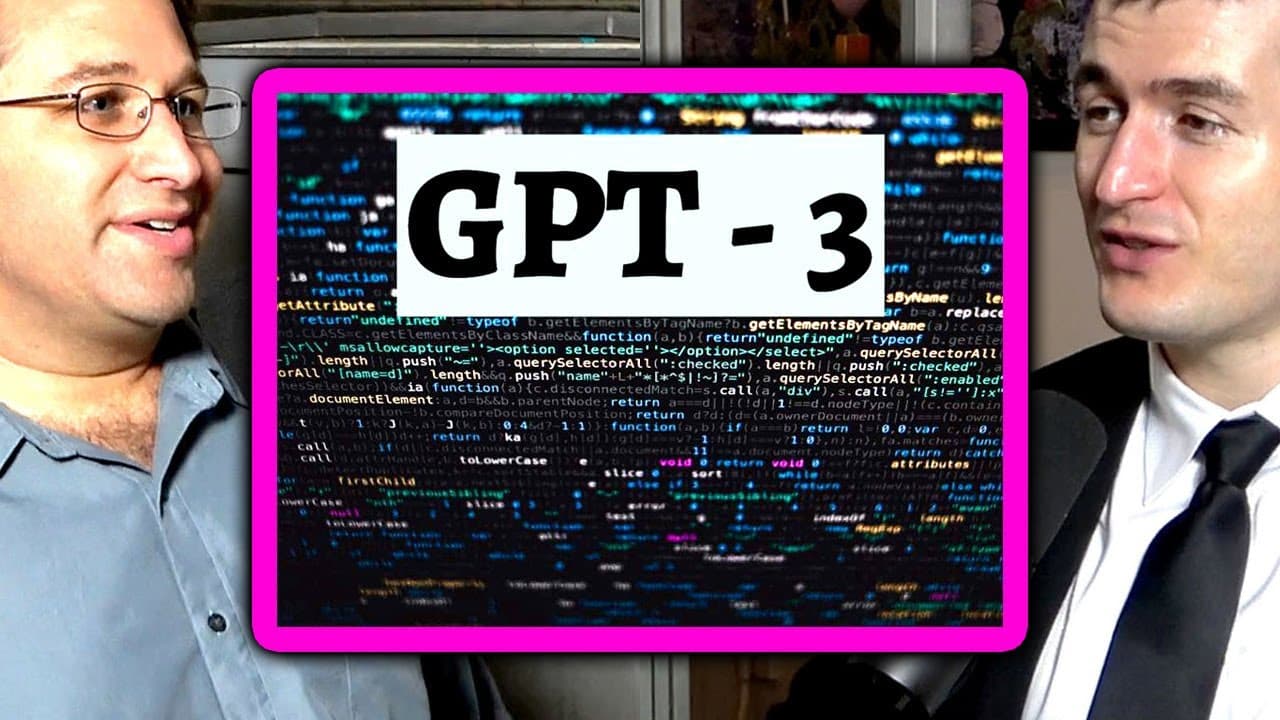
TL;DR
GPT-3 is a groundbreaking text engine that can complete various tasks and produce reasonable-sounding responses to prompts.
Transcript
i'd love to hear your thoughts about gpt yeah yeah yeah in the last few months we've had you know we've we've the world has now seen a chat engine or a text engine i should say called gpt3 um that you know i think it's still you know it does not pass a touring test you know there are no real claims that it passes the touring test right you know thi... Read More
Key Insights
- 🚒 GPT-3 represents a significant advancement in text engine technology, surpassing previous models and showcasing impressive capabilities.
- 🍉 The training process for GPT-3 involved leveraging massive amounts of internet data, requiring substantial resources in terms of computation and electricity.
- ⚾ The neural net architecture of GPT-3, based on deep learning algorithms, enables it to predict the next word or generate responses based on previous context.
- ⛩️ Despite its achievements, GPT-3 still has limitations in areas such as logical reasoning and arithmetic, hinting at the need for integrating other cognitive mechanisms.
- 🤨 The usage of GPT-3's capabilities raises philosophical questions about the nature of cognition, the limits of predictive processing, and the potential for future advancements.
- 🤞 The cost and scalability of GPT-3 are areas of consideration, with the hope that expenses will decrease and availability will increase as the technology develops further.
- 🎭 GPT-3's ability to complete images and perform visual reasoning showcases potential in expanding its capabilities beyond text generation.
- 🎙️ More videos with Scott Aaronson:
Install to Summarize YouTube Videos and Get Transcripts
Explore YouTube Video Summarizer or Get YouTube Transcript Extractor
Questions & Answers
Q: What is GPT-3 and how does it differ from other text engines?
GPT-3, developed by OpenAI, is a text engine that generates coherent and relevant completions to prompts. It outperforms previous models, showcasing advancements in natural language processing and generation.
Q: How does GPT-3 achieve its capabilities?
GPT-3 achieves its capabilities by training on a large dataset comprising the entire internet, allowing it to have a vast knowledge base to draw from when generating responses.
Q: Can GPT-3 reason and perform logical thinking?
While GPT-3 excels in predictive processing, it struggles with tasks that require logical reasoning and exact calculations. Its limitations suggest that it lacks certain cognitive mechanisms that humans possess.
Q: What are the potential limitations or boundaries of GPT-3?
The limitations of GPT-3 include potential diminishing returns in performance as the model scales up, limitations on the amount of data available on the internet, and challenges in handling certain specific tasks like balancing parentheses or solving word problems.
Summary & Key Takeaways
-
GPT-3 is a text engine developed by OpenAI that can generate coherent and on-topic completions to a wide range of prompts.
-
It surpasses previous text engines, such as Eliza, in its capability to compose poems and essays that would receive a passing grade.
-
GPT-3's impressive performance is attributed to training on a vast corpus of internet data and using deep learning algorithms.
Read in Other Languages (beta)
Share This Summary 📚
Summarize YouTube Videos and Get Video Transcripts with 1-Click
Try YouTube Summary with ChatGPT & Claude or YouTube Transcript Generator
Explore More Summaries from Lex Clips 📚






Summarize YouTube Videos and Get Video Transcripts with 1-Click
Try YouTube Summary with ChatGPT & Claude or YouTube Transcript Generator