What Is Inheritance in Object-Oriented Programming?
TL;DR
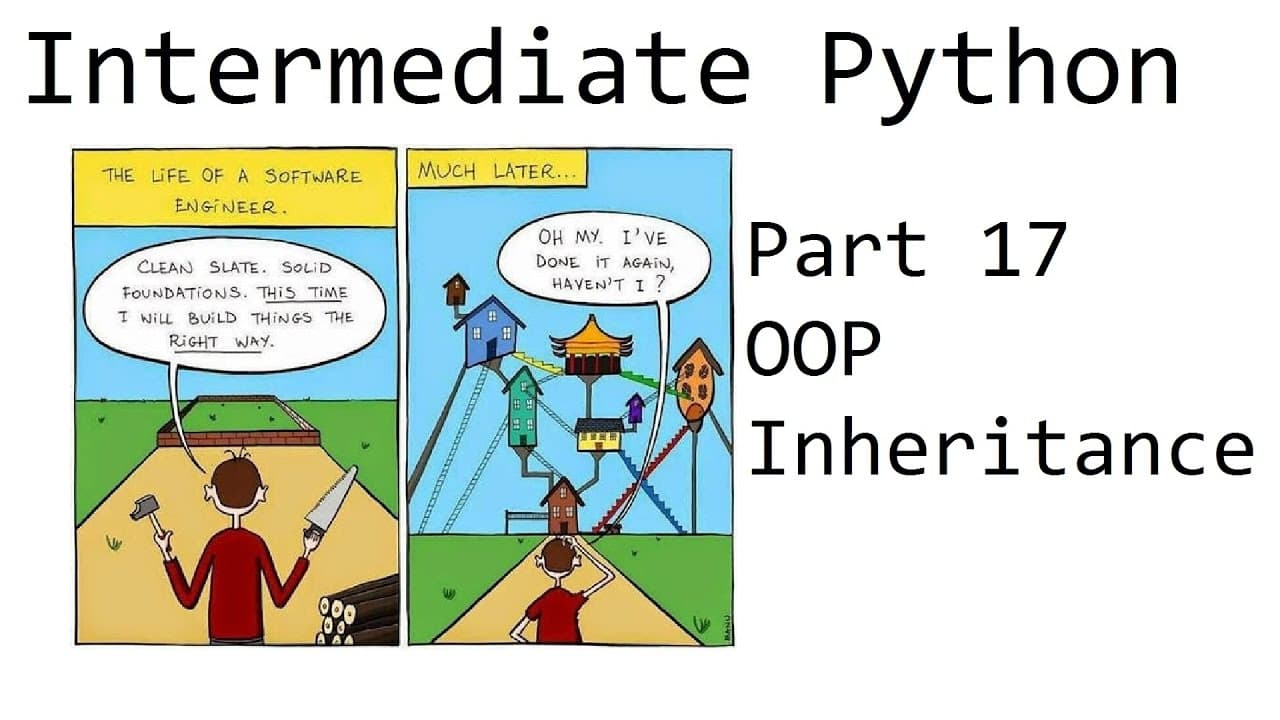
Inheritance in object-oriented programming allows a class to inherit methods and attributes from another class, promoting code reuse and modularity. This concept aids in maintaining clarity and scalability, especially when developing software for clients or open-source projects. Using the 'super' keyword simplifies method access from a parent class, enhancing customization and functionality.
Transcript
well everybody and welcome to part 17 of our intermediate Python series as well as another part in the object-oriented programming mini-series so in this tutorial we're going to be talking about inheritance and inheritance is a major player in modularity but it also can help a lot with actually scaling and maintainability over time mostly because t... Read More
Key Insights
- 👨💻 Inheritance in object-oriented programming promotes code reuse and modularity, making it easier to scale and maintain software over time.
- 😄 The concept of "Minimum Viable Product" encourages simplicity and ease of use in code design and implementation.
- 👪 The "super" keyword in Python simplifies the process of accessing and using parent class methods and attributes in the child class.
- 👶 Overwriting methods and adding new methods in the child class allows for customization and extension of functionality.
- 👨💻 Inheritance is widely used in libraries and frameworks to provide reusable components and improve code organization.
- 👤 Understanding inheritance and the principles of object-oriented programming is valuable in delivering software to clients or users.
- 😒 Raymond Hettinger's talk on the use of "super" in Python provides further insights and examples on the topic.
Install to Summarize YouTube Videos and Get Transcripts
Explore YouTube Video Summarizer or Get YouTube Transcript Extractor
Questions & Answers
Q: How does inheritance in object-oriented programming help with code modularity and maintainability?
Inheritance allows for the reuse of code from parent classes, reducing code duplication and making it easier to maintain and update code over time. By organizing code into smaller, modular classes, it becomes easier to understand and manage.
Q: Can inheritance be used in all programming languages?
Yes, inheritance is a fundamental concept in object-oriented programming and is supported in most programming languages, including Python. However, the terminology used to refer to inheritance may vary between languages.
Q: How does the concept of "Minimum Viable Product" apply to object-oriented programming?
The concept of "Minimum Viable Product" encourages developers to create the simplest form of a product that meets the basic requirements. In object-oriented programming, this means creating classes that are focused on specific functionalities, making it easier to add new features or customize the code for specific purposes.
Q: How does the use of the "super" keyword simplify inheritance in Python?
The "super" keyword allows for the easy referencing of parent or superclass methods and attributes in the child or subclass. It eliminates the need for hard-coding the parent class name and simplifies the process of calling and using inherited methods.
Summary & Key Takeaways
-
Inheritance in object-oriented programming helps to avoid code clutter and allows for scalability and maintainability over time.
-
Inheritance is particularly useful when creating software for clients or open-source projects.
-
The concept of "Minimum Viable Product" is important in object-oriented programming, as it encourages simplicity and ease of use.
-
Inheriting from a parent class allows for the inclusion of all methods and attributes of that class in the child class.
Read in Other Languages (beta)
Share This Summary 📚
Summarize YouTube Videos and Get Video Transcripts with 1-Click
Try YouTube Summary with ChatGPT & Claude or YouTube Transcript Generator
Explore More Summaries from sentdex 📚

Summarize YouTube Videos and Get Video Transcripts with 1-Click
Try YouTube Summary with ChatGPT & Claude or YouTube Transcript Generator