Why Are Future Computers Shifting Back to Analog?
TL;DR
Future computers are shifting back to analog because they are better suited for the demands of artificial intelligence, especially in executing large neural networks. Analog computers offer advantages in speed, energy efficiency, and simplicity for specific calculations, despite their limitations in general-purpose computing and precision. As digital computers face challenges like energy consumption and the Von Neumann Bottleneck, analog technology is becoming a viable alternative.
Transcript
- For hundreds of years, analog computers were the most powerful computers on Earth, predicting eclipses, tides, and guiding anti-aircraft guns. Then, with the advent of solid-state transistors, digital computers took off. Now, virtually every computer we use is digital. But today, a perfect storm of factors is setting the scene for a resurgence of... Read More
Key Insights
- 💻 Analog computers were once the most powerful computers and were widely used for predicting eclipses, tides, and solving complex problems.
- 🥡 Digital computers took over with the advent of solid-state transistors, but now the demands of artificial intelligence are creating a resurgence of analog technology.
- 🐎 Analog computers have advantages such as speed, energy efficiency, and simplicity in certain calculations.
- 🖤 However, they are not suitable for general-purpose computing, lack precision and repeatability, and have inherent variations in component values.
- 💻 The limitations of digital computers in terms of energy consumption, the Von Neumann Bottleneck, and miniaturization are driving the interest in analog computers for running large neural networks.
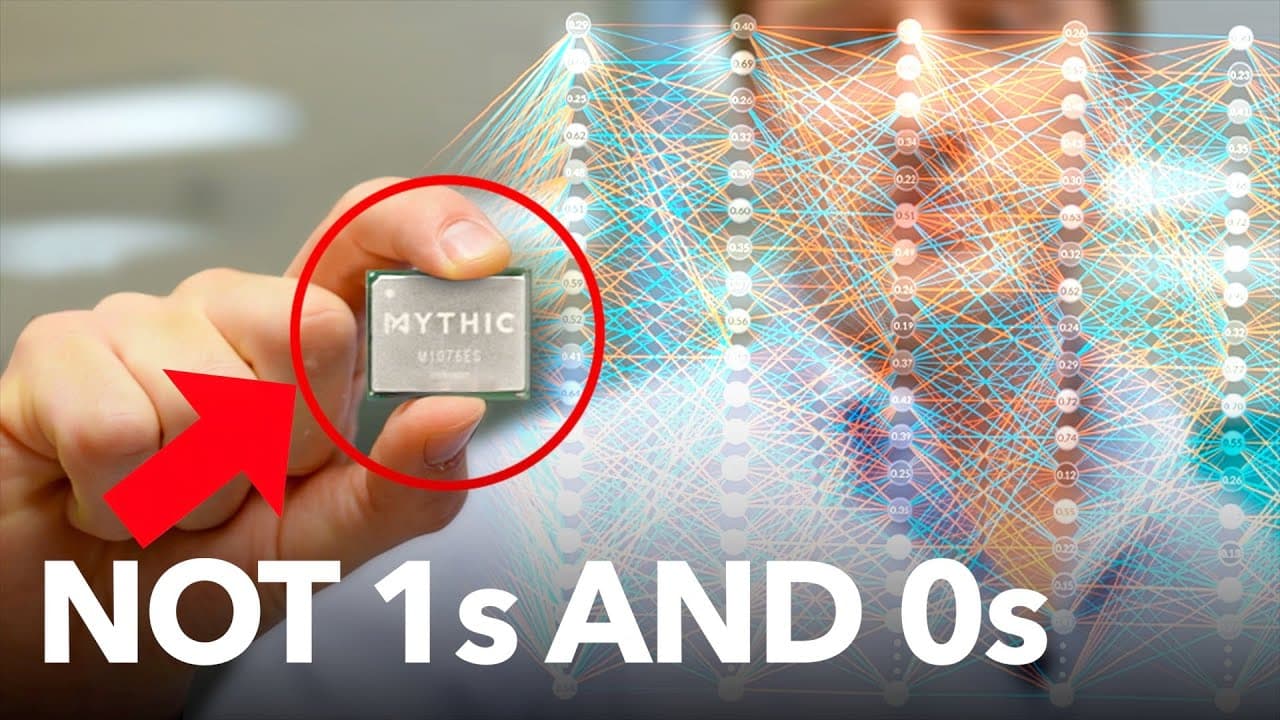
- 🏃 Analog computing startup Mythic AI is repurposing digital flash storage cells as variable resistors to run neural networks efficiently in the analog domain.
- 👪 Analog computers have potential applications in augmented and virtual reality, smart home devices, security cameras, and more.
Install to Summarize YouTube Videos and Get Transcripts
Explore YouTube Video Summarizer or Get YouTube Transcript Extractor
Questions & Answers
Q: What are analog computers and how do they differ from digital computers?
Analog computers use voltage fluctuations to represent physical problems and solve differential equations, while digital computers process information using zeros and ones. Analog computers are faster and more energy-efficient for certain calculations, but lack the versatility and precision of digital computers.
Q: What are the advantages of analog computers over digital computers?
Analog computers can perform computations quickly, require less power, and perform calculations with minimal components. They are particularly efficient for tasks like addition and multiplication.
Q: What are the drawbacks of analog computers?
Analog computers are single-purpose devices and cannot run general-purpose software like Microsoft Word. Their inputs and outputs are continuous, which means exact values cannot be inputted, leading to non-repeatable results. Additionally, there is always a margin of error due to component variations.
Q: Why are analog computers making a comeback?
The limitations of digital computers, such as energy consumption and the Von Neumann Bottleneck, make analog computers more appealing for tasks like running large neural networks. Analog computers can handle matrix multiplications efficiently and do not require the same level of precision as digital computers.
Summary & Key Takeaways
-
Analog computers are powerful devices that can perform computations quickly and efficiently, using voltage fluctuations to represent physical problems.
-
They have advantages over digital computers in terms of speed, power consumption, and simplicity in performing certain calculations.
-
However, analog computers are not suitable for general-purpose computing, have limitations in precision and repeatability, and are subject to component variations.
Read in Other Languages (beta)
Share This Summary 📚
Summarize YouTube Videos and Get Video Transcripts with 1-Click
Try YouTube Summary with ChatGPT & Claude or YouTube Transcript Generator
Explore More Summaries from Veritasium 📚




Summarize YouTube Videos and Get Video Transcripts with 1-Click
Try YouTube Summary with ChatGPT & Claude or YouTube Transcript Generator