How Does NVIDIA Vid2Vid Perform AI-Based Video-to-Video Synthesis?
TL;DR
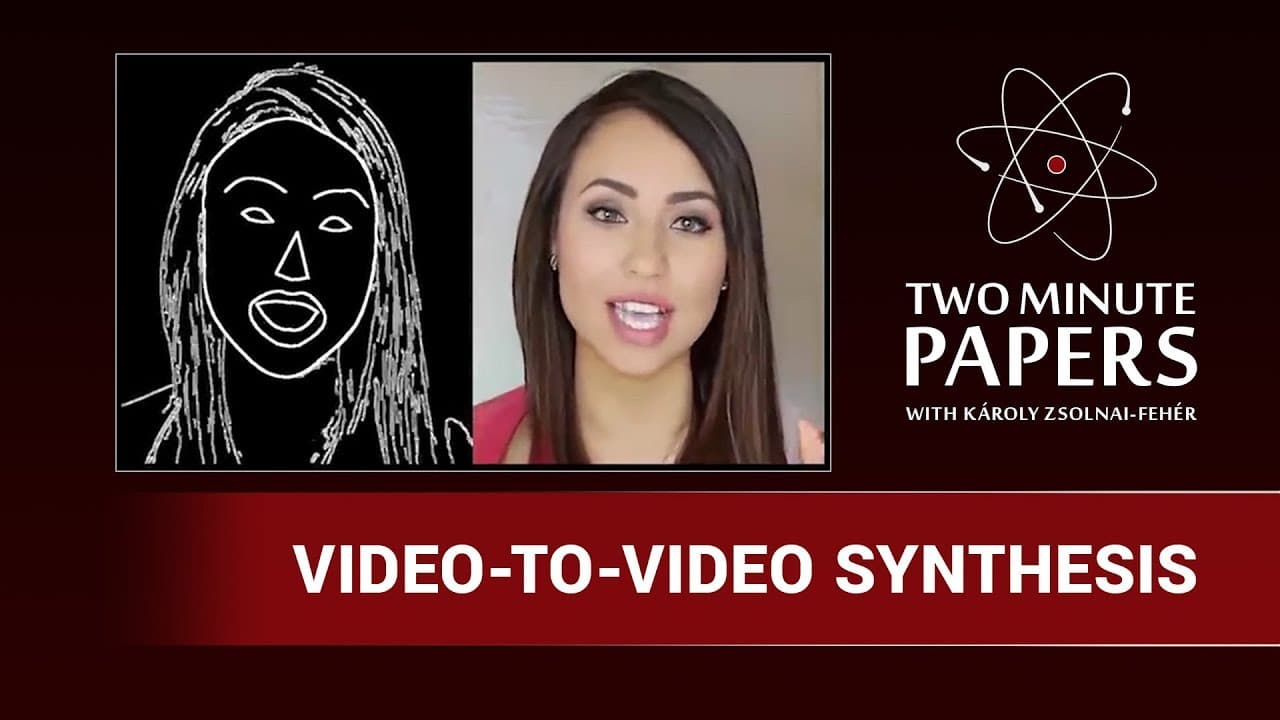
NVIDIA Vid2Vid creates temporally coherent videos from edge maps, labeled maps, and motion inputs by combining a generator with two discriminators, progressive training, and a flow map. One discriminator evaluates individual frames, while the other evaluates whether each sequence works as a video. The system supports up to 2k resolution and 30 seconds of video, and the details below explain why its output flickers less than pix2pix.
Transcript
Dear Fellow Scholars, this is Two Minute Papers with Károly Zsolnai-Fehér. Do you remember the amazing pix2pix algorithm from last year? It was able to perform image translation, which means that it could take a daytime image and translate it into a nighttime image, create maps from satellite images, or create photorealistic shoes from a crude draw... Read More
Key Insights
- Moving translation into the time dimension: Pix2pix translated one image representation into another, such as day into night or satellite imagery into maps. NVIDIA Vid2Vid extends the underlying concept by generating sequences rather than isolated images. That shift introduces a central requirement absent from ordinary still-image translation: consecutive outputs must remain visually consistent enough to function as a believable video.
- Generating faces from sparse edges: The face demonstration begins with edge maps rather than complete photographs. The system converts those structural inputs into realistic human faces and animates them over time. It does not treat one edge arrangement as having only one valid facial interpretation. Because the same edges may describe several different faces, the algorithm can offer multiple output options for the same input.
- Treating labels as object classes: In the labeled-map examples, colors carry semantic meanings rather than ordinary visual appearance. A color can identify a road, car, building, or another object class. The algorithm tracks the labels as they evolve through time and renders an animation from them. This establishes a controllable relationship between a simplified scene description and the resulting synthesized video.
- Reassigning labels changes generated objects: The semantic meaning of a label is not permanently fixed in the demonstrated workflow. Changing that meaning can make an area previously rendered as buildings appear as trees. The reverse change can turn trees into buildings. The output therefore responds not only to where colored regions appear, but also to the object classes assigned to those regions.
- Extending synthesis to motion transfer: NVIDIA Vid2Vid can perform a variant of motion transfer, following movement information to generate an animated character. The result also includes synthesized shadows around that character in a reasonably correct manner. This detail shows that the method handles more than the moving figure alone, because surrounding visual effects must change along with the character's motion.
- Remembering choices across consecutive frames: Temporal coherence means the technique retains what it did with past images and avoids doing anything drastically different in the next frame. This continuity makes the generated video smoother. It is especially apparent when the output is placed beside results from the previous pix2pix method, where frame-to-frame consistency is not handled in the same way.
- Separating frame and sequence evaluation: The two discriminator networks judge different aspects of the generator's work. One assesses images individually and focuses on whether each frame looks good. The second oversees the sequence and asks whether the images collectively pass as a video. This division makes both single-frame quality and video-level continuity explicit parts of the system's evaluation.
- Penalizing temporally inconsistent sequences: The sequence discriminator actively cracks down on the generator when its outputs are not temporally coherent. Its feedback targets problems that may not be visible when frames are judged separately. By evaluating relationships across the sequence, it helps suppress abrupt frame-to-frame differences. The presentation attributes the output's minimal flickering to this additional discriminator.
- Increasing training difficulty over time: The network is not immediately confronted with the hardest version of the synthesis problem. Progressive training first gives it an easier version and gradually makes the task more difficult. This is intended to ease the training process. The paper's approach is progressive along two dimensions, applying the progression in terms of both space and time.
- Describing change with flow maps: A flow map supplies information about changes that occurred since the previous frame. This directly connects the current synthesis step to recent motion or transformation. It is one of three key differences identified between Vid2Vid and the previous technique. The other two are the additional sequence discriminator and progressive training across space and time.
- Showing rapid progress after pix2pix: The earlier pix2pix algorithm was published in 2017, described as a little more than a year before this presentation. Within that period, the concept advanced from impressive still-image translation to animated, temporally coherent synthesis. The comparison is presented as evidence of the pace of progress occurring in machine learning research.
- Supporting substantial video output: The reported system supports output at up to 2k resolution and video durations of 30 seconds. These specifications accompany demonstrations involving faces, semantic maps, scene-class substitutions, and motion transfer. The source code is also available, giving the work a concrete implementation in addition to the results discussed in the presentation.
Install to Summarize YouTube Videos and Get Transcripts
Explore YouTube Video Summarizer or Get YouTube Transcript Extractor
Questions & Answers
Q: How does NVIDIA Vid2Vid perform AI-based video-to-video synthesis?
NVIDIA Vid2Vid uses a generator neural network to create images and two discriminator networks to evaluate its work. One discriminator judges whether each image looks good, while the other judges whether the entire image sequence would pass as a video. Progressive training introduces easier versions of the task before harder ones, in both space and time. A flow map describes changes since the previous frame, helping the system maintain temporal coherence and minimize flickering.
Q: How is NVIDIA Vid2Vid different from pix2pix?
Pix2pix performed image translation on individual images, including converting daytime scenes to nighttime, satellite images to maps, and crude drawings to photorealistic shoes. NVIDIA Vid2Vid extends that idea to sequences, such as animated faces generated from edge maps. It adds a second discriminator that evaluates video sequences, uses progressive training in space and time, and incorporates a flow map. These changes help it remember earlier outputs and avoid drastic differences between consecutive frames.
Q: How does Vid2Vid turn edge maps into animated human faces?
The generator converts edge maps into human-face images and produces those images across time as an animation. A frame-level discriminator checks whether individual faces look good. A sequence-level discriminator checks whether consecutive frames work together as a video and penalizes temporal inconsistency. The system also accounts for ambiguity by producing multiple facial options because the same edges can correspond to different faces.
Q: How does Vid2Vid reduce flickering in generated videos?
Vid2Vid uses a dedicated discriminator to oversee sequences rather than evaluating every frame only in isolation. This discriminator penalizes the generator when a sequence is not temporally coherent. The method also remembers what it produced in past images and avoids making drastically different choices for the next frame. A flow map describing changes since the previous frame further supports smoother output with minimal flickering.
Q: Can Vid2Vid generate video from labeled maps?
Yes, it accepts crude maps whose colors represent object classes such as roads, cars, or buildings. It follows how those labels evolve over time and creates an animation matching their movement and changes. The meaning of a label can also be reassigned, causing buildings to become trees or trees to become buildings. This works because the labels specify what each region represents while their temporal evolution guides the animation.
Q: What are the three key improvements used by Vid2Vid?
The first improvement is a second discriminator network that judges whether a sequence of generated images passes as a video. The second is progressive training, where the network begins with an easier problem and faces harder versions over time, with progression in both space and time. The third is a flow map describing changes since the previous frame. Together, these additions target image quality, sequence coherence, manageable training, and frame-to-frame change.
Q: What does progressive training mean in Vid2Vid?
Progressive training means the network starts with an easier version of the synthesis problem. The difficulty then increases over time instead of presenting the full challenge immediately. The presentation states that this progression applies in terms of both space and time. The approach is used to ease the training process while the network learns the video-generation task.
Q: What resolution and video length does NVIDIA Vid2Vid support?
The system supports output at up to 2k resolution. It can generate videos lasting 30 seconds. These capabilities accompany demonstrations of animated faces, labeled-map synthesis, semantic object changes, and a motion-transfer variant. The presentation also states that the source code is available.
Summary & Key Takeaways
-
Building beyond the pix2pix algorithm: The presentation begins with pix2pix, an image-translation system published in 2017. It could turn daytime images into nighttime images, create maps from satellite images, and produce photorealistic shoes from crude drawings. NVIDIA Vid2Vid advances that idea from still-image translation to video synthesis. Its first demonstration transforms edge maps into animated human faces while recognizing that identical edges can correspond to multiple plausible faces, so it can provide several different outputs.
-
Animating evolving labeled maps: The algorithm can interpret crude maps in which each color represents an object class, including roads, cars, or buildings. By following how those labels change over time, it synthesizes a corresponding animation. The meaning assigned to a label can also be changed easily. The examples show buildings being transformed into trees and trees being transformed into buildings, demonstrating that the generated scene follows both the temporal evolution and the chosen semantic interpretation of the input labels.
-
Transferring motion and synthesizing shadows: The technique can perform a variant of motion transfer similar to work discussed in an earlier Two Minute Papers episode. It does more than reproduce the character's movement because it also synthesizes shadows around the character in a reasonably correct manner. The resulting animation maintains unusually strong temporal coherence. Compared directly with the earlier pix2pix method, Vid2Vid remembers what it produced in past images and avoids making drastically different choices in the next frame.
-
Using two specialized discriminator networks: The original architecture paired a generator neural network with one discriminator that judged its images and taught it to improve. This work instead employs two discriminators with separate responsibilities. One checks whether each generated image looks good on its own. The other examines whether the sequence of images would pass as a video. When the generator creates a sequence lacking temporal coherence, the sequence discriminator penalizes it, which helps produce output videos with minimal flickering.
-
Training progressively with motion information: Two further changes support coherent synthesis. Training proceeds progressively, first presenting the network with an easier form of the problem and then increasing the difficulty over time. According to the paper, this progression occurs in both space and time. The method also uses a flow map describing changes since the preceding frame. Together with the two discriminators, these mechanisms extend pix2pix into a system supporting videos up to 2k resolution and 30 seconds, with source code available.
Read in Other Languages (beta)
Share This Summary 📚
Summarize YouTube Videos and Get Video Transcripts with 1-Click
Try YouTube Summary with ChatGPT & Claude or YouTube Transcript Generator
Explore More Summaries from Two Minute Papers 📚


Summarize YouTube Videos and Get Video Transcripts with 1-Click
Try YouTube Summary with ChatGPT & Claude or YouTube Transcript Generator