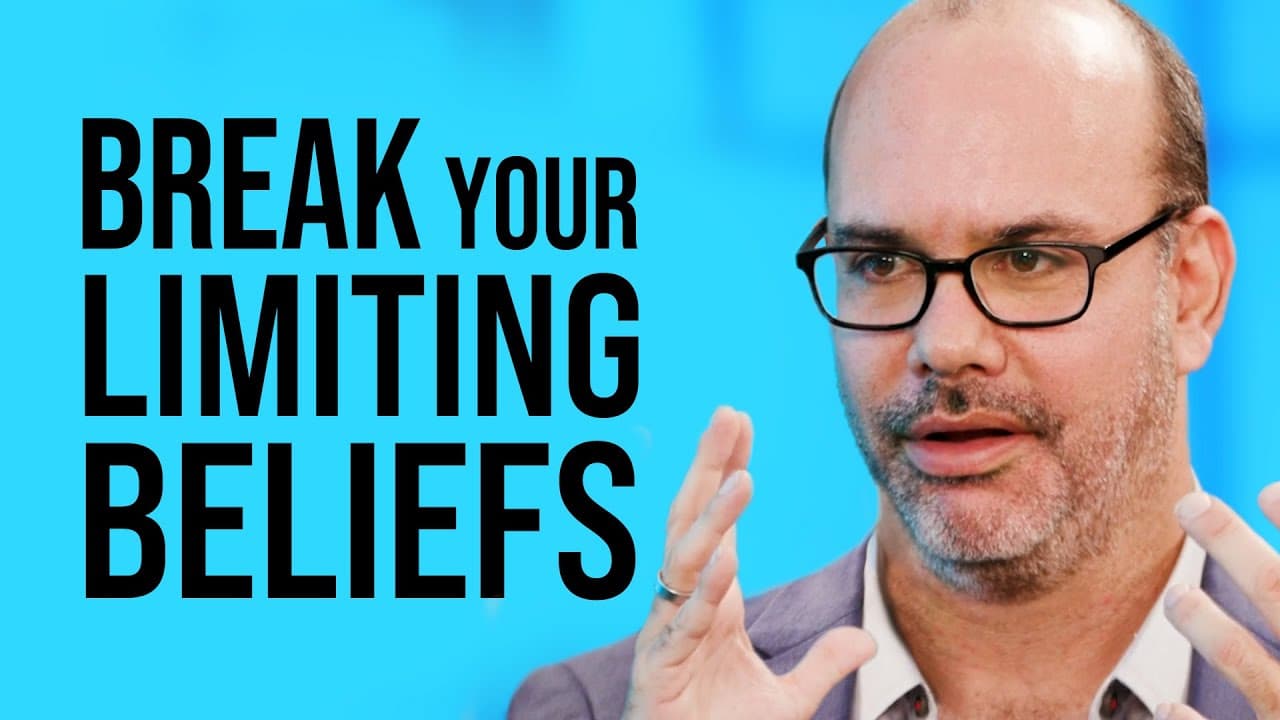
How Does Jonas Kaplan Say You Can Achieve Lasting Change by Rewiring Your Beliefs?
TL;DR
Lasting change starts with recognizing that beliefs and perceptions are constructed models, not objective truth. The brain develops these models early in life, partly through osmosis, while trying to maintain the body and navigate physical and social problems. Some assumptions about gravity and shadows are built into perception through evolution. Read on to understand how the brain creates convincing realities.
Transcript
jones kaplan welcome to the show thank you happy to be here i am very happy to have you as i was saying before we started rolling anything about the brain beliefs like all that stuff is is my absolute sweet spot my total obsession right and as somebody who studies this for a living i want to start with the idea of beliefs i think beliefs govern you... Read More
Key Insights
- "the brain starts to build models of the world" (0:56)
- "the brain is a complicated solution to the problem of homeostasis" (1:08)
- "a high-powered intellect we want smart brains right not necessarily big brains" (1:28)
- "the brain is a in many ways a general purpose problem solver" (2:17)
- "perception is a constructive process the brain is making hypotheses about what's out there and it's confirming and disconfirming those hypotheses" (3:59)
Install to Summarize YouTube Videos and Get Transcripts
Explore YouTube Video Summarizer or Get YouTube Transcript Extractor
Questions & Answers
Q: How do beliefs get formed?
Beliefs can form very early in life, almost through osmosis, as the brain builds models of the world. Some are also built into the perceptual system through evolution, including beliefs about gravity and shadows.
Q: Why does the brain build beliefs about the world?
The brain builds a simulated picture of the world it must navigate, and that model is the basis of belief. Its problems include maintaining life, controlling movement, and navigating communities where people have different intentions and beliefs.
Q: Are beliefs the same as objective truth?
No. People can mistake beliefs they have chosen throughout life for objective truth, even when those beliefs came from parents or other experiences.
Q: How do beliefs influence behavior and life?
The discussion presents beliefs as governing behavior and behavior as governing life. From that perspective, the quality of a person's life is closely connected to the quality of their beliefs.
Q: What is the brain primarily for?
The brain is described as being there to keep the body alive. It is a complicated solution to homeostasis, the problem of maintaining a complicated organism such as the human body.
Q: Why did human brains become wrinklier instead of simply larger?
Brain size is not necessarily the most important feature for a high-powered intellect. The brain became wrinklier to fit more surface area into the same head, because increasingly large heads would create problems involving the pelvis and walking.
Q: How do optical illusions show that perception is constructed?
Two patches receiving the same amount of light can look like different shades of gray when one appears inside a cast shadow. The brain reasons that the shadowed patch must actually be lighter, showing that perception involves hypotheses about what is present.
Q: Why can people perceive the blue and gold dress differently?
The blue and gold dress example shows that people can see the same image differently while finding their own perception completely convincing. It supports the point that perception is a constructive process rather than a direct presentation of objective truth.
Summary & Key Takeaways
-
Beliefs play a crucial role in shaping our behaviors and ultimately our lives.
-
Beliefs are often formed early in life through osmosis and influence how we perceive and understand the world.
-
Our brains build a model of the world which forms the basis of our beliefs, and some beliefs are deeply ingrained through evolution.
Read in Other Languages (beta)
Share This Summary 📚
Summarize YouTube Videos and Get Video Transcripts with 1-Click
Try YouTube Summary with ChatGPT & Claude or YouTube Transcript Generator
Explore More Summaries from Conversations with Tom 📚

Summarize YouTube Videos and Get Video Transcripts with 1-Click
Try YouTube Summary with ChatGPT & Claude or YouTube Transcript Generator