What Is the Phototransduction Cascade in Vision?
TL;DR
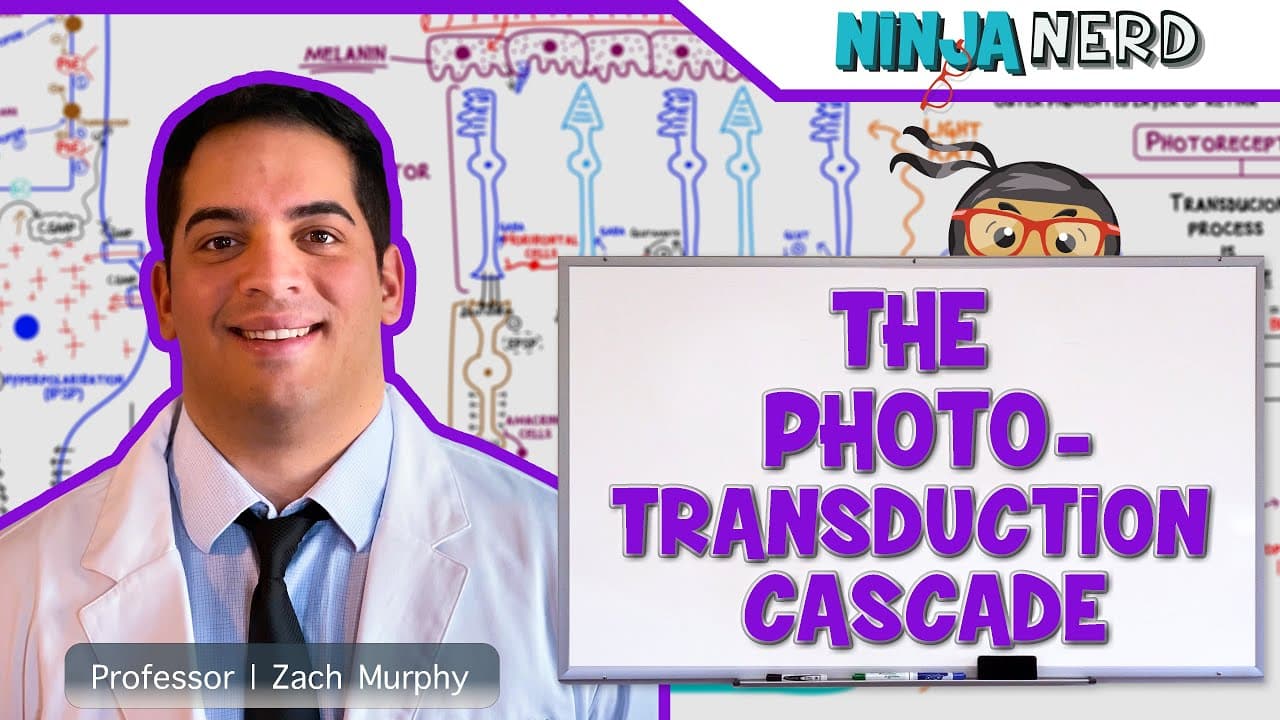
The phototransduction cascade converts light into electrical signals in the retina. Light hits rhodopsin, changing it from 11-cis retinal to all-trans retinal, which activates a signaling pathway that results in ion channel closure and hyperpolarization of photoreceptors. Horizontal and amacrine cells modulate this process, ensuring proper adaptation and precision in visual perception.
Transcript
I'm in generics in this video we're going to talk about specifically the phototransduction cascade so we're going to dig into the layers of the retina a little bit more talk about those layers and then we're going to talk about how we can turn light rays into electrical signals that basically produce vision all right so let's go ahead and start her... Read More
Key Insights
- 👁️ The retina is made up of three main cell layers: the outer pigmented layer, the photoreceptor layer (rods and cones), and the ganglion cell layer.
- 🌞 The outer pigmented layer of the retina contains melanin granules, which help absorb and prevent the scattering and reflection of light rays entering the eye.
- 🔴 Rods are photoreceptors that are specialized for scotopic vision, which allows vision in dim or dark light conditions. They are sensitive to shades of gray and are not good at color vision or precise edge detection.
- 🌈 Cones are photoreceptors that are specialized for photopic vision, allowing for color vision and visual acuity. They are sensitive to specific wavelengths of light: blue, red, and green.
- 🧪 Photoreceptors contain a pigment called rhodopsin, which consists of retinal and opsin. When light hits rhodopsin, it converts from the cis form to the all-trans form, activating a signaling cascade.
- 🌌 The signaling cascade involves the activation of the G protein transducin, which then activates the enzyme phosphodiesterase. This enzyme breaks down cyclic GMP, leading to the closure of sodium and calcium channels and hyperpolarization of the photoreceptor cell.
- ⚖️ Horizontal cells and amacrine cells play a modulatory role in the visual pathway. Horizontal cells release GABA, which inhibits photoreceptors to control their sensitivity to light. Amacrine cells release various chemicals (such as dopamine, acetylcholine, GABA, and glycine) to modulate the transmission between bipolar neurons and ganglion cells.
- 💡 In the absence of light, the photoreceptors return to their original state, allowing for the release of glutamate and the generation of receptor potentials. This leads to the release of more glutamate by bipolar neurons, causing the stimulation of ganglion cells and increased action potentials in the optic nerve.
- 👁️ Understanding the phototransduction cascade and the functioning of the retina is crucial for comprehending processes such as dark and light adaptation, as well as the pupillary light reflex.
Install to Summarize YouTube Videos and Get Transcripts
Explore YouTube Video Summarizer or Get YouTube Transcript Extractor
Questions & Answers
Q: How do horizontal cells and amacrine cells modulate the signaling process in the retina?
Horizontal cells and amacrine cells play a crucial role in modulating the signaling process in the retina. The horizontal cells release the neurotransmitter GABA, which inhibits the photoreceptors and helps adapt the visual system to changes in light levels. On the other hand, amacrine cells release various neurotransmitters, such as dopamine, acetylcholine, GABA, and glycine, to fine-tune the communication between the bipolar neurons and the ganglion cells, ensuring precise transmission of visual information.
Q: What happens when light enters the photoreceptor layer and hits the rhodopsin molecule?
When light hits the rhodopsin molecule in the photoreceptor layer, it triggers a structural change in the molecule. The all-trans retinal component of rhodopsin activates a protein called transducin, which, in turn, activates an enzyme called phosphodiesterase. The phosphodiesterase enzyme breaks down cyclic guanosine monophosphate (cGMP), leading to the closure of ion channels in the photoreceptor cells. This closure causes hyperpolarization of the cells and decreases neurotransmitter release onto the bipolar cells, effectively signaling the presence of light.
Q: How do the rods and cones differ in their functions and response to light?
Rods and cones are two types of photoreceptor cells in the retina that have distinct functions and responses to light. Rods are responsible for scotopic (low-light) vision and are more sensitive to dim or dark light. They are better suited for detecting shades of gray and do not provide color vision. Cones, on the other hand, are responsible for photopic (bright-light) vision and are critical for visual acuity, color vision, and detecting fine details. Cones are less sensitive to light and are more active in bright light conditions.
Q: How does the phototransduction process lead to the generation of action potentials in the ganglion cells?
The phototransduction process in the photoreceptor cells generates receptor potentials, not action potentials. Receptor potentials are graded electrical signals that result from changes in the membrane potential of the photoreceptor cells. These receptor potentials are then transmitted to the bipolar cells, which generate action potentials if the receptor potentials reach a certain threshold. The action potentials are then propagated along the axons of the ganglion cells, which eventually form the optic nerve and transmit visual information to the brain.
Q: What is the role of rhodopsin and opsin in the phototransduction process?
Rhodopsin is a pigment molecule found in the photoreceptor cells, specifically in the outer segment of the rod cells in this context. It is composed of a derivative of vitamin A called retinal and a protein called opsin. When light interacts with rhodopsin, it causes a conformational change in retinal, converting it from its 11-cis form to the all-trans form. This structural change in retinal triggers a cascade of events that ultimately leads to changes in ion channel activity and the generation of receptor potentials in the photoreceptor cells. Opsin, on the other hand, acts as the receptor for rhodopsin and plays a crucial role in initiating the signaling pathway.
Summary & Key Takeaways
-
The retina is made up of three main layers: the outer pigmented layer, the photoreceptor layer (rods and cones), and the ganglion cell layer.
-
Light rays enter the retina and hit the rhodopsin molecule, which converts from 11-cis retinal to all-trans retinal.
-
This conversion triggers a series of events that lead to the opening or closing of ion channels, creating receptor potentials.
-
Horizontal cells and amacrine cells modulate the signaling process in the retina, contributing to the adaptation and precision of visual information.
Read in Other Languages (beta)
Share This Summary 📚
Summarize YouTube Videos and Get Video Transcripts with 1-Click
Try YouTube Summary with ChatGPT & Claude or YouTube Transcript Generator
Explore More Summaries from Ninja Nerd 📚




Summarize YouTube Videos and Get Video Transcripts with 1-Click
Try YouTube Summary with ChatGPT & Claude or YouTube Transcript Generator