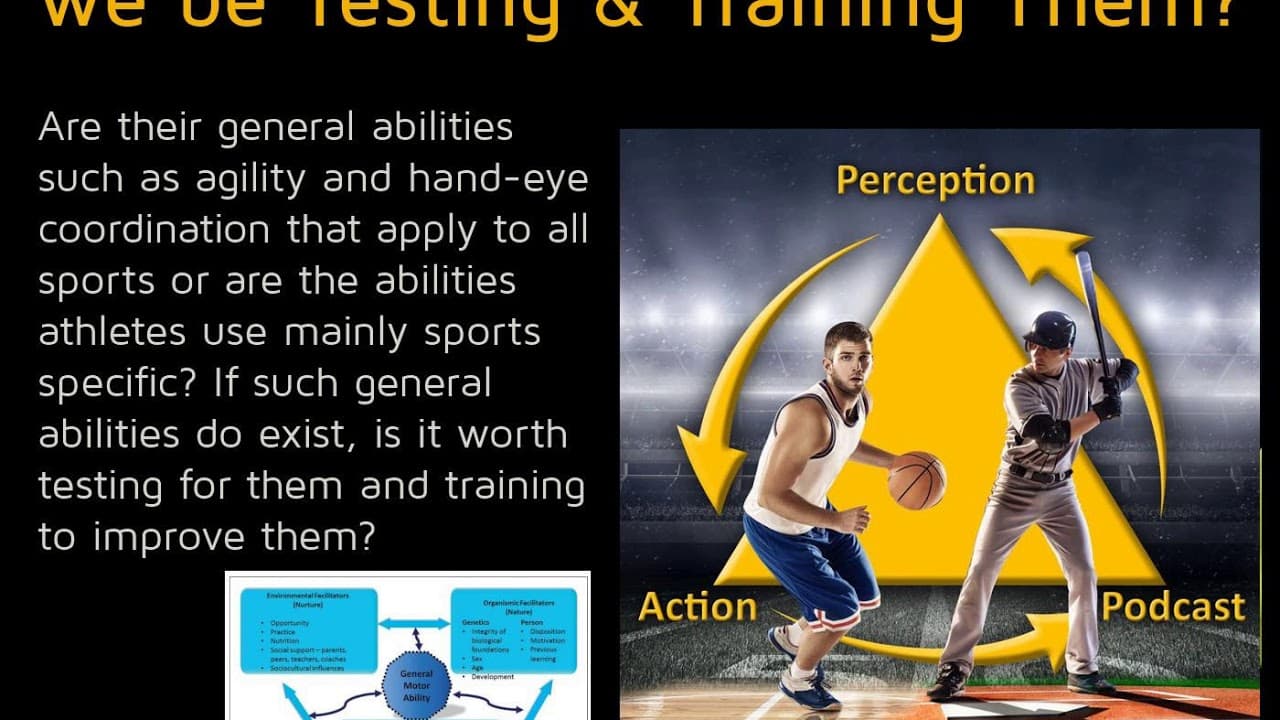
134 – Are there General Perceptual-Motor Abilities? Should we be Testing & Training Them?
TL;DR
Explores if general perceptual-motor skills apply across sports.
Transcript
today on the perception and action podcast a look at the somewhat controversial topic of general perceptual motor abilities are there general abilities such as the agility and hand-eye coordination that apply to all sports or are the abilities underlying effective performance primarily sports specific so it's time for a call to action hi everyone t... Read More
Key Insights
- The concept of general perceptual-motor abilities, like hand-eye coordination, suggests that certain skills can be applied across various sports.
- Richard Schmidt defined general perceptual-motor abilities in 1991 as inherited, stable traits supporting motor and cognitive activities.
- Testing for general abilities like eye-hand coordination often shows low correlation values, questioning their practical value.
- Studies show that general abilities might only explain a small variance in performance, especially in complex sports tasks.
- General abilities may help identify deficits in athletes, but they offer limited value in high-level sports performance.
- Franklin Henry's theory of specific motor abilities suggests performance relies on task-specific abilities rather than general ones.
- Training general abilities like reaction time or agility has not shown significant benefits for improving sports performance.
- A recent model suggests general abilities adapt over time, influenced by biological and environmental factors, but measuring this remains challenging.
Install to Summarize YouTube Videos and Get Transcripts
Explore YouTube Video Summarizer or Get YouTube Transcript Extractor
Questions & Answers
Q: What are general perceptual-motor abilities?
General perceptual-motor abilities are traits such as hand-eye coordination, agility, and balance that are believed to apply across various sports. Defined by Richard Schmidt in 1991, these abilities are considered inherited, stable traits supporting motor and cognitive activities. However, their practical value in sports has been debated, with some arguing they are not as influential as sport-specific skills.
Q: How are general perceptual-motor abilities tested?
General perceptual-motor abilities are tested using various tasks that measure skills like eye-hand coordination and reaction time. Common tests include devices like Dynavision and tasks such as the wall catch test. These tests aim to find correlations between performance on different tasks to determine if a general ability exists. However, studies often find low correlation values, questioning the validity of these tests.
Q: What does the research say about the correlation between tests of general abilities?
Research typically shows low correlation values between different tests of the same general ability, such as eye-hand coordination. For example, a study found only moderate correlations between tests like the Batac and sport vision trainer, with explained variance often being low. This suggests that while some common factors may exist, their impact on complex sports tasks is minimal.
Q: Can testing for general abilities help in athlete evaluation?
Testing for general abilities might help identify deficits or abnormalities in athletes, guiding individual training programs. However, for athletes at similar high levels, these tests offer limited value. Differences are often only significant when comparing highly different groups, like professional athletes versus non-athletes, rather than within similar skill levels.
Q: Is it beneficial to train general perceptual-motor abilities?
Training general perceptual-motor abilities, such as reaction time or agility, has not shown significant benefits for improving sports performance. These abilities contribute minimally to complex sports tasks, and focusing on sport-specific skills is deemed a more efficient use of training time. There's little evidence supporting the effectiveness of generalized training methods in enhancing sports performance.
Q: What is the theory of specific motor abilities?
The theory of specific motor abilities, proposed by Franklin Henry, argues that successful performance relies on task-specific abilities rather than general ones. Each motor skill is based on a unique combination of abilities used in a highly context-specific way. This theory suggests that the contribution of any general ability to complex sports tasks is likely very small.
Q: How does Newell's constraint theory relate to general abilities?
A recent model situates general perceptual-motor abilities within Newell's constraint theory, proposing that these abilities are constructs that adapt to individual, task, and environmental constraints. This model suggests that general abilities are not fixed but change over time, influenced by biological and environmental factors. However, measuring this adaptability remains challenging.
Q: What is the podcast's stance on general abilities in sports?
The podcast argues that while general perceptual-motor abilities might exist, their practical value diminishes in complex sports tasks. Testing and training for these abilities may help identify deficits but offer limited value for high-level athletes. The focus should shift towards developing sport-specific training methods that adhere to representative learning design principles.
Summary & Key Takeaways
-
The podcast explores whether general perceptual-motor abilities, such as agility and hand-eye coordination, are applicable to all sports or if skills are primarily sport-specific. The discussion includes examining the validity of testing and training for these abilities and their potential impact on sports performance.
-
The host, Rob Gray, reviews research findings that show low correlations between tests of the same general ability, such as eye-hand coordination, suggesting limited practical value. He argues that training should focus more on sport-specific skills rather than generalized abilities.
-
The podcast concludes that while general perceptual-motor abilities might exist, their significance diminishes in complex sports tasks. Testing for these abilities may help identify deficits but offers little value for high-level athletes. The focus should be on developing sport-specific training methods.
Read in Other Languages (beta)
Share This Summary 📚
Summarize YouTube Videos and Get Video Transcripts with 1-Click
Try YouTube Summary with ChatGPT & Claude or YouTube Transcript Generator
Explore More Summaries from Rob Gray 📚
Summarize YouTube Videos and Get Video Transcripts with 1-Click
Try YouTube Summary with ChatGPT & Claude or YouTube Transcript Generator