The Ocean is Way Deeper Than You Think
TL;DR
Explore the ocean's depths and its mysterious inhabitants.
Transcript
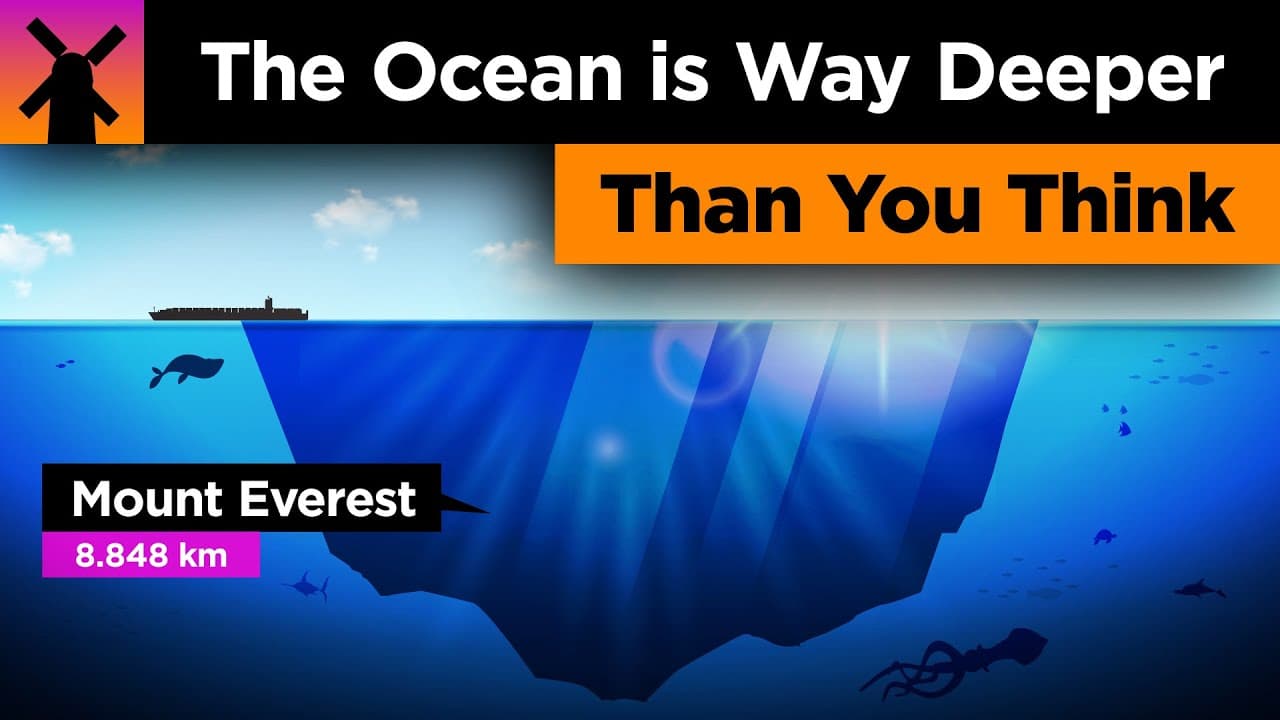
The ocean is really, really deep, deeper, in fact, than most of us realize. If you were to shave off all of the land from the tops of every continent and island in the world and fill up the ocean's deepest points with that land, then the entire earth would be covered in an ocean 2 miles deep. Three fourths of our planet is already covered i... Read More
Key Insights
- The ocean is deeper than most realize; if the land was shaved off and filled the ocean, Earth would be covered in water 2 miles deep.
- Recreational scuba diving is limited to 40 meters, but free divers like Herbert Nitsch have reached depths of 214 meters on a single breath.
- At 1,000 meters, the ocean becomes pitch black, and the pressure is equivalent to standing on Venus's surface.
- Sperm whales and colossal squids are found at 2,250 meters, where they engage in epic battles, leaving marks on the whales.
- The Abyssal Zone begins at 4,000 meters, home to bizarre creatures like the Angler Fish, under immense pressure of 11,000 psi.
- The Hadal Zone starts at 6,000 meters, with pressure 1,100 times that at the surface, yet life persists in unique forms.
- The deepest human dive reached 10,916 meters in 1960, but the ocean's floor remains largely unexplored, with only 5% mapped.
- Challenger Deep is the known ocean's deepest point at 10,994 meters, yet undiscovered depths likely exist beyond this point.
Install to Summarize YouTube Videos and Get Transcripts
Explore YouTube Video Summarizer or Get YouTube Transcript Extractor
Questions & Answers
Q: What is the maximum depth allowed for recreational scuba diving?
The maximum depth allowed for recreational scuba diving is 40 meters. Beyond this depth, diving becomes more dangerous due to increased pressure and the risk of decompression sickness. Specialized training and equipment are required for deeper dives, which are typically undertaken by professional divers or researchers.
Q: Who holds the free diving world record and at what depth?
The free diving world record is held by Herbert Nitsch, who reached a depth of 214 meters. He achieved this remarkable feat on a single breath, showcasing the incredible capabilities and endurance of trained free divers. This depth is significantly beyond the limits of recreational diving and requires exceptional skill and preparation.
Q: What happens at 1,000 meters below the ocean's surface?
At 1,000 meters below the ocean's surface, sunlight no longer penetrates, plunging the environment into permanent darkness. The pressure at this depth is immense, comparable to standing on the surface of Venus, making it a hostile environment for humans. Despite this, some marine life, like the Giant Squid, thrives here.
Q: What is significant about the depth of 2,250 meters?
At 2,250 meters, we find the maximum diving depth of sperm whales and the habitat of the colossal squid. These depths are known for the epic battles between these two giants, with sperm whales often bearing scars from encounters with the colossal squid, which can grow up to 14 meters long.
Q: What defines the Abyssal Zone, and what creatures inhabit it?
The Abyssal Zone, starting at 4,000 meters, is characterized by extreme pressure, around 11,000 psi, and complete darkness. This zone is home to unique and bizarre creatures such as the Angler Fish, Viper Fish, and Fangtooth, which have adapted to the harsh conditions with specialized features for survival.
Q: How deep is the Hadal Zone, and what are its conditions?
The Hadal Zone begins at 6,000 meters and is named after the underworld Hades. Conditions here are extreme, with water pressure 1,100 times that at the surface, enough to crush a human instantly. Despite this, life exists in various forms, adapted to survive in such a hostile environment.
Q: What was the deepest point reached by humans in the ocean?
The deepest point reached by humans was 10,916 meters, achieved in 1960 by Don Walsh and Jacques Piccard using the Trieste submarine. This historic dive took five hours to descend, and the explorers only stayed at the bottom for 20 minutes due to a cracked window, illustrating the challenges of deep-sea exploration.
Q: What is Challenger Deep, and why is it significant?
Challenger Deep is the known deepest point of the ocean, reaching a depth of 10,994 meters. Located in the Mariana Trench, it represents the extreme limits of our planet's underwater environment. Despite being the deepest known point, it is believed that even deeper locations may exist, highlighting the ocean's vast unexplored mysteries.
Summary & Key Takeaways
-
The ocean is incredibly deep, with vast areas unexplored. If land filled the ocean's deepest points, Earth would be submerged under 2 miles of water. The ocean's depth is home to various creatures, from blue whales to colossal squids, and poses extreme challenges due to immense pressure and darkness.
-
Recreational divers can explore up to 40 meters, while free divers like Herbert Nitsch have reached 214 meters. Beyond 1,000 meters, the ocean becomes completely dark, and pressure becomes deadly. Creatures like the Giant Squid and Black Dragonfish inhabit these depths, adapted to the harsh environment.
-
The Abyssal and Hadal Zones, starting at 4,000 and 6,000 meters respectively, host unique life forms under extreme pressure. Human exploration has reached 10,916 meters, but much of the ocean floor remains a mystery. Challenger Deep is the known deepest point, yet further depths may exist.
Read in Other Languages (beta)
Share This Summary 📚
Summarize YouTube Videos and Get Video Transcripts with 1-Click
Try YouTube Summary with ChatGPT & Claude or YouTube Transcript Generator
Explore More Summaries from RealLifeLore 📚



Summarize YouTube Videos and Get Video Transcripts with 1-Click
Try YouTube Summary with ChatGPT & Claude or YouTube Transcript Generator