How to Implement PID Control for a Stepper Motor
TL;DR
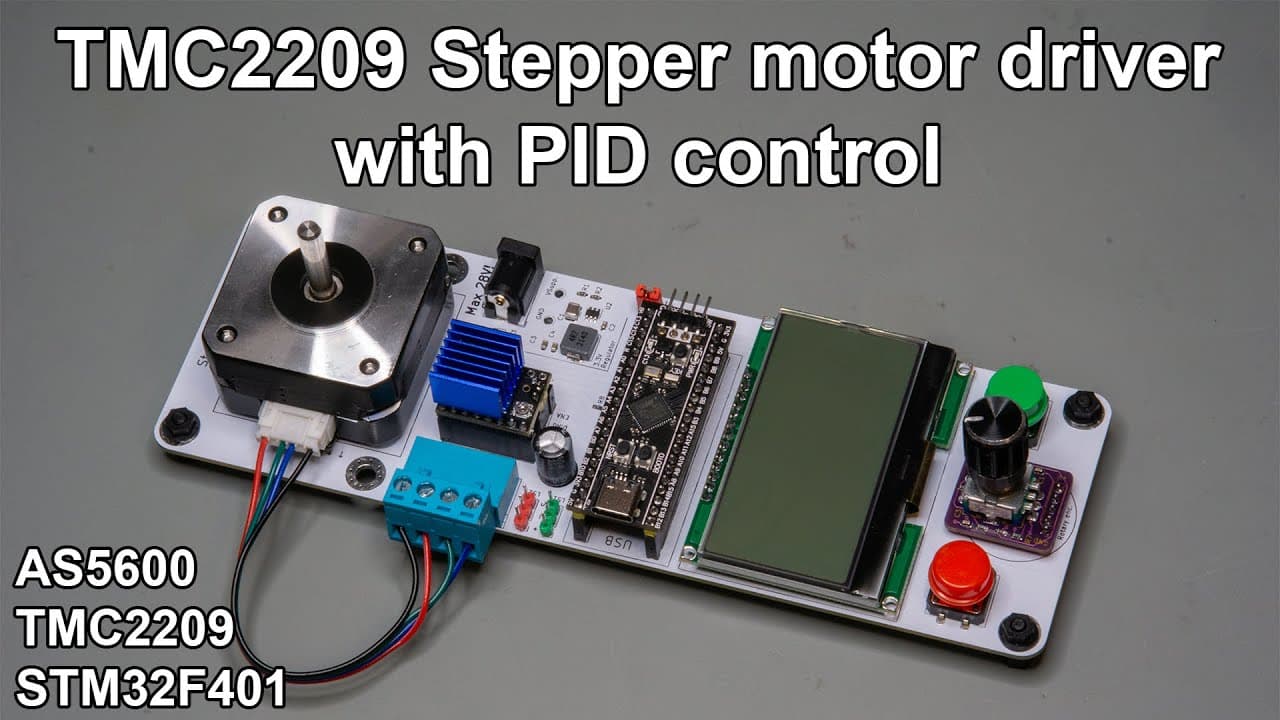
Implementing PID control for a stepper motor involves using an AS5600 magnetic encoder for precise position feedback and a TMC2209 driver for silent operation. This setup allows the motor to maintain its position accurately by adjusting based on the set target value, which can be controlled via a rotary encoder. Real-time data is displayed on a graphical LCD, enhancing the user experience.
Transcript
this video is sponsored by pcbway welcome everyone in this video I'm going to show you some news about my stepper motor development platform in my previous video regarding this platform I have already shown you how it is assembled what are the parts that it is made of and uh what it can do and now in this video I'm going to show you a new feature t... Read More
Key Insights
- 👶 The new feature in the stepper motor development platform addresses user requests and enhances functionality.
- 🤩 Key components include an AS5600 encoder for precision feedback and a TMC2209 driver for silent operation and advanced communication.
- 🎮 The P-I-D control demonstrates the capability of maintaining motor positions accurately, providing essential control in robotics applications.
- 🧑🦼 The design principles can be universally adapted to various stepper motor projects, promoting flexibility for developers.
- 👤 A graphical LCD display facilitates real-time feedback, enhancing user experience and engagement during testing.
- 🏂 Users can order printed circuit boards (PCBs) through the sponsor’s website, facilitating easy replication of the project.
- 🧑🦼 The presentation emphasizes the importance of tuning P-I-D parameters for optimal performance in stepper motor applications.
Install to Summarize YouTube Videos and Get Transcripts
Explore YouTube Video Summarizer or Get YouTube Transcript Extractor
Questions & Answers
Q: What is the main purpose of the stepper motor development platform?
The platform is designed to test, write, and develop new Arduino-compatible codes specifically for stepper motors. It allows engineers and hobbyists to experiment easily with motor control, implement various features, and adapt their designs for different applications related to stepper motors.
Q: How does the AS5600 magnetic encoder improve the functionality of the development platform?
The AS5600 magnetic encoder provides precise position feedback by detecting the angle of rotation of the stepper motor shaft through a small magnet. This information allows for accurate closed-loop control, enabling more reliable performance in applications that require precise motor positioning, thus enhancing the overall usability of the development platform.
Q: What advantages does the TMC2209 driver module provide?
The TMC2209 driver module offers silent operation due to advanced microstepping technology and allows for bidirectional communication via serial. This facilitates the adjustment of various parameters like microstepping options directly through code, thus enhancing the control over the stepper motors and providing users the ability to implement sophisticated features easily.
Q: Can the features demonstrated be applied to other motor circuits?
Yes, the features showcased in the video can be translated to other stepper motor circuits beyond the specific development platform presented. Users can adapt the discussed components and coding techniques to suit their unique projects, ensuring greater flexibility and customization.
Q: What kind of feedback is provided by the P-I-D controller?
The P-I-D controller calculates error feedback based on the difference between the target position and the actual position reported by the encoder. This enables continuous adjustment to the motor’s movements to maintain a set position within a specified tolerance, allowing it to correct any deviations effectively.
Q: Why is it important for the platform to support various voting and adjustment methods?
Supporting multiple input methods, such as the rotary encoder and various buttons, allows users to easily interact with the platform, set target values, and manipulate motor operations. This versatility caters to a wide range of user needs and simplifies the development process.
Summary & Key Takeaways
-
The video showcases a new feature implemented in the stepper motor development platform, developed specifically for Arduino-compatible codes. This feature has been highly requested by viewers and can be adapted for various stepper motor circuits.
-
Key components discussed include the Nema 17 stepper motor, an AS5600 magnetic encoder for precise position feedback, and the TMC2209 motor driver that ensures silent operation and serial communication for enhanced control.
-
The presenter demonstrates a basic P-I-D controller functionality implemented for maintaining the motor’s position accurately, displaying real-time data on a graphical LCD, and using a rotary encoder to set target positions smoothly.
Read in Other Languages (beta)
Share This Summary 📚
Summarize YouTube Videos and Get Video Transcripts with 1-Click
Try YouTube Summary with ChatGPT & Claude or YouTube Transcript Generator
Explore More Summaries from Curious Scientist 📚
Summarize YouTube Videos and Get Video Transcripts with 1-Click
Try YouTube Summary with ChatGPT & Claude or YouTube Transcript Generator