Value for Money in Global Health | Essentials of Global Health with Richard Skolnik
TL;DR
This session discusses the concept of value for money and cost-effectiveness analysis in global health investments.
Transcript
welcome in this session we'll talk about value for money when investing in key Global Health efforts by the time you finish this session you should be able to speak about the notion of value for money and health articulate some of the basic principles of cost-effectiveness analysis and note some of the Best Buys in global health let's start with so... Read More
Key Insights
- 🤑 Value for money is crucial in global health investments, as resources are limited and choices have to be made between investment alternatives.
- 🇨🇷 Cost-effectiveness analysis compares the cost of an investment with the health outcomes it can achieve, helping prioritize investments based on the most efficient use of resources.
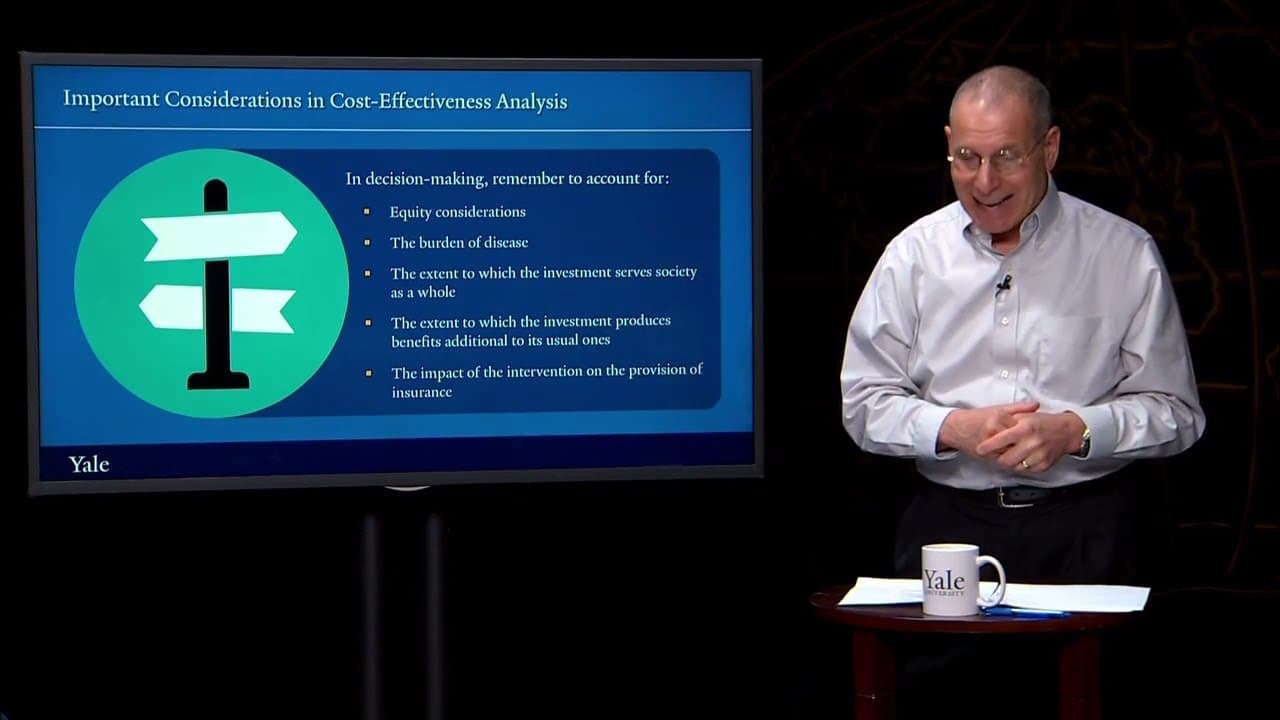
- 🧑⚕️ Factors such as politics, equity, capacity to deliver services, and transitional costs should also be considered in investment decision-making in health.
Install to Summarize YouTube Videos and Get Transcripts
Explore YouTube Video Summarizer or Get YouTube Transcript Extractor
Questions & Answers
Q: Why is it important to consider value for money in global health investments?
Value for money ensures that limited resources are used in the most efficient way, maximizing the health outcomes achieved per investment. It helps governments prioritize their spending and make informed decisions about resource allocation.
Q: What is cost-effectiveness analysis?
Cost-effectiveness analysis is a method for comparing the cost of an investment with the health outcomes it can produce. It helps determine which interventions or treatments provide the most health benefits per dollar spent, allowing for informed decision-making in resource allocation.
Q: How can cost-effectiveness analysis be applied to tuberculosis control?
In the example provided, cost-effectiveness analysis compares the cost and cure rates of unobserved therapy and observed therapy for tuberculosis patients. By calculating the cost per patient cured, it shows which approach is more cost-effective and provides policymakers with a basis for decision-making.
Q: What factors should be considered in addition to cost-effectiveness analysis when making investment choices in health?
In addition to cost-effectiveness, equity, burden of disease, additional benefits, impact on insurance provision, capacity to deliver services, links with existing services, ability to change budget priorities, and transitional costs should be considered when making investment choices in health.
Summary & Key Takeaways
-
The session introduces the concept of value for money and its importance in making investment choices in global health.
-
Examples are provided to illustrate the principles of value for money, such as comparing the cost of a tablet device and choosing the most cost-effective treatment for heartburn.
-
Cost-effectiveness analysis is introduced as a tool to compare the cost of an investment with the health outcomes it can achieve, using examples of tuberculosis control and different healthcare interventions.
Read in Other Languages (beta)
Share This Summary 📚
Summarize YouTube Videos and Get Video Transcripts with 1-Click
Try YouTube Summary with ChatGPT & Claude or YouTube Transcript Generator
Explore More Summaries from YaleCourses 📚





Summarize YouTube Videos and Get Video Transcripts with 1-Click
Try YouTube Summary with ChatGPT & Claude or YouTube Transcript Generator