How to Calculate Ease of Movement in Python
TL;DR
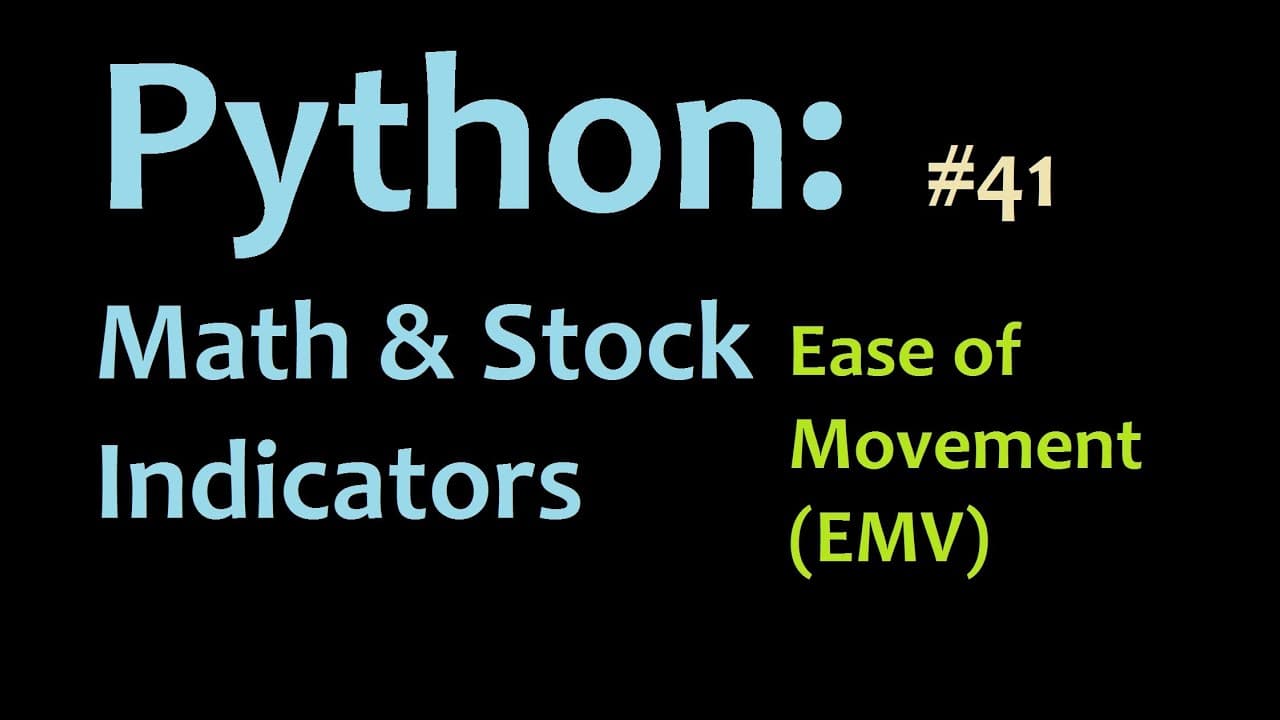
To calculate Ease of Movement in Python, first import necessary libraries and load your sample data from a text file. Define a function that computes movement and box rate, averages the results, and appends the calculated values to a list for analysis. Ensure to include a time frame for smoothing the results using a simple moving average.
Transcript
hello everybody welcome to the second part of our ease of movement calculation in this video we're going to be actually calculating ease of movement in python one thing that you're going to need real quick actually two things you'll want the sample data the link for that is in the description you should be taken to this page and there's sample data... Read More
Key Insights
- 🫠 Calculating Ease of Movement in Python involves importing necessary libraries, reading sample data, and defining the appropriate variables and functions.
- 😘 The calculation for Ease of Movement includes division and subtraction of current and previous high and low prices.
- ⌛ Adding a time frame to the calculation can help smooth or average out the Ease of Movement values.
- 💾 The sample data should be saved as "sampledata.txt" in the same directory as the script.
- 👣 The calculated Ease of Movement values can be printed for observation and verification.
- ⌛ To add a time frame to the calculation, a simple moving average function is applied with the desired window size.
- 👂 Appending the calculated Ease of Movement values to a list is important for further analysis or visualization.
Install to Summarize YouTube Videos and Get Transcripts
Explore YouTube Video Summarizer or Get YouTube Transcript Extractor
Questions & Answers
Q: What do you need to calculate Ease of Movement in Python?
To calculate Ease of Movement in Python, you need sample data, which can be found in the link provided, and a simple moving average function, which is explained in a separate tutorial video.
Q: How do you import the necessary libraries and read the sample data?
To import the libraries, you need to use the numpy library as "np" and the time library. To read the sample data, you should save it as "sampledata.txt" in the same directory as your script, and use the open and read functions to load the data into memory.
Q: What is the calculation for Ease of Movement in Python?
The calculation for Ease of Movement involves dividing the sum of current high and low prices by 2, subtracting the sum of previous high and low prices divided by 2, and then dividing the result by the difference between the current high and low prices.
Q: How do you add a time frame to the Ease of Movement calculation?
To add a time frame, you can use a simple moving average function. In this video, a time frame of 14 is used. The function is called "moving_average" and is applied to the calculated Ease of Movement values.
Summary & Key Takeaways
-
This video explains how to calculate Ease of Movement in Python using sample data and a simple moving average.
-
The video provides step-by-step instructions on importing necessary libraries, reading and parsing the sample data, and defining the ease of movement function.
-
The tutorial also covers calculating box rate and dividing movement by box rate, and includes printing out the calculated values.
Read in Other Languages (beta)
Share This Summary 📚
Summarize YouTube Videos and Get Video Transcripts with 1-Click
Try YouTube Summary with ChatGPT & Claude or YouTube Transcript Generator
Explore More Summaries from sentdex 📚


Summarize YouTube Videos and Get Video Transcripts with 1-Click
Try YouTube Summary with ChatGPT & Claude or YouTube Transcript Generator