How Do You Implement an AI System for Production? #16 AI for Good Specialization [Course 1, Week 2, Lesson 1]
TL;DR
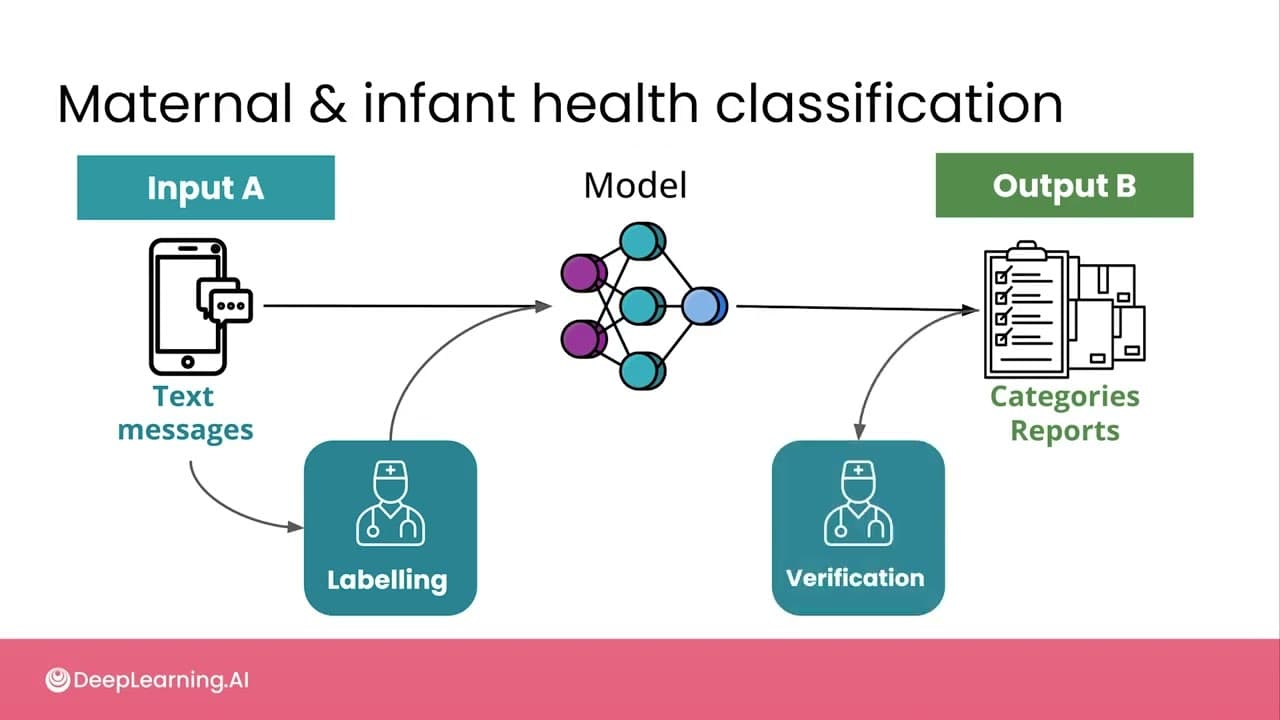
Implementing an AI system for production requires final model training and testing, scalable deployment, end-to-end testing, performance monitoring, and validation with end users. In the maternal health project in Nigeria, clinic staff annotated sensitive messages, while humans reviewed predictions where the single-layer model was uncertain. Read on to see how privacy, usability, failure modes, and continuous improvement shaped deployment.
Transcript
once you've looked at your data and designed your model strategy and your annotation strategy I figured out how you're going to do a data privacy and security and plan your user experience then you're ready to begin implementing your system in this phase you'll get ready for production by running any final training and testing of your model and mov... Read More
Key Insights
- 🎨 Designing an effective model strategy and annotation strategy is crucial before implementing an AI system.
- 💁 Data privacy and security need to be considered to protect sensitive information.
- ♻️ In the implementation phase, final training and testing of the model are conducted, and it is moved into a scalable production environment.
- 💼 Human review of model predictions is important for uncertain cases to avoid biasing the output.
- ❤️🩹 Evaluating model performance and the success of the end-users is essential in the implementation phase.
- 🐎 Continuous improvement of the model's performance enhances the overall system's volume and response speed.
- 😘 Real-world AI deployments involve technical challenges like system uptime and low latency predictions.
Install to Summarize YouTube Videos and Get Transcripts
Explore YouTube Video Summarizer or Get YouTube Transcript Extractor
Questions & Answers
Q: How do you implement an AI system in a production environment?
Complete any final model training and testing, then move the model into a scalable production environment. Integrate it with the wider system, run end-to-end testing, monitor performance, and understand potential failure modes.
Q: What should be completed before implementing an AI system?
The data must be examined, and the model and annotation strategies must be designed. The team must also decide how to handle data privacy and security and plan the user experience.
Q: What does making an AI model production-ready mean?
It means making the model developed and tested during the design phase more available, reliable, and robust within the production system. The model must also be accessible to the end-user application.
Q: What should end-to-end testing cover in a production AI system?
End-to-end testing should examine the entire system, including data throughput, model monitoring, reliability, system updates, and user experience. It becomes possible as the model is integrated into the production environment.
Q: How was the model adapted for the maternal health project in Nigeria?
The project used a very simple single-layer model that had originally been developed for industry applications. It was retrained for the specific use case and the available languages, metadata, instructions, and unstructured data.
Q: Why did clinic staff perform the data annotation?
Clinic staff already had expertise and experience working with the messages, so their annotations were expected to be more accurate than those from a third party. Keeping annotation within the clinic also limited additional access to personal health information.
Q: How were uncertain model predictions handled?
Humans focused on cases where the model could not make an accurate prediction. The system did not show annotators what the model prediction might be, helping prevent incorrect predictions from biasing manual annotations.
Q: How do you know whether the AI implementation phase is complete?
The team must determine whether model performance is acceptable and whether end users can successfully use the system. If performance or usability is inadequate, the project must return to the design phase to address those problems.
Summary & Key Takeaways
-
Definition: Productionizing a model means making it more available, reliable, robust, and accessible to the end-user application.
-
Tool: Final training, testing, scalable deployment, monitoring, and failure-mode analysis prepare an AI model for production.
-
Definition: End-to-end testing examines data throughput, model monitoring, reliability, system updates, and user experience across the complete system.
-
Who: Clinic staff annotated maternal health messages because they had relevant expertise and already worked with the messages.
-
Definition: Keeping annotation within the clinic reduced additional access to the personal health information of supported people.
-
Tool: Highly accurate tasks such as language detection could be handled almost automatically, with manual rerouting when necessary.
-
Who: Human reviewers concentrated on predictions where the model was uncertain and completed annotations without seeing suggested predictions.
-
Compare: Acceptable model performance alone was insufficient, because end users also needed to use the system successfully.
-
When: Performance or usability problems discovered during implementation required returning to the design phase.
-
Compare: Continuous model improvement increased the clinic staff's overall volume and response speed, although some messages still required manual review.
-
Tool: Real-world AI deployment can involve system uptime, low-latency predictions, retraining time, and other practical challenges.
-
Definition: Final evaluation should connect project results and user experience back to the original problem definition.
Read in Other Languages (beta)
Share This Summary 📚
Summarize YouTube Videos and Get Video Transcripts with 1-Click
Try YouTube Summary with ChatGPT & Claude or YouTube Transcript Generator
Explore More Summaries from DeepLearningAI 📚




Summarize YouTube Videos and Get Video Transcripts with 1-Click
Try YouTube Summary with ChatGPT & Claude or YouTube Transcript Generator