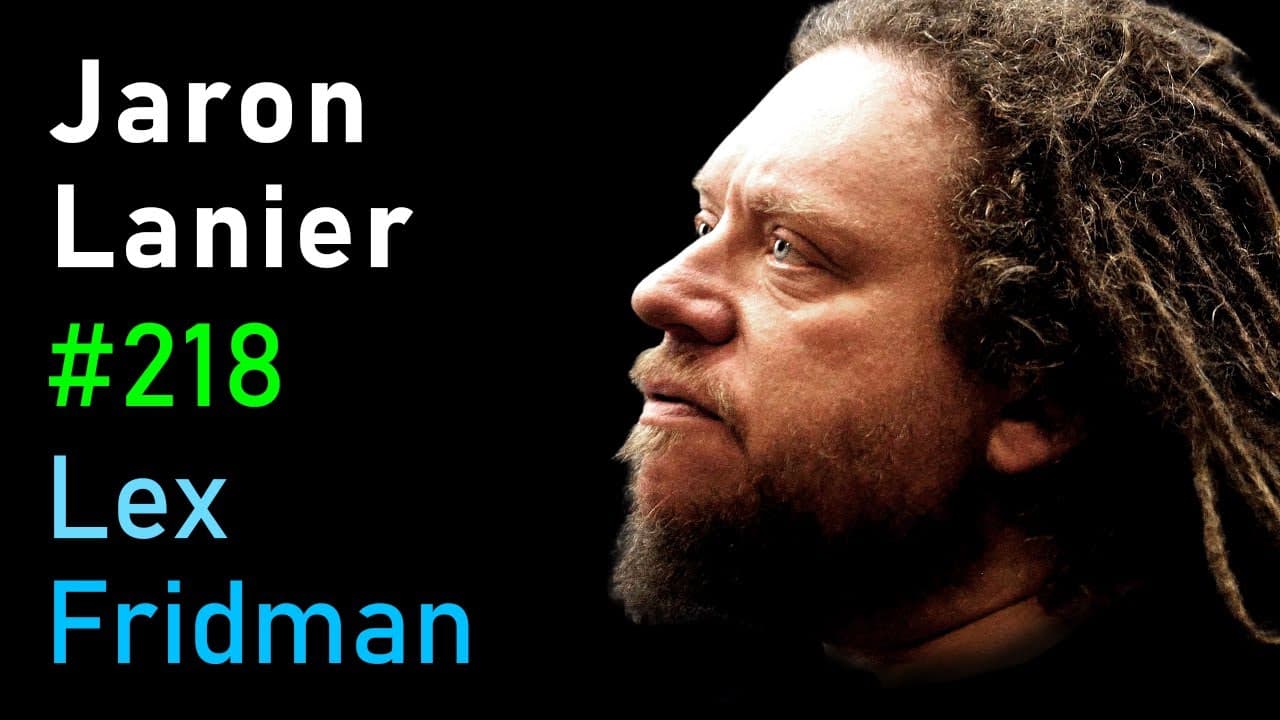
Jaron Lanier: Virtual Reality, Social Media & the Future of Humans and AI | Lex Fridman Podcast #218
TL;DR
To enhance social media, users should be empowered with control over their data and algorithmic preferences. Jaron Lanier emphasizes the creation of data unions, enabling individuals to negotiate data usage and contribute to more meaningful, user-centered platforms that foster creativity and community sharing.
Transcript
the following is a conversation with jaron lanier a computer scientist visual artist philosopher writer futurist musician and the founder of the field of virtual reality to support this podcast please check out our sponsors in the description as a side note you may know that jiren is a staunch critic of social media platforms him and i agree on man... Read More
Key Insights
- 🌍 Virtual reality (VR): Jaron Lanier believes that the true magic of VR is experiencing physical reality after being immersed in a virtual world, emphasizing the beauty, strangeness, and delicacy of the real world.
- 📚 Respecting conversations: Lex Friedman values respectful and exploratory conversations, where he aims to learn and have fun, pushing back respectfully when necessary to create an exchange that highlights the wisdom of the other person.
- 🧠 Perceiving reality: Jaron Lanier explores the distinction between the virtual and physical worlds, finding software-based virtuality to be less understandable and messy compared to the physical world.
- 💻 Unraveling the universe: According to Jaron Lanier, understanding the universe as a computer is plausible as long as it follows consistent principles, but attempting to comprehend it as a Turing machine may be limited by human cognitive capabilities.
- 🤖 AI limitations: Jaron Lanier believes that the universality of certain AI models, like the Turing machine, may be deceiving, as they aren't truly accessible or practical, emphasizing the limitations and messiness of software in comparison to the physical world.
- 💀 Fear of death: Jaron Lanier suggests that the fear of death has motivated the development of civilization and the formation of human thought, but it is often under-acknowledged. He suggests revisiting Ernest Becker's book, "The Denial of Death," which explores this fear.
- 🌱 Appreciating reality: Jaron Lanier argues for the importance of appreciating the physical world and gaining a deeper understanding and tenderness towards it through experiences in virtual reality.
- 🔁 Evolution of media: Jaron Lanier points out that new media technologies have often been initially perceived as realistic and indistinguishable from reality, but over time, individuals evolve and become more discerning, leading to a greater appreciation for the flaws and complexities of reality.
- 💬 Fixing social media: Jaron Lanier suggests designing social media platforms that prioritize respect for individuals, allowing them to have control over their data, algorithms, and the ability to easily delete their accounts. He also highlights the potential of economic incentives to benefit creativity and value, rather than simply grabbing attention.
Install to Summarize YouTube Videos and Get Transcripts
Explore YouTube Video Summarizer or Get YouTube Transcript Extractor
Questions & Answers
Q: How can social media platforms be redesigned to prioritize user control and empowerment?
Social media platforms can be redesigned by giving individuals complete control over their data, allowing for easy deletion of accounts, and implementing personalized algorithms that prioritize user preferences and values. Additionally, the establishment of data unions would allow individuals to negotiate the use of their data and contribute to the improvement of algorithms, promoting creativity and value-sharing within communities.
Q: What are the potential benefits of user control over data and algorithms in social media?
User control over data and algorithms in social media can lead to a more personalized and empowering user experience. It allows individuals to have greater agency in shaping their online identity, ensures transparency in data usage, and fosters a sense of ownership and pride in their contributions to the platform. Additionally, personalized algorithms that prioritize user preferences can result in a more relevant and meaningful social media experience.
Q: How can the concept of data dignity be applied to social media platforms?
Data dignity can be applied to social media platforms by establishing data unions, where individuals have the power to negotiate the use of their data and contribute to the improvement of algorithms. This framework ensures that individuals have control and ownership over their data, promoting transparency and accountability. Data unions can also enable individuals to collectively advocate for their rights and interests within the social media ecosystem.
Q: What are the potential challenges in implementing user control and data dignity in social media platforms?
Implementing user control and data dignity in social media platforms may face challenges, such as resistance from platform owners who benefit from the current centralized model. Additionally, it may require significant changes to existing business models, algorithms, and data practices, which can be met with opposition. Ensuring security, privacy, and ethical considerations while giving users more control over their data is also a challenge that needs to be addressed.
Summary
In this conversation with Jaron Lanier, Lex Friedman explores various topics including virtual reality, the difference between the virtual world and physical reality, the role of death in human civilization, the nature of consciousness, the potential benefits and drawbacks of AI, and the need to design technologies that respect and support human values. They also discuss the impact of social media, the manipulation of algorithms, and the possibility of creating systems that optimize for human well-being and deeper connections.
Questions & Answers
Q: Do you think people will one day spend most or all of their lives in virtual reality worlds?
Jaron Lanier believes that virtual reality can provide valuable experiences, but he personally finds the physical world more astonishing and important. He emphasizes the magic of perceiving physical reality after experiencing virtual reality. However, he acknowledges that people have different attitudes towards virtuality, and younger generations may perceive it differently. He also mentions the potential applications of augmented reality, such as augmenting a forest or creating surgical simulators.
Q: What is the difference between the virtual world and the physical world, and why are you personally drawn to the physical world?
Lanier discusses the limitations and nuances of software, stating that it is messy and arbitrary compared to the physical world. He considers the physical world mysterious and acknowledges that it is not fully understood, questioning the notion of whether the universe is a computer. Lanier believes that trying to understand the universe as a Turing machine is a foolish approach. He also highlights the importance of experiencing physical reality and rejecting the assumption of a fixed level of perception.
Q: What is the role of death in human civilization?
Lanier acknowledges that the fear of death has been a driving force in human history and the formation of civilization. He references Ernest Becker's book, "The Denial of Death," and suggests that the fear of mortality is a core motivator behind various philosophical approaches to consciousness. Lanier emphasizes the importance of faith and the recognition that nobody can claim absolute knowledge about consciousness. He also discusses how the fear of death manifests in different belief systems, such as the idea of a soul surviving death or the aspiration of uploading one's consciousness into a machine.
Q: Can virtual reality or AI help us appreciate and understand physical reality better?
Lanier argues that virtual reality and AI can help people appreciate physical reality and develop a tender attitude towards it. He references historical examples, such as early wire recorders or crude video teleconferencing, where people initially perceived the technology as realistic but eventually recognized its limitations. Lanier believes that the experience of virtual worlds should enhance our understanding and admiration of the physical world, rather than solely focusing on creating alternative realities or trying to simulate reality perfectly.
Q: Are you skeptical about AI's potential to build better platforms and systems that prioritize human well-being and happiness?
Lanier expresses his skepticism about the current state of AI, particularly in the context of social media platforms. He believes that algorithms are not effective at persuading or manipulating people as often assumed. Instead, he argues that engagement on social media platforms relies on crude measurements that capture more extreme emotions, leading to a cycle of negative emotional states. Lanier suggests that fixing social media requires understanding economics and incentivizing systems that respect and subordinate themselves to human values, rather than relying solely on algorithms.
Q: Can AI systems be designed to foster deeper connections, compassion, and personal growth in social media?
Lanier believes that it is possible to design technologies that respect and support human values, including social media systems. He refers to musical instruments as an example of technologies that help people connect in fantastic ways and promote empathy. He also mentions his design during the pandemic called "together mode," which allows people to have a more immersive and interactive video conferencing experience. However, he cautions against relying solely on algorithms and emphasizes the need for human curation and responsibility in promoting healthy conversations and connections.
Q: How do you think we can fix social media platforms to avoid manipulation and negative effects on individuals?
Lanier suggests the need to approach social media from an economic perspective and shift the focus from algorithmic manipulation to incentivizing systems that respect individuals. He acknowledges that companies currently operate based on engagement feedback loops, but he argues that measurement mechanisms for engagement are crude and primarily capture negative emotional responses. Lanier mentions GitHub as an example of a platform with relatively low toxicity, possibly due to users having a shared stake in real-world projects. He emphasizes the importance of subordinating technology to human values and designing systems that are respectful and beneficial to individuals.
Takeaways
Lanier's perspectives highlight the value of the physical world and the need to appreciate its strangeness and delicate nature. While virtual reality and AI can offer alternative experiences, they should be designed to enhance our understanding and admiration of physical reality, rather than replace it. Lanier encourages an approach that respects and supports human values, subordinates technology to human agency, and fosters deeper connections and empathy. He raises concerns about the manipulation and negative effects of social media platforms, emphasizing the need for economic incentives that prioritize human well-being and healthy conversations. Overall, Lanier's insights prompt a critical examination of our relationship with technology and the importance of designing systems that serve humanity's long-term interests and happiness.
Summary & Key Takeaways
-
Jaron Lanier, computer scientist and virtual reality pioneer, discusses the future of social media and the importance of user control over data and algorithms.
-
He envisions a social media landscape where individuals have complete control over their data, the ability to easily delete their accounts, and personalized algorithms that prioritize their own preferences and values.
-
Lanier suggests the implementation of data unions, where individuals can negotiate the use of their data and contribute to the improvement of algorithms, promoting creativity and value-sharing within communities.
Read in Other Languages (beta)
Share This Summary 📚
Summarize YouTube Videos and Get Video Transcripts with 1-Click
Try YouTube Summary with ChatGPT & Claude or YouTube Transcript Generator
Explore More Summaries from Lex Fridman Podcast 📚




Summarize YouTube Videos and Get Video Transcripts with 1-Click
Try YouTube Summary with ChatGPT & Claude or YouTube Transcript Generator