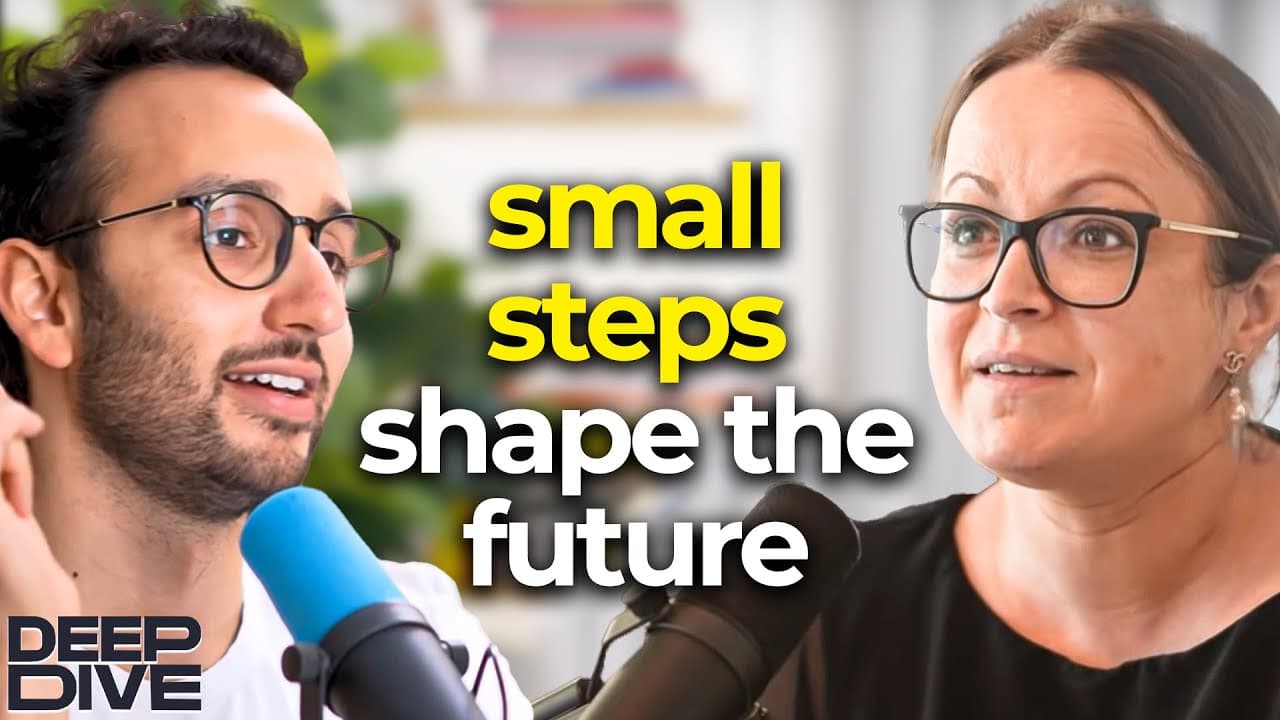
How To Build Career Success - Behavioural Scientist Dr Grace Lordan
TL;DR
Career success comes from examining the daily tasks behind a career, taking small steps toward a desired future, and treating setbacks as experiences people can rebound from. Behavioral scientist Dr Grace Lordan explains that anticipated failure often makes people underestimate their resilience. She also connects better decisions with emotional awareness, adaptable leadership, and realistic career exploration, making the full discussion useful for anyone choosing or changing direction.
Transcript
if i was to think about leaders of the future actually their ability to stand up and say i don't know i got it wrong or i've changed my mind those three things are really in the forefront of my mind because when you're navigating through uncertainty you're going to get it wrong sometimes and that's okay but it's the deliberate part have you sat dow... Read More
Key Insights
- Admitting uncertainty is leadership: Lordan places three statements at the center of future leadership: not knowing, getting something wrong, and changing one's mind. These admissions matter because uncertain environments do not permit flawless judgment. Her standard is not permanent certainty, but the willingness to recognize error and respond thoughtfully when evidence or circumstances require reconsideration.
- Changing minds should be deliberate: Simply announcing a new opinion is not the complete leadership behavior Lordan describes. She asks whether the person has sat down and deliberately changed their mind. That question makes reflection the crucial step. A revised position becomes meaningful when it follows conscious reassessment, especially while someone is navigating uncertainty and knows that mistakes will sometimes occur.
- Daily work tests ambitions: Lordan translates broad aspirations into concrete questions about tasks. Someone considering medicine or trading should investigate what they would actually do from day to day, then ask whether those activities would be enjoyable. This method tests the lived substance of a career instead of relying on the appeal of its label or imagined status.
- Small steps shape futures: The subtitle of Lordan's book links thinking big with taking small steps and building the future a person wants. The sequence joins ambition to action without treating them as opposites. A large future goal supplies direction, while attention to smaller steps turns that desired future into something that can be approached through present choices.
- Anticipation distorts expected recovery: When people imagine failure or loss, Lordan says they underestimate their own resilience. The forecast concentrates on the negative experience without fully accounting for the capacity to rebound. As a result, anticipated failure can appear worse than the experienced setback ultimately proves to be, which helps explain why fear can obstruct action before any failure occurs.
- Experience reveals remaining options: Lordan says that allowing oneself to go through a negative experience can change its meaning. Afterward, people may recognize that the event was not as bad as expected and that other options exist later. Resilience is therefore visible through lived recovery, not merely through reassurance offered before the difficult event happens.
- Fear connects with procrastination: The conversation explicitly links procrastination with fear of failure. This frames delay as part of how people respond to an anticipated negative outcome, rather than discussing it only as a time-management problem. Lordan's resilience point adds an important contrast: the feared experience may discount a person's actual ability to recover and pursue another option.
- Emotions enter economic decisions: Lordan's behavioral science work examines how people really make choices, including the influence of emotion. Standard economics teaches that people weigh costs, benefits, and risks. Her approach asks how that model should be adjusted to describe human decision making more accurately and make the resulting understanding useful to governments and firms.
- Immediate choices have delayed costs: Lordan uses choosing a Big Mac today to question whether people fully weigh costs that may emerge in 10 years, particularly when the choice is repeated the next day and again afterward. The example exposes the gap between a simple rational-choice model and the way consequences accumulate through repeated human behavior.
- Behavioral science bridges disciplines: Lordan places herself between economics and psychology. She retains economics' concern with costs, benefits, risks, labor, and policy, while using behavioral science to understand decisions more realistically. She also wants that understanding to generate advice that governments and firms can use, giving the research a practical policy orientation.
- Education can span adulthood: The board's work was connected to a view that education should not end with secondary school or be confined to young university students. Lordan cites the possibility of attending university at 25, 35, or 45. That creates a skills agenda focused on repeated opportunities to learn across different stages of adult life.
- Mixed expertise supports policy: The Skills and Productivity Board contained six experts with different perspectives. Lordan describes one education specialist, four traditional economists, and herself between economics and behavioral economics. Her economics and labor background, behavioral science expertise, and book about careers from an individual perspective were the combination she believes made her application appealing.
Install to Summarize YouTube Videos and Get Transcripts
Explore YouTube Video Summarizer or Get YouTube Transcript Extractor
Questions & Answers
Q: How can Dr Grace Lordan's approach help build career success?
Start by replacing an abstract career title with the tasks the job requires every day. Lordan suggests asking what you would do as a doctor, trader, or in another chosen role, then deciding whether you would ultimately enjoy those activities. Connect that investigation to a large future ambition, but move toward it through the small steps emphasized in Think Big. This works because career success is evaluated through the work you will repeatedly experience, not only through the name of the destination.
Q: What does Dr Grace Lordan say about fear of failure and procrastination?
The conversation identifies fear of failure as one reason people procrastinate. When anticipating failure or loss, people tend to underestimate how resilient they will be afterward. Lordan says that actually passing through a negative experience can reveal that it was not as bad as expected and that other options remain. Fear can therefore delay action because the prediction gives too little weight to a person's capacity to rebound.
Q: How should future leaders handle uncertainty?
Lordan says future leaders should be able to admit that they do not know, acknowledge that they were wrong, and state that they have changed their mind. These responses are necessary because navigating uncertainty means getting things wrong sometimes. The change of mind should be deliberate, following time spent reconsidering the issue. Her account makes reflective adaptation more important than maintaining an appearance of uninterrupted certainty.
Q: Why focus on career tasks instead of job titles?
A title does not reveal what a person will spend each working day doing. Lordan recommends identifying the actual tasks associated with a possible career and asking whether those tasks would be enjoyable. This makes the decision more concrete by comparing an aspiration with its recurring activities. The method matters because those activities, rather than the title alone, determine the day-to-day experience of the career.
Q: What is the main idea of Think Big by Dr Grace Lordan?
The book is titled Think Big: Take Small Steps and Build the Future You Want. Its framing combines a desired future with smaller actions that move a person toward it. In the discussion, career exploration includes examining the daily tasks behind roles such as doctor or trader and assessing whether they would be enjoyable. The approach connects an ambitious direction with concrete scrutiny of the life and work that direction would create.
Q: How does behavioral science fit into economics for Dr Grace Lordan?
Lordan begins with the economics lesson that decision makers weigh costs, benefits, and risks. She then asks how people actually decide and how that simple model can be adjusted to describe human behavior better. Her Big Mac example questions whether someone choosing immediate consumption fully weighs costs 10 years later, especially across repeated choices. She positions her work between economics and psychology so it can offer useful advice to policymakers and firms.
Q: What did Dr Grace Lordan do on the Skills and Productivity Board?
The board sat under the secretary of state and reported into Boris as part of the leveling-up strategy described in the conversation. Its work involved thinking about future skills, how those skills could be delivered in the UK, and whether some existing providers performed better than others. It also considered education beyond secondary school and young people going directly to university, including study at 25, 35, or 45. Lordan contributed a perspective combining economics, labor, behavioral science, and individual career decisions.
Q: How did Dr Grace Lordan join the UK government advisory body?
Lordan says membership was filled through an open competition rather than through an unsolicited approach. The advertisement sought backgrounds including economics and labor. She believes her combination of economics, behavioral science, and a book examining careers from an individual perspective appealed to the selectors. She then joined a six-person committee with an education specialist, four traditional economists, and Lordan occupying a position between economics and behavioral economics.
Summary & Key Takeaways
-
Leadership through uncertain conditions: Dr Grace Lordan argues that future leaders need the ability to say, "I don't know," "I got it wrong," or "I've changed my mind." Uncertainty means leaders will sometimes make mistakes, and she considers that acceptable. The important distinction is whether someone has deliberately reconsidered the issue and consciously changed their position. Adaptability is therefore presented as an active process of reflection, rather than a casual or unexplained reversal.
-
Introducing Dr Grace Lordan: Deep Dive host Ali describes the podcast as an exploration of how entrepreneurs, creators, and other inspiring people find joy and fulfillment in work and life. Lordan is introduced as an associate professor in behavioral science at the London School of Economics. She also serves as an expert adviser to the UK government through the Skills and Productivity Board, and her academic work has appeared in international academic journals.
-
Looking beneath career labels: The conversation draws on Lordan's book, Think Big: Take Small Steps and Build the Future You Want. Instead of concentrating only on becoming a doctor or trader, she recommends asking what tasks each role requires every day. The next question is whether those activities would actually be enjoyable. This shifts career planning away from an attractive title and toward the repeated experiences that would constitute life in that career.
-
Understanding behavior and failure: The episode covers how emotions influence decisions, the relationship between gender and risk aversion, and why fear of failure contributes to procrastination. Lordan says people are generally good at rebounding after negative experiences. Once they allow themselves to experience a setback, they may discover it was less severe than anticipated and that other options remain. Before a possible failure or loss, however, people tend to underestimate this resilience.
-
Connecting skills with policy: Lordan explains that the Skills and Productivity Board considered future UK skills and how they could be delivered. Its remit reflected the idea that education should not be limited to secondary school or young people attending university, but could include university study at 25, 35, or 45. She joined through an open competition, bringing economics, labor, behavioral science, and an individual career perspective to a six-expert committee that also included an education specialist and four traditional economists.
Read in Other Languages (beta)
Share This Summary 📚
Summarize YouTube Videos and Get Video Transcripts with 1-Click
Try YouTube Summary with ChatGPT & Claude or YouTube Transcript Generator