Making Benzaldehyde From Cinnamon Oil
TL;DR
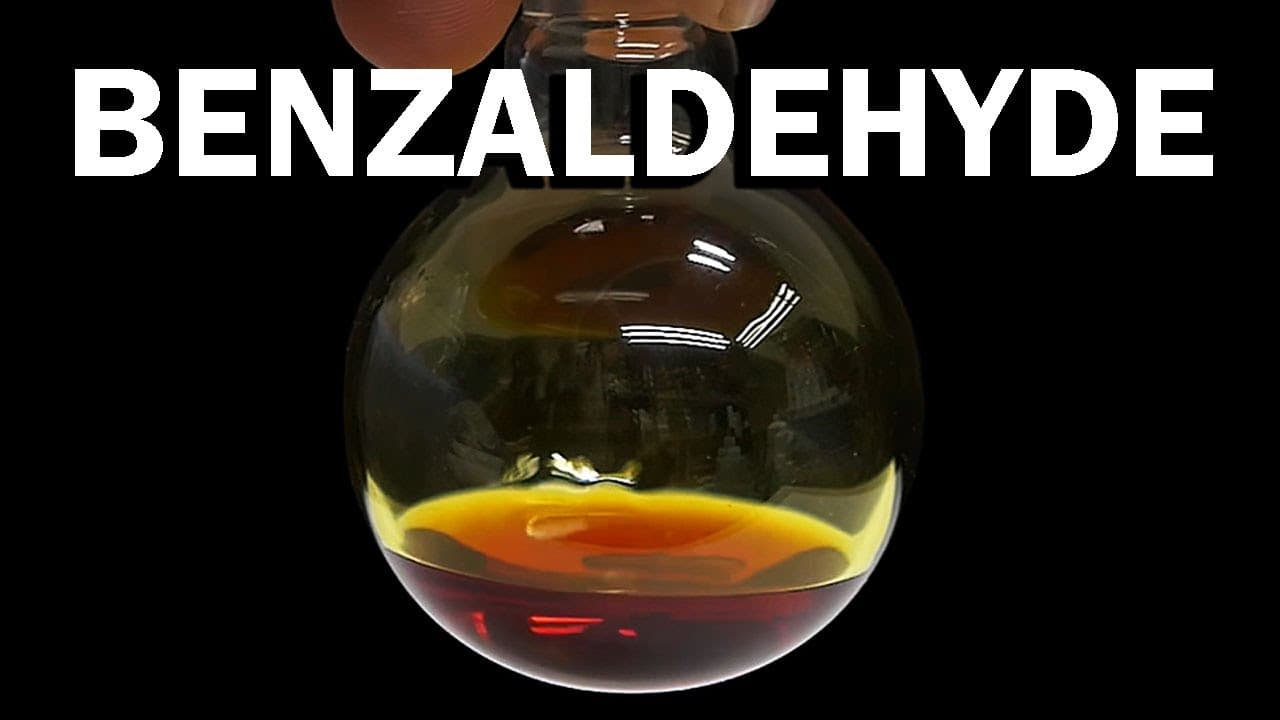
This video demonstrates the process of making benzaldehyde from cinnamaldehyde using a retro aldol reaction, highlighting the distinct change in smell throughout the synthesis.
Transcript
today we're going to be making some benzaldehyde starting from cinnamaldehyde the cinnamaldehyde that we're starting with smells like cinnamon and benzaldehyde that we're ending with smells like almonds or like cherry candy I think that the distinct change in smell from the beginning to the end is pretty cool for this synthesis we need to carry out... Read More
Key Insights
- 👾 Retro aldol reactions are not commonly used in organic synthesis, making this demonstration unique.
- 👾 Normal aldol reactions, which involve the formation of carbon-carbon bonds, are more frequently employed compared to retro aldol reactions.
- 🛢️ The presence of sodium carbonate and cinnamon oil is crucial in this synthesis to facilitate the desired chemical reactions.
- 👃 The change in smell from cinnamaldehyde (cinnamon) to benzaldehyde (almond/cherry candy) highlights the transformation of compounds throughout the synthesis.
- 😤 The separation of benzaldehyde from other components is achieved through steam distillation under vacuum.
- 🛢️ The yield of benzaldehyde obtained from this synthesis is unclear due to the varying cinnamaldehyde content in different cinnamon oils.
- 🚾 The experiment demonstrates the importance of creating a saturated salt solution to separate the oil layer from water.
Install to Summarize YouTube Videos and Get Transcripts
Explore YouTube Video Summarizer or Get YouTube Transcript Extractor
Questions & Answers
Q: What is the purpose of the retro aldol reaction in this synthesis?
The retro aldol reaction is utilized to break apart cinnamaldehyde and produce benzaldehyde and acetaldehyde. It is a unique and rare reaction with an interesting mechanism.
Q: Is this synthesis an efficient way to produce benzaldehyde?
No, this synthesis is not efficient in terms of yield and time. It is more of a fun and educational experiment rather than a practical method for synthesizing benzaldehyde.
Q: Why is the use of sodium carbonate and cinnamon oil important in this reaction?
Sodium carbonate acts as a catalyst in the retro aldol reaction, facilitating the conversion of cinnamaldehyde to benzaldehyde. Cinnamon oil contains cinnamaldehyde, which is the starting compound for the synthesis.
Q: What is the purpose of the steam distillation process in this synthesis?
The steam distillation is used to separate the benzaldehyde from other components in the reaction mixture. Heating and boiling the mixture allow the benzaldehyde to co-distill with the water, which can later be separated.
Summary & Key Takeaways
-
The video showcases the step-by-step process of converting cinnamaldehyde to benzaldehyde through a retro aldol reaction.
-
Sodium carbonate and cinnamon oil are the main ingredients used in the reaction.
-
The reaction involves a reflux, followed by steam distillation to separate the desired benzaldehyde.
Read in Other Languages (beta)
Share This Summary 📚
Summarize YouTube Videos and Get Video Transcripts with 1-Click
Try YouTube Summary with ChatGPT & Claude or YouTube Transcript Generator
Explore More Summaries from NileRed 📚

Summarize YouTube Videos and Get Video Transcripts with 1-Click
Try YouTube Summary with ChatGPT & Claude or YouTube Transcript Generator