How Can We Terraform Mars to Support Human Life?
TL;DR
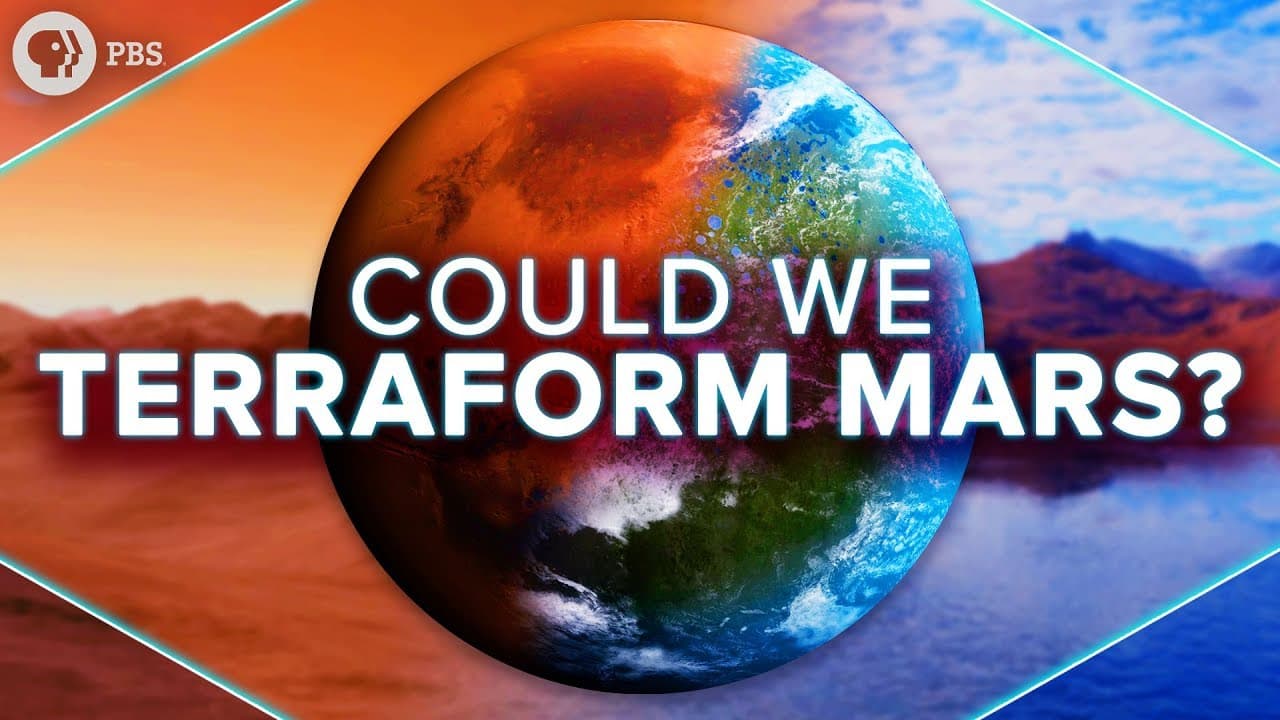
Terraforming Mars involves creating an Earth-like atmosphere, which is currently unfeasible with existing technology. The planet lost its atmosphere due to weak gravity and lack of a magnetic field, necessitating the release of CO2 from its polar ice caps and crust. Future strategies may include importing gases from comets or constructing artificial habitats, but these concepts require significant technological advancements and resources.
Transcript
Thanks to LEGO – presenting LEGO City - for their support of PBS Digital Studios. Humanity’s future is glorious. As we master space travel, we’ll hop from one cold dead world to the next. Terraforming as we go. Life will blossom in our path and eventually the galaxy will shimmer with beautiful Earth-like orbs. I mean... maybe. Sounds a little scien... Read More
Key Insights
- Terraforming Mars involves creating an Earth-like atmosphere, which is currently a distant goal due to technological limitations.
- Mars' thin atmosphere and lack of a magnetic field make it inhospitable, requiring significant atmospheric enhancement to support life.
- Mars once had a thicker atmosphere and liquid water, but most of it may have been lost to space due to solar winds.
- To terraform Mars, we need to release CO2 from the poles, regolith, and carbonates, but current technology can't achieve this.
- Future possibilities include mining deep carbonates or importing volatiles from comets to build a sufficient atmosphere.
- Creating a protective magnetic shield in space could help retain a newly formed atmosphere on Mars.
- An alternative to full terraforming is building enclosed habitats or 'worldhouses' to create livable environments on Mars.
- The energy requirements for terraforming are astronomical, requiring innovations in power generation and resource extraction.
Install to Summarize YouTube Videos and Get Transcripts
Explore YouTube Video Summarizer or Get YouTube Transcript Extractor
Questions & Answers
Q: Why is terraforming Mars considered a distant future possibility?
Terraforming Mars is considered a distant future possibility due to the immense technological and energy challenges involved. The process requires creating an Earth-like atmosphere by releasing or importing vast quantities of CO2 and other gases. Current technology cannot achieve this, and the energy requirements are several thousand times the Earth's annual consumption. Additionally, Mars lacks a magnetic field to protect a new atmosphere, necessitating further innovations.
Q: What challenges does Mars' atmosphere present for terraforming?
Mars' atmosphere presents several challenges for terraforming. It is extremely thin, with a pressure only 0.6% of Earth's, making it unable to support liquid water or protect against harmful radiation. Additionally, Mars lacks a magnetic field, which means any new atmosphere would be vulnerable to solar wind stripping. To terraform Mars, we need to significantly increase atmospheric pressure and protect it from space weather.
Q: What are the potential sources of CO2 on Mars for terraforming?
Potential sources of CO2 on Mars include the polar ice caps, regolith, and carbonate minerals in the crust. The polar ice caps contain CO2 ice, but releasing it would only double the current atmospheric CO2, which is insufficient. The regolith could release some CO2 over thousands of years, while carbonates require mining and processing. However, even with these sources, achieving Earth-like atmospheric pressure is currently beyond our capability.
Q: How could comets contribute to terraforming Mars?
Comets could contribute to terraforming Mars by delivering volatiles such as CO2, H2O, and nitrogen, which are essential for building an atmosphere. Comets are rich in these gases, and redirecting a sufficient number of them to collide with Mars could help increase atmospheric pressure and water content. However, this approach requires advanced technology to control comet trajectories and would take centuries to implement.
Q: What role does Mars' magnetic field play in its habitability?
Mars' lack of a magnetic field plays a significant role in its current uninhabitability. Without a magnetic shield, Mars' atmosphere is vulnerable to solar wind stripping, which has likely contributed to its current thin state. A magnetic field is crucial for protecting an atmosphere from being eroded by space weather, making it a critical consideration for any terraforming efforts. Creating an artificial magnetic shield could be a potential solution.
Q: What are 'worldhouses' and how do they relate to Mars colonization?
'Worldhouses' are enclosed habitats that could provide livable environments on Mars without full terraforming. These structures would consist of airtight bubbles covering large areas, creating Earth-like conditions inside while protecting inhabitants from Mars' harsh environment. Constructing worldhouses would require less material and energy than building an entire atmosphere, offering a more feasible approach to Mars colonization in the near term.
Q: What energy sources are considered for terraforming Mars?
The energy sources considered for terraforming Mars include solar power and fusion power. Solar cells could be manufactured from Martian silicon to cover large areas, while fusion power plants would provide immense energy output. Both options require significant advancements in technology and infrastructure, as terraforming demands energy several thousand times greater than Earth's current annual consumption. These energy sources are key to powering atmospheric processing and resource extraction.
Q: How does the concept of terraforming Mars address humanity's future in space?
Terraforming Mars is seen as a potential first step in humanity's expansion into space, serving as a proof of concept for transforming other planets. Successfully creating a habitable environment on Mars could pave the way for similar efforts on other celestial bodies, enabling humans to establish colonies beyond Earth. This vision aligns with the idea of spreading life throughout the galaxy, although it remains a distant future possibility requiring significant technological advancements.
Summary & Key Takeaways
-
Terraforming Mars is a long-standing science fiction dream, but practical challenges make it a distant future possibility. Current technology can't generate a sustainable atmosphere on Mars, but future advancements might make it feasible.
-
Mars lost its atmosphere due to its weak gravity and lack of a magnetic field. To terraform Mars, we need to release CO2 from its poles and crust, but current methods are insufficient to create an Earth-like environment.
-
Alternative strategies for making Mars habitable include importing volatiles from comets or building enclosed habitats. Both ideas require significant technological advancements and energy resources, making them far-future possibilities.
Read in Other Languages (beta)
Share This Summary 📚
Summarize YouTube Videos and Get Video Transcripts with 1-Click
Try YouTube Summary with ChatGPT & Claude or YouTube Transcript Generator
Explore More Summaries from PBS Space Time 📚




Summarize YouTube Videos and Get Video Transcripts with 1-Click
Try YouTube Summary with ChatGPT & Claude or YouTube Transcript Generator