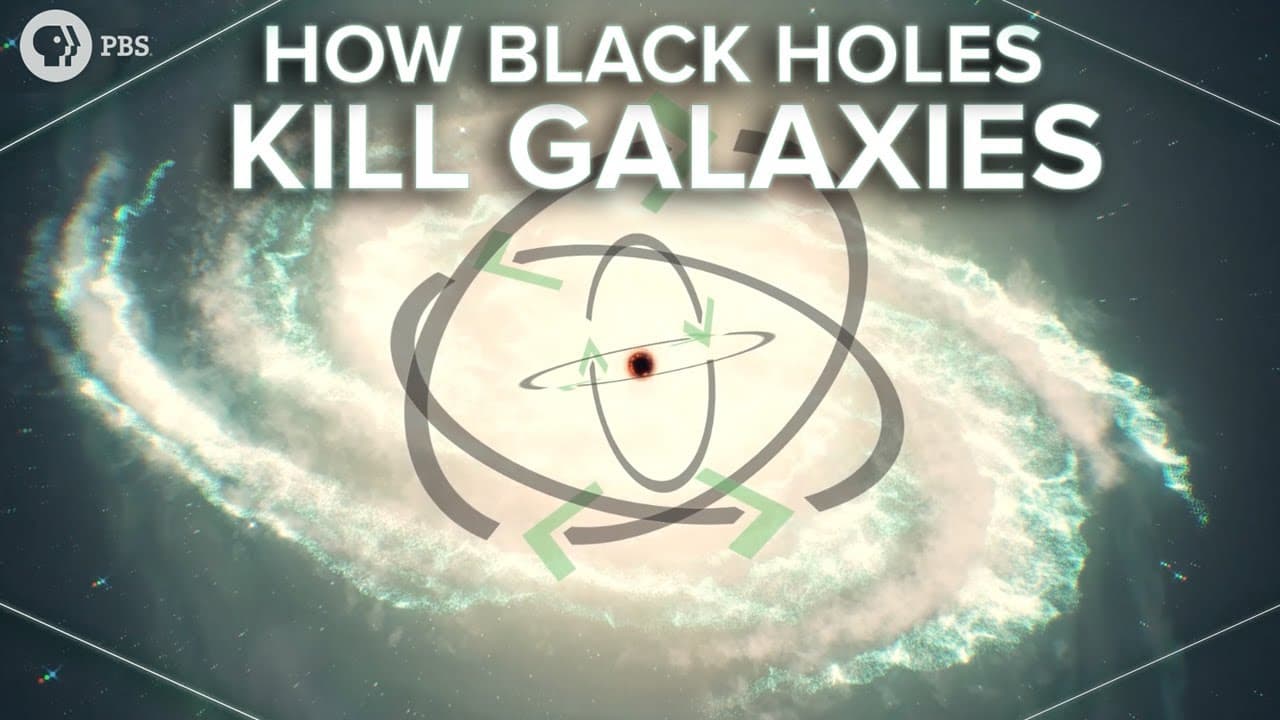
How Black Holes Kill Galaxies
TL;DR
Black holes may halt star formation across the universe.
Transcript
Thanks to Brilliant.org for supporting PBS Digital Studios Black Holes are really only dangerous if you get too close Who am I kidding ? It turns out that they may be responsible for ending Star formation across the entire Universe When we first realized that Black Holes could have masses of Millions or even Billions of times that of the Sun It cam... Read More
Key Insights
- Black holes, though seemingly dangerous only when approached, might play a crucial role in halting star formation throughout the universe, affecting the growth and evolution of galaxies.
- The discovery of supermassive black holes in all decent-sized galaxies revealed a surprising correlation between the mass of these black holes and the mass of stars in the galaxy's central bulge.
- Despite the gravitational influence of supermassive black holes being limited to their immediate surroundings, they seem to have a broader impact on the galaxy's ability to form new stars.
- Galaxies form through a 'bottom-up' process, where smaller galaxies merge to create larger ones, and this hierarchical formation process is influenced by the presence of dark matter.
- Quasars, powered by supermassive black holes, can inhibit star formation by expelling or heating gas, a process known as 'quenching,' which limits the galaxy's growth potential.
- The historical growth patterns of black holes and star formation rates show a synchronized peak around 10 billion years ago, suggesting a linked evolutionary path.
- Alternative explanations for declining star formation include supernova activity and the shock of gas entering galaxies, but black holes remain a prime suspect.
- Modern-day 'red and dead' elliptical galaxies house supermassive black holes, remnants of past quasars that once influenced the galaxies' developmental history.
Install to Summarize YouTube Videos and Get Transcripts
Explore YouTube Video Summarizer or Get YouTube Transcript Extractor
Questions & Answers
Q: How do black holes influence star formation in galaxies?
Black holes influence star formation through a process called 'quenching.' When quasars, powered by supermassive black holes, become active, they emit intense energy that can heat or expel gas from galaxies. This prevents the gas from cooling and collapsing into new stars, thereby halting star formation.
Q: What is the relationship between black holes and the mass of stars in a galaxy?
There is a tight correlation between the mass of a galaxy's central supermassive black hole and the mass of its stars in the galactic bulge. This unexpected relationship suggests that black holes and galaxies evolve together, influencing each other's growth and development over cosmic time.
Q: Why is the connection between black holes and galaxies surprising to astronomers?
The connection is surprising because, despite the chaotic nature of galaxy formation, there is a remarkably consistent relationship between black hole and galaxy mass. This suggests a feedback mechanism where black holes regulate galaxy growth, a process not fully understood and still under investigation by astronomers.
Q: What is 'bottom-up hierarchical galaxy formation'?
'Bottom-up hierarchical galaxy formation' refers to the process where smaller galaxies form first and then merge to create larger galaxies. This contrasts with a 'top-down' approach, where large galaxies would form directly from primordial gas. This bottom-up process is supported by observations and simulations of the universe.
Q: How do quasars affect the growth of galaxies?
Quasars, powered by active supermassive black holes, emit vast amounts of energy that can heat or expel gas from galaxies. This energy output prevents gas from cooling and forming new stars, limiting the galaxy's growth. Quasars can effectively 'quench' star formation, influencing the galaxy's evolutionary path.
Q: What historical pattern is observed in black hole and star formation growth?
Both black hole growth and star formation peaked around 10 billion years ago, indicating a linked evolutionary pattern. This synchronicity suggests that as black holes grew and became more active, they influenced the rate of star formation, possibly through quasar activity that quenched new star development.
Q: What other factors might contribute to the decline in star formation?
Other factors contributing to the decline in star formation include intense supernova activity, which can heat or expel galactic gas, and the shock experienced by gas entering galaxies. These processes can limit the ability of gas to cool and form new stars, but black holes remain a primary suspect in this decline.
Q: What is the significance of 'red and dead' elliptical galaxies?
The term 'red and dead' refers to elliptical galaxies that no longer form new stars and appear red due to the aging of their star populations. These galaxies often house supermassive black holes, remnants of active quasars that once influenced their growth, providing clues to the galaxies' developmental histories.
Summary & Key Takeaways
-
Black holes, though often perceived as threats only when approached, might be responsible for halting star formation across the universe. This connection between black holes and galaxies has puzzled astronomers, revealing a complex relationship that influences galaxy evolution.
-
Supermassive black holes are found in all sizable galaxies, with a surprising correlation between the mass of these black holes and the mass of stars in the galaxy's central region. This relationship suggests a deeper connection between black holes and galactic development.
-
Quasars, driven by supermassive black holes, can disrupt star formation by ejecting or heating galactic gas, a process termed 'quenching.' This activity not only limits the growth of galaxies but also affects the black holes' ability to gather new material.
Read in Other Languages (beta)
Share This Summary 📚
Summarize YouTube Videos and Get Video Transcripts with 1-Click
Try YouTube Summary with ChatGPT & Claude or YouTube Transcript Generator
Explore More Summaries from PBS Space Time 📚
Summarize YouTube Videos and Get Video Transcripts with 1-Click
Try YouTube Summary with ChatGPT & Claude or YouTube Transcript Generator