Cube Trick - work out cubic numbers (1 - 100) fast!
TL;DR
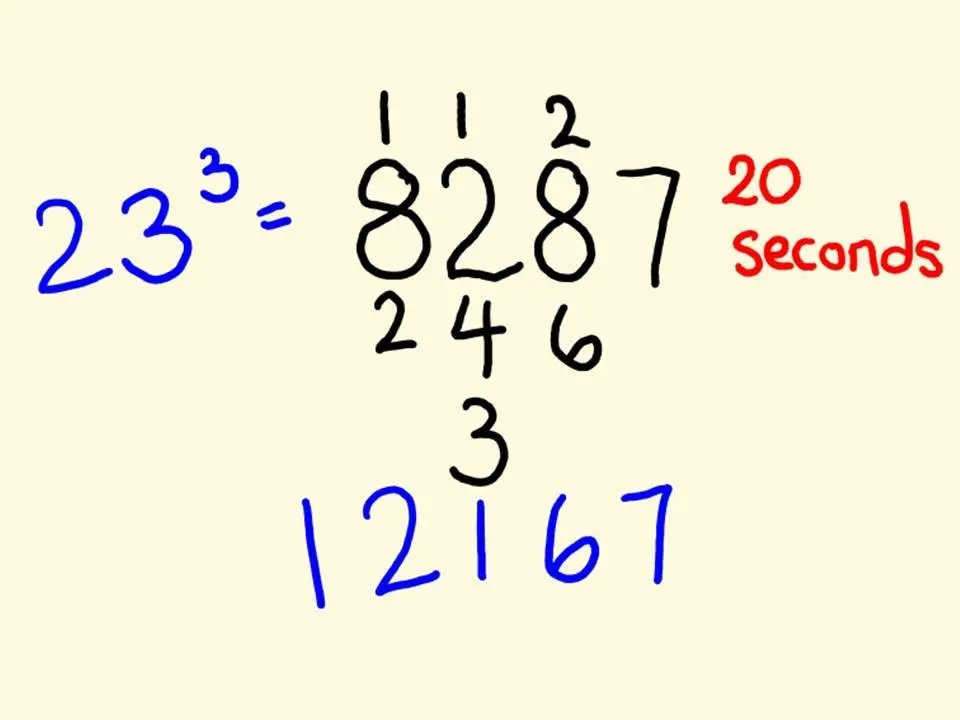
To cube a number between 1 and 100, label its digits a and b, calculate a cubed, a squared times b, b squared times a, and b cubed, then double the two middle results and add everything in aligned positions. The method produces 12,167 for 23 cubed and becomes more manageable with practice. Read on for the full pattern, calculation order, and worked examples.
Transcript
good day and welcome to the tech math Channel what I'm going to be having a look at in this video is a way of cubing any number between 1 and 100 it's a really Nifty little trick uh and I'll show it to you right now anyway let's start uh first off I'm going to get you to try and Cube this number here now I'm guessing the way that you'd usually do i... Read More
Key Insights
- 💌 The trick for cubing numbers between 1 and 100 involves assigning letters to digits and using algebraic patterns.
- 🧊 By following the steps of cubing the first digit, multiplying the square of the first digit by the second digit, squaring the second digit and multiplying it by the first digit, and cubing the second digit, then doubling the results, you can find the cubed value.
- 🫚 The trick can also be used to find cube roots of numbers between 1 and 100 by reversing the process.
- 🔨 While the trick may seem complicated at first, it becomes easier with practice and can be a handy tool for quick calculations.
- ⚾ The technique is based on algebraic principles, making it a useful introduction to algebra concepts.
Install to Summarize YouTube Videos and Get Transcripts
Explore YouTube Video Summarizer or Get YouTube Transcript Extractor
Questions & Answers
Q: How can you quickly cube numbers between 1 and 100?
Assign a to the first digit and b to the second digit. Calculate a cubed, a squared times b, b squared times a, and b cubed; double the two middle results, align them as demonstrated, and add them together.
Q: What algebraic pattern does the cube trick use?
The pattern is a cubed, followed by a squared times b, then b squared times a, and finally b cubed. The two middle values are doubled before all the values are added.
Q: How does the cube trick work for 31 cubed?
For 31, a is 3 and b is 1. The method calculates 27, 9, 3, and 1, then doubles the middle values to 18 and 6 before adding the aligned results.
Q: How does the method calculate 23 cubed?
For 23, the four initial values are 8, 12, 18, and 27. After doubling 12 and 18 to get 24 and 36 and adding the aligned values, the result is 12,167.
Q: Can the trick be used with larger two-digit numbers?
Yes, the presenter begins an example using 45 cubed and also mentions numbers such as 96. However, the calculations become more difficult as the numbers get bigger.
Q: What are the first calculations for 45 cubed?
For 45, the method starts with 4 cubed, which is 64. It then calculates 4 squared times 5 as 80, 5 squared times 4 as 100, and 5 cubed as 125.
Q: Is this cube trick instant or easy to use?
The presenter explicitly says the trick is not instant and may not look simple at first. It becomes easier as you get used to the calculation pattern.
Q: What should you memorize to make the cube trick easier?
The presenter recommends learning the displayed cube values, saying they may take about three or 4 minutes to learn. Knowing them helps with calculating cubes for numbers from 1 to 100 and with working out cube roots in related examples.
Summary & Key Takeaways
-
The video introduces a trick for cubing numbers between 1 and 100 in a different way than the traditional method.
-
The trick involves assigning letters to the digits of the number and using certain patterns.
-
By cubing the first digit, multiplying the square of the first digit by the second digit, squaring the second digit and multiplying it by the first digit, and cubing the second digit, then doubling the resulting numbers, you can find the cubed value of the original number.
Read in Other Languages (beta)
Share This Summary 📚
Summarize YouTube Videos and Get Video Transcripts with 1-Click
Try YouTube Summary with ChatGPT & Claude or YouTube Transcript Generator
Explore More Summaries from tecmath 📚


Summarize YouTube Videos and Get Video Transcripts with 1-Click
Try YouTube Summary with ChatGPT & Claude or YouTube Transcript Generator