Conflict Might Be Preventing the Discovery of Alien Life
TL;DR
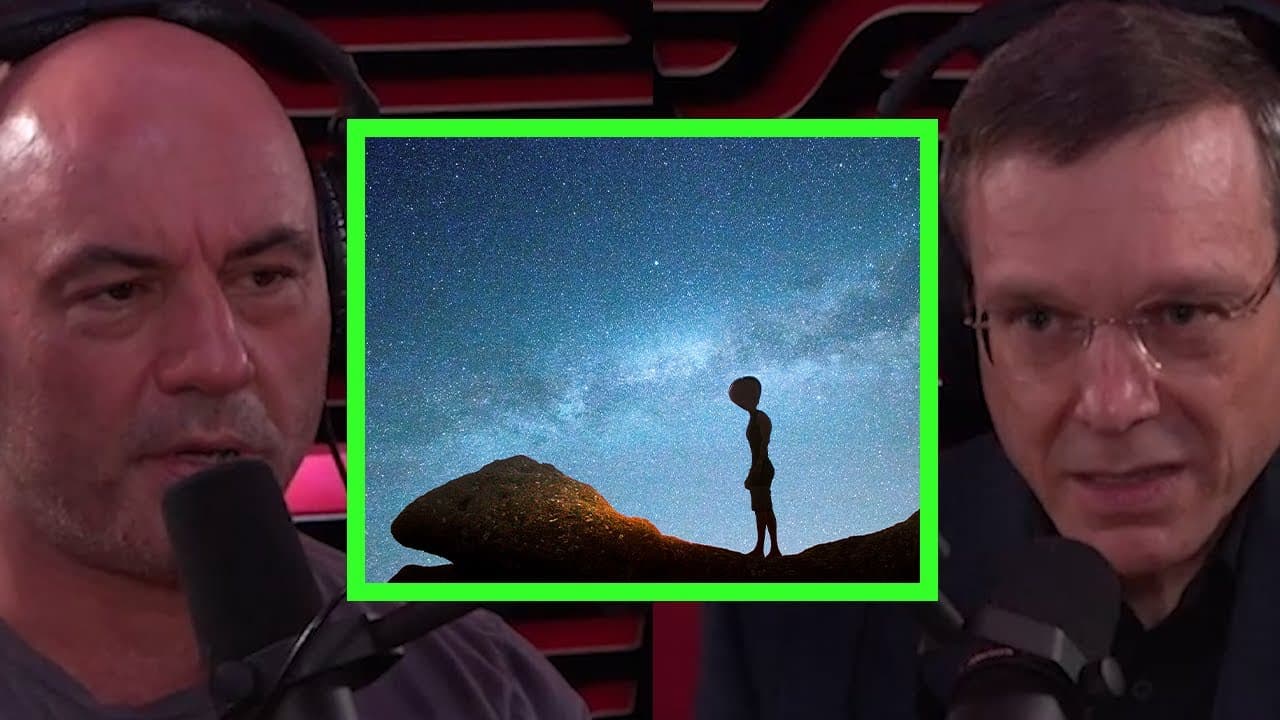
Conflict and tribalism in human nature significantly hinder the search for extraterrestrial life. Despite billions of galaxies potentially harboring life, mainstream astronomy avoids this topic due to ingrained biases and taboos, even as public interest grows. The guest urges researchers to utilize existing technology to address these compelling questions rather than dismiss them.
Transcript
the jurogan experience just to give you an example in my book i talk about winston churchill winston church 1939 wrote an essay about the fact that there could be life around other in on other planets around other stars and we should search for it now he didn't have a chance to publish it because he became prime minister and then had to fight the t... Read More
Key Insights
- 🛟 Historical context: Winston Churchill's interest in extraterrestrial life was overshadowed by his duties as Prime Minister during World War II.
- 🫚 Human nature: Tribalism and conflict are deep-rooted in human DNA, hindering progress and unity.
- 👏 Scientific taboos: Mainstream astronomy's avoidance of discussing extraterrestrial life raises questions about the use of available technology and public interest.
- 👨🔬 Priorities in research: The guest criticizes the physics community for prioritizing speculative theories over practical research into extraterrestrial life.
- 🇨🇫 Public engagement: The guest highlights public interest in the search for extraterrestrial life, questioning why the scientific community shies away from addressing this topic.
- 🖤 Historical perspective: The guest hopes that future generations will view our era as primitive and lacking in foresight when it comes to scientific exploration.
- 🤨 Conflict as a driver: The guest suggests that conflict is sometimes necessary for progress but raises concerns about the extent to which it hinders collective advancement.
Install to Summarize YouTube Videos and Get Transcripts
Explore YouTube Video Summarizer or Get YouTube Transcript Extractor
Questions & Answers
Q: Why did Winston Churchill's essay on extraterrestrial life remain unpublished?
Winston Churchill's essay on extraterrestrial life was left unpublished due to his role as Prime Minister during World War II, diverting resources away from such pursuits.
Q: What does the guest propose as a reason for human conflict and lack of progress?
The guest suggests that tribalism and biological limitations inherited from our ancestry, characterized by chaos and tribal conflicts, hinder humanity's potential for unity and progress.
Q: Why does the guest criticize the mainstream astronomy community's reluctance to explore the possibility of extraterrestrial life?
The guest challenges mainstream astronomy to embrace the search for extraterrestrial life, citing public interest and the potential use of existing technology to investigate industrial pollution on other planets.
Q: How does the guest view the prioritization of speculative physics theories over the search for extraterrestrial life?
The guest criticizes the physics community for prioritizing speculative theories lacking empirical evidence over the exploration of extraterrestrial life, arguing that the focus should be on understanding reality.
Summary
In this video, the speaker discusses the importance of searching for extraterrestrial life and the limitations of human intelligence and progress. They argue that despite advancements in technology and knowledge, humans still struggle with tribalism and conflict, hindering our ability to work together for a better future. The speaker also criticizes the mainstream astronomy community for not actively pursuing the search for evidence of extraterrestrial life, despite the public's interest and the potential to use existing technology for this purpose. They highlight the prevalence of speculative ideas in theoretical physics that lack empirical evidence, suggesting a bias towards showcasing intellectual prowess rather than focusing on understanding and describing reality.
Questions & Answers
Q: Why was Winston Churchill unable to publish his essay on the search for extraterrestrial life?
Winston Churchill wrote an essay about the possibility of extraterrestrial life in 1939, but was unable to publish it due to becoming the prime minister and having to focus on leading the fight against the Nazi regime in World War II. The speaker suggests that if the resources allocated to the war had been directed towards the search for extraterrestrial life as Churchill envisioned, we might have gained answers to this question by now. This example serves to illustrate our lack of coordination and foresight as a species.
Q: Do you think humans have made progress in working towards a better future?
While the speaker acknowledges that there are significant challenges and problems in society, they argue that humans have made considerable advancements compared to our ancestors from 2000 years ago. They express optimism that future generations will look back at our current era and recognize how far we have come. However, they also admit that they are not as optimistic as the interviewer and believe that there is still work to be done before achieving a better future.
Q: Why do conflicts often arise as a catalyst for progress and improvement?
The speaker suggests that conflicts, whether they be ideological, cultural, or political, often serve as catalysts for progress and improvement. They explain that the yin and yang of conflict and cooperation create a dynamic environment where ideas are challenged, mistakes are learned from, and new approaches are developed. Without conflicts, complacency can set in, hindering innovation and growth.
Q: Why do humans struggle to understand the best path forward without recalculating after crises?
The speaker argues that humans have biological limitations rooted in our ancestral history of tribalism and chaos. They posit that these limitations are responsible for our tendency to embrace conflicts and recalibrate our course of action based on past mistakes. These biological and evolutionary factors shape our behavior and create challenges in our ability to make smart decisions from the beginning.
Q: What is the main cause of issues like racism and discrimination?
The speaker states that issues like racism, religious discrimination, and cultural discrimination stem from the same problem: tribalism. They explain that humanity's tribalistic instincts, inherited from our primate ancestors, lead to prejudices and discrimination based on arbitrary factors. The speaker agrees with the interviewer that the problem lies within our DNA and is deeply ingrained in our society.
Q: Why should there not be a taboo on discussing the search for extraterrestrial life?
The speaker questions why there is a taboo surrounding discussions about the search for extraterrestrial life, especially considering the vastness of the observable universe and the potential for billions of Earth-like systems. They argue that the mainstream of astronomy should embrace the topic, even if conservatively, and actively search for evidence of extraterrestrial life. They highlight the public's interest and argue that science should address questions that are significant to society.
Q: Can the search for life through the detection of oxygen in the atmosphere of other planets be conclusive?
The speaker argues that searching for the presence of oxygen in the atmosphere of other planets to find evidence of life is not a conclusive method. They point out that the Earth itself had very little oxygen in its atmosphere for the first two billion years, despite supporting microbial life. Additionally, they note that oxygen can be produced naturally through various processes other than life. Even if oxygen is found, it cannot be considered definitive proof of life. The speaker suggests using the same instruments to search for industrial pollution as a potential indicator of extraterrestrial life.
Q: Why are speculative ideas embraced in physics, even without empirical evidence?
The speaker criticizes the physics community for extensively discussing and awarding each other for speculative ideas such as extra dimensions, the multiverse, super symmetry, and superstring theory, despite the lack of empirical evidence. They differentiate physics from mathematics, stating that physics should be concerned with understanding and describing reality, rather than showcasing intellectual prowess. The speaker finds it perplexing that speculative ideas are given more significance than the search for evidence of extraterrestrial life, which they deem as more important and within reach.
Q: Why is it surprising that the search for extraterrestrial life is not part of mainstream science?
The speaker expresses surprise that the search for life outside of Earth is not integrated into mainstream scientific research. They mention that they personally transitioned into this subject after studying black holes and uncovering ideas related to the search for extraterrestrial life. They argue that given the public's interest and the accessibility of existing technology, this topic should be actively pursued and integrated into scientific discussions.
Q: Why is it essential for the scientific community to address questions that interest the public?
The speaker highlights the public's interest in the search for extraterrestrial life and emphasizes that the public funds scientific research. They question why the scientific community would shy away from a topic of public interest. They believe that the scientific community should address questions that captivate the public, especially when the tools and technology already exist to investigate such questions.
Takeaways
In this video, the speaker discusses the lack of coordination and focus on the search for extraterrestrial life, emphasizing the importance of overcoming tribalism and conflicts to work together towards a better future. They criticize the mainstream astronomy community for neglecting the search for evidence of extraterrestrial life, despite public interest and the potential for existing technology to address this question. The speaker also highlights the prevalence of speculative ideas in physics that lack empirical evidence, indicating a bias towards showcasing intellectual prowess rather than understanding and describing reality.
Summary & Key Takeaways
-
Joe Rogan and a guest discuss the potential for humanity to search for extraterrestrial life.
-
They delve into the idea that tribalism and conflict are ingrained in human DNA, hindering progress.
-
The guest questions why mainstream astronomy avoids discussing the search for extraterrestrial life despite public interest.
Read in Other Languages (beta)
Share This Summary 📚
Summarize YouTube Videos and Get Video Transcripts with 1-Click
Try YouTube Summary with ChatGPT & Claude or YouTube Transcript Generator
Explore More Summaries from PowerfulJRE 📚





Summarize YouTube Videos and Get Video Transcripts with 1-Click
Try YouTube Summary with ChatGPT & Claude or YouTube Transcript Generator