What Are the Most Controversial Takes on Anime?

TL;DR
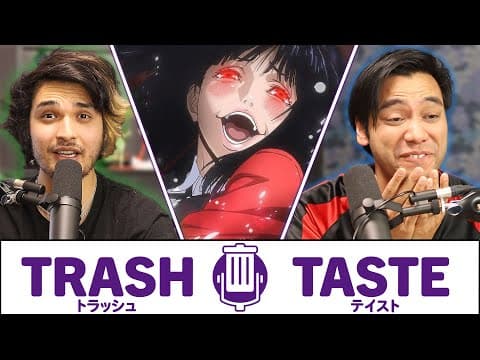
The podcast discusses how anime like One Piece and Attack on Titan reflect political themes and leftist symbolism. It highlights personal experiences and insights from the guests, emphasizing the cultural implications of anime and its role in societal critiques, particularly regarding authority and gender representation.
Transcript
every single Arc quite literally details like leftist politics which I think Oda is Oda is 100 leftist first of all Luffy is a terrorist hello welcome back to another episode of the trash taste podcast uh I'm Joe and I'm with the boys as per usual and uh I have an absolute Giga Chad sitting next to me uh introduce yourself what's up everybody I'm a... Read More
Key Insights
- 🫠 One Piece acts as a political commentary, with arcs showcasing themes of leftist politics and critiques of authority.
- 💖 The representation of women in anime often oscillates between hyper-sexualization and extreme caricature, sparking discussions on gender roles.
- 🤨 Cultural exchange through anime fosters understanding yet raises concerns regarding appropriation versus appreciation.
- 🍉 The juxtaposition of traditional values and modern challenges in Japan creates a complex societal narrative that captivates long-term residents and newcomers alike.
- ♿ The accessibility and popularity of anime continue to shape cultural discourse and promote discussions on societal issues globally.
- 😘 Homelessness in Japan is notably low compared to other developed countries due to a blend of cultural practices and social values.
- 🥰 The podcast serves as a platform for exploring the intersectionality of media consumption and individual political ideologies, emphasizing that art cannot be divorced from its socio-political context.
Install to Summarize YouTube Videos and Get Transcripts
Explore YouTube Video Summarizer or Get YouTube Transcript Extractor
Questions & Answers
Q: What political themes are explored in One Piece?
One Piece frequently addresses themes of freedom, oppression, and resource deprivation. The character Luffy, symbolically seen as a freedom fighter, often battles against corrupt systems and authoritarian figures, which could be interpreted as a critique of real-world politics. The podcast notably highlights the leftist symbolism apparent throughout various arcs, particularly in how Luffy's actions align with revolutionary ideals.
Q: How do the speakers view the portrayal of women in Japanese media?
The speakers comment on the extreme portrayals of women in anime, often depicting them in exaggerated, unrealistic ways. They point out the inconsistency in character design and how often female characters are drawn either as hyper-sexualized figures or entirely oversized. This raises broader questions about gender representation and the cultural implications behind these artistic choices.
Q: Why is the conversation about anime's politics relevant today?
The discussion is relevant as it highlights how media reflects and shapes societal norms, and how viewers interpret these themes in contemporary contexts. Anime's often nuanced portrayal of political ideas and social dynamics resonate with audiences, paralleling real-life issues such as systemic inequality, freedom, and government oppression, making the conversation about these themes increasingly important.
Q: How does the podcast host feel about the convenience of living in Japan?
The host expresses a mix of admiration and confusion about the intricacies of life in Japan. They marvel at the efficiency of the society juxtaposed with its traditional values. Despite the challenges of navigating cultural differences and language barriers, they appreciate the beauty and charm found within everyday experiences, showcasing a clear fascination with Japanese culture.
Q: How do the hosts differentiate between cultural appreciation and appropriation?
The speakers emphasize the importance of understanding cultural contexts and recognizing the value in different practices without reducing them to stereotypes. They maintain that enjoying and learning about cultures, like through anime and other media, should be rooted in respect and a genuine interest, noting that conversations about boundaries and representation are crucial in fostering cultural appreciation.
Q: What do the speakers think about the accessibility of anime and its impact on fans?
They contend that the accessibility of anime, such as through streaming services, has opened up pathways for broader audiences to engage with the medium. This increased exposure allows anime to influence various cultural dialogues, including political themes, while also presenting challenges in representation and the potential dilution of cultural authenticity as different audiences interact with the content.
Summary & Key Takeaways
-
The podcast features a lively debate on how anime like One Piece and Attack on Titan encapsulate political themes, with examples exploring leftist symbolism and societal critiques.
-
Personal anecdotes from guests, including insights into their favorite shows and experiences navigating Japanese culture, add depth and entertainment to the discourse.
-
The discussion also touches on the differences in cultural perceptions and media representation, with humor and personal reflections enhancing the engaging conversation.
Read in Other Languages (beta)
Share This Summary 📚
Summarize YouTube Videos and Get Video Transcripts with 1-Click
Try YouTube Summary with ChatGPT & Claude or YouTube Transcript Generator
Explore More Summaries from Special Guests! 📚





Summarize YouTube Videos and Get Video Transcripts with 1-Click
Try YouTube Summary with ChatGPT & Claude or YouTube Transcript Generator