Can Simulation Theory Truly Explain Our Reality?
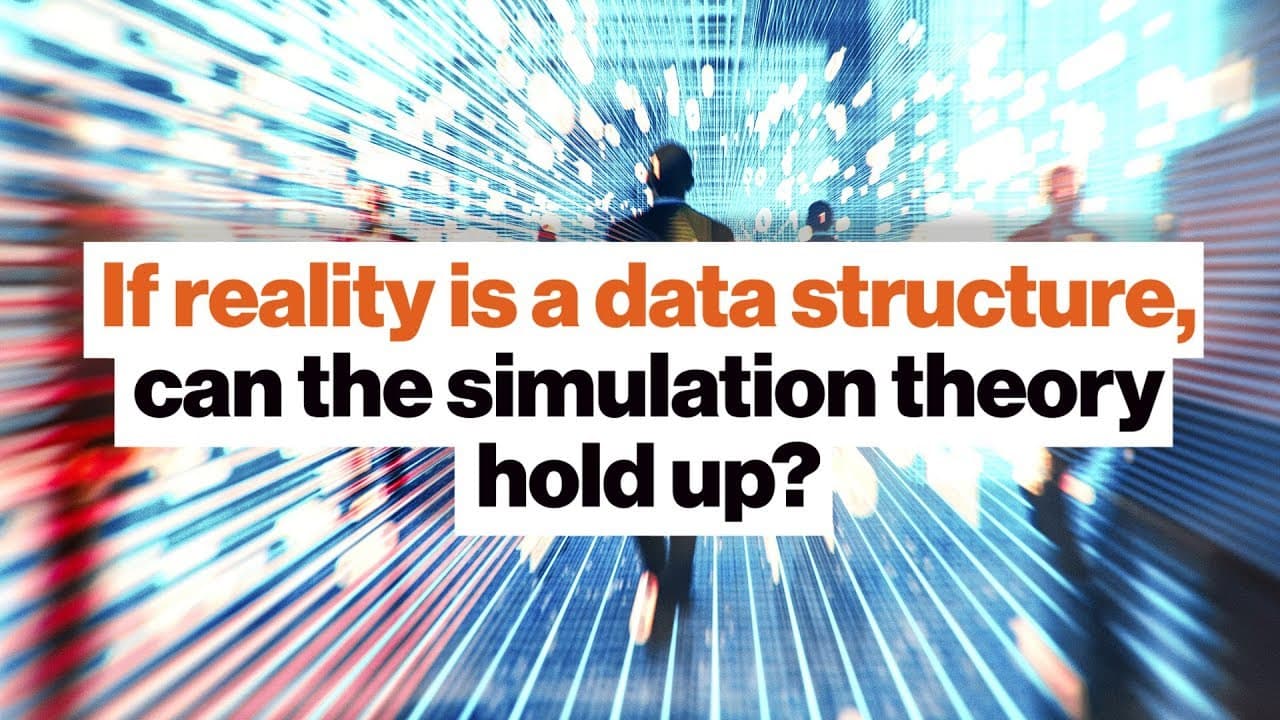
TL;DR
Simulation theory posits that our reality may be a virtual construct, but Donald Hoffman argues that consciousness cannot emerge from unconscious algorithms, challenging the idea that physical reality exists at a foundational level. He asserts that neither space-time nor physical objects correspond to an objective reality, as consciousness cannot be generated from non-conscious components.
Transcript
Everything that we perceive around us -- space and time, the sun and the moon, apples -- are just a virtual reality. We have a headset on. It's very similar, in spirit, to the simulation hypothesis of Nick Bostrom and others that say we're not seeing reality as it is. And there are many things that are similar from my point of view and Nick Bostrom... Read More
Key Insights
- 👾 Reality is perceived as a virtual simulation where space-time and physical objects are data structures, challenging the concept of objective reality.
- 👾 The speaker rejects the idea of a bottom-level physical world in the simulation hypothesis, claiming that space-time and physical objects do not correspond to an objective reality.
- 🧩 Consciousness remains a puzzle, with the speaker negating the possibility of unconscious algorithms producing subjective experiences.
- 🎙️ More videos with Donald Hoffman:
Install to Summarize YouTube Videos and Get Transcripts
Explore YouTube Video Summarizer or Get YouTube Transcript Extractor
Questions & Answers
Q: How does the speaker's viewpoint on reality simulation differ from Nick Bostrom's hypothesis?
The speaker agrees that our reality may be a simulation but rejects the notion of a physical world at the bottom level and questions the origin of consciousness within this virtual reality.
Q: What is the hard problem of consciousness mentioned by the speaker?
The hard problem of consciousness is how subjective experiences like taste and smell can arise from physical brain activity, challenging the idea that unconscious algorithms can generate consciousness.
Q: Why does the speaker refute the possibility of unconscious programs booting up consciousness?
The speaker argues that unconscious systems, like neural networks or computer circuits, cannot give rise to consciousness as consciousness cannot be produced by algorithms without subjective experiences.
Summary & Key Takeaways
-
The speaker discusses the idea that our reality is a simulation, similar to Nick Bostrom's simulation hypothesis.
-
While agreeing that our perception is not the absolute truth, the speaker differs in beliefs about the existence of a physical world at the bottom level.
-
Another significant difference is the speaker's assertion that consciousness cannot be produced by computer programs.
Read in Other Languages (beta)
Share This Summary 📚
Summarize YouTube Videos and Get Video Transcripts with 1-Click
Try YouTube Summary with ChatGPT & Claude or YouTube Transcript Generator
Explore More Summaries from Big Think 📚


Summarize YouTube Videos and Get Video Transcripts with 1-Click
Try YouTube Summary with ChatGPT & Claude or YouTube Transcript Generator