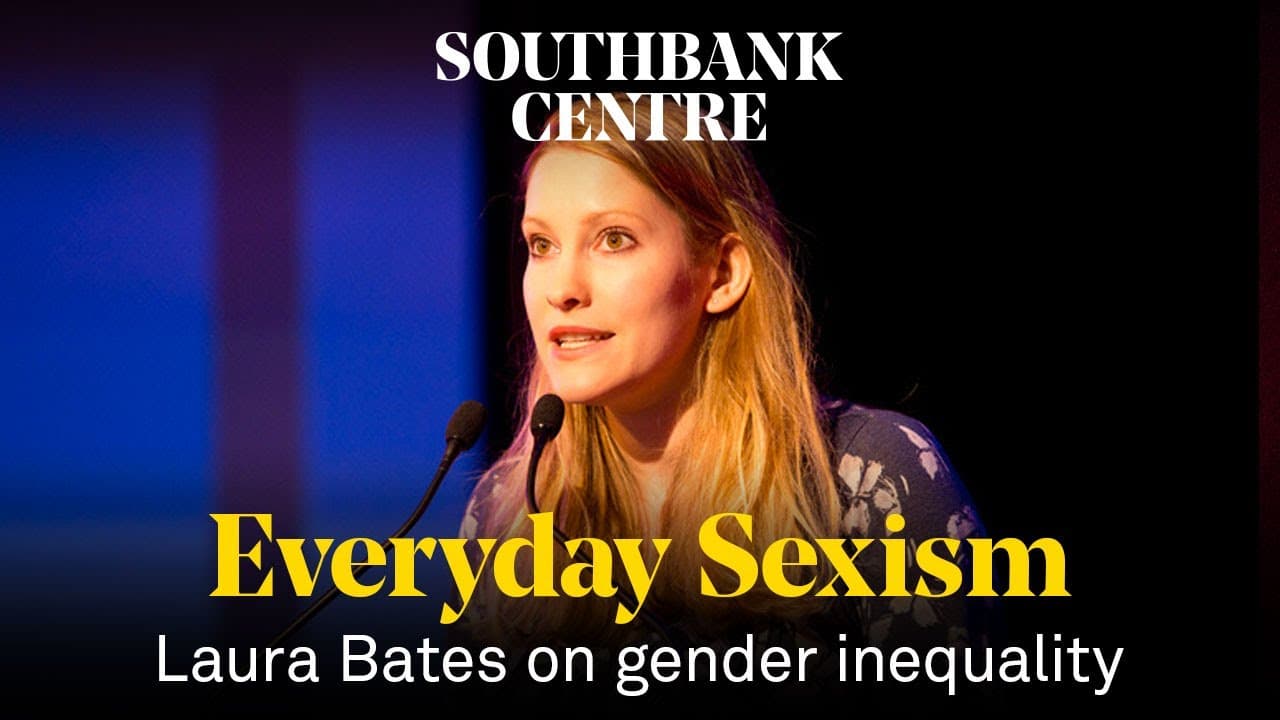
Laura Bates: the Everyday Sexism Project
TL;DR
Laura Bates defines activism as changing people’s minds and shows how the Everyday Sexism Project turns individual accounts of sexism into collective evidence. In just over a year, its website gathered nearly 40,000 stories from women around the world, challenging claims that sexism is no longer a serious problem. Read on to see what inspired the project and how its inclusive online model made hidden experiences visible.
Transcript
it's really wonderful to be here I'm going to speak quite quickly because I've got a lot to say and try and fit it into 15 minutes um speaking this weekend has made me start thinking a lot about what activism is and I think um it's something I didn't come to until very recently and uh before that I really thought that it meant big protests and marc... Read More
Key Insights
- 🤯 Activism is not limited to physical protests but can involve changing minds against societal injustices like sexism.
- 🧔♀️ Stark statistics reveal the ongoing gender inequalities despite claims of women's equality.
- ✊ Online collective actions have the power to challenge societal norms and influence policy changes.
- 🌐 Success in activism against misogyny requires global support and innovative, creative approaches.
- 💋 Facebook's policy changes due to the campaign mark a significant shift towards addressing gender violence and misogyny.
- 🧔♀️ Inclusive activism involves both men and women raising their voices against societal injustices for a more equitable future.
- 🥺 Collective efforts in activism can lead to tangible results, showcasing the power of unity in driving social change.
Install to Summarize YouTube Videos and Get Transcripts
Explore YouTube Video Summarizer or Get YouTube Transcript Extractor
Questions & Answers
Q: What is Laura Bates’s Everyday Sexism Project?
The Everyday Sexism Project began as a simple website where women could record their experiences of sexism. Bates hoped that displaying many accounts together would help people recognize that sexism remained a widespread problem.
Q: Why did Laura Bates start the Everyday Sexism Project?
Bates experienced street harassment, unwanted grabbing, comments about her body, and dismissive responses when she spoke about sexism. She created the project because people told her that women were already equal and that such incidents were not a big deal.
Q: How does Laura Bates define activism?
Bates defines activism as changing somebody’s mind and, ideally, changing more than one person’s mind. She emphasizes that activism is not limited to protests, marches, banners, or other physical action.
Q: How quickly did the Everyday Sexism Project grow?
In just over a year, the project collected nearly 40,000 stories from women around the world. Participants contributed online without leaving their homes or joining physical demonstrations.
Q: Who contributed stories to the Everyday Sexism Project?
Contributors included women of different races, ethnicities, sexual orientations, religions, employment situations, and disability statuses. Bates cites both a seven-year-old wheelchair user and a 74-year-old woman using a mobility scooter who reported nearly identical abuse about women drivers.
Q: What evidence does Laura Bates give about women in UK leadership and law?
Bates says fewer than one in four members of Parliament were women and that the UK ranked joint 57th worldwide for gender equality in Parliament. She also reports that women held four of 38 appeal-justice positions and 17 of 110 High Court judge positions.
Q: What statistics does Laura Bates cite about women in science, engineering, and architecture?
Bates says fewer than one in 10 UK engineers were women, while women comprised 50% of chemistry undergraduates but only 6% reached professor level. She also says one in five UK architects was female and 63% of them reported sexual harassment during their careers.
Q: How does collective action support the Everyday Sexism Project’s activism?
Collective action brings many individual experiences together so they cannot be dismissed as isolated incidents. By gathering nearly 40,000 accounts in one place, the project sought to make the scale and diversity of everyday sexism visible and change public attitudes.
Summary & Key Takeaways
-
Activism isn't just protests; it's changing minds against sexism.
-
Statistics reveal inequalities despite claims of women's equality.
-
Collective action online can combat misogyny and influence policy changes.
Read in Other Languages (beta)
Share This Summary 📚
Summarize YouTube Videos and Get Video Transcripts with 1-Click
Try YouTube Summary with ChatGPT & Claude or YouTube Transcript Generator
Explore More Summaries from Southbank Centre 📚





Summarize YouTube Videos and Get Video Transcripts with 1-Click
Try YouTube Summary with ChatGPT & Claude or YouTube Transcript Generator