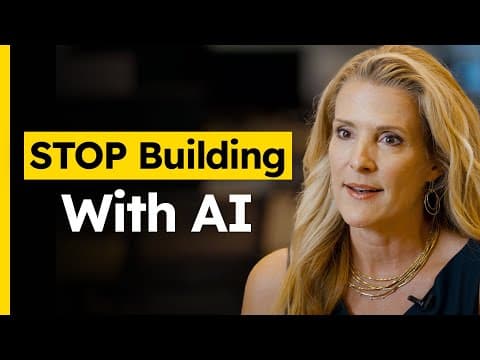
Fix your AI-limited mindset in 12 mins | Caltech, Anima Anandkumar

TL;DR
AI tools improve but human curiosity remains irreplaceable.
Transcript
A lot of these AI tools are getting better, but that only means they can do a certain set of instructions which are seen in data. You still need to provide AI what to do, right? You still need to be able to describe it. And that ability to describe what are the tasks AI should do, what are the programs to be written is still important. I think one ... Read More
Key Insights
- AI tools are advancing, but human input is crucial for defining tasks and interpreting results, ensuring AI remains a tool rather than a replacement.
- Curiosity and the pursuit of challenging problems are key skills that AI cannot replace, emphasizing the importance of critical thinking and questioning.
- Professor Anima Anandkumar encourages students to explore their passions and develop intuitive problem-solving skills, even if they lack formal training.
- AI can significantly accelerate scientific research by developing general tools that apply across various fields, such as neural operators for weather forecasting.
- Despite AI's potential to replace traditional methods, human scientists remain essential for tackling open problems and exploring new scientific frontiers.
- AI can enhance or hinder curiosity depending on its use, highlighting the importance of human agency in guiding AI applications.
- Developing AI tools that understand physical phenomena can reduce the need for costly and time-consuming lab experiments, streamlining scientific progress.
- The future of programming involves collaboration between humans and AI, where skilled programmers who can guide and refine AI outputs will be in high demand.
Install to Summarize YouTube Videos and Get Transcripts
Explore YouTube Video Summarizer or Get YouTube Transcript Extractor
Questions & Answers
Q: What is the main message of Professor Anima Anandkumar's talk?
The main message of Professor Anima Anandkumar's talk is that while AI tools are advancing and becoming more capable, they cannot replace human curiosity and critical thinking. She emphasizes the importance of human input in defining tasks for AI and interpreting its outputs, highlighting the need for curiosity and problem-solving skills in an AI-driven world.
Q: How does Professor Anandkumar encourage her students to approach learning?
Professor Anandkumar encourages her students to approach learning by exploring their passions and developing intuitive problem-solving skills. She emphasizes the importance of curiosity and critical thinking, urging students to question everything and pursue what interests them. Her teaching approach focuses on fostering creativity and practical understanding rather than rote memorization or conforming to traditional methods.
Q: What role does AI play in scientific research according to Anandkumar?
According to Anandkumar, AI plays a significant role in accelerating scientific research by developing general tools that can be applied across various fields. She highlights the potential of AI to solve complex problems more efficiently, such as using neural operators for weather forecasting. However, she also stresses that human scientists remain essential for tackling open problems and exploring new scientific frontiers.
Q: Can AI replace scientists, according to the talk?
According to the talk, AI cannot replace scientists. While AI can assist in solving complex problems and accelerate research, human scientists are crucial for tackling open problems and exploring new scientific frontiers. Anandkumar emphasizes that the definition of a scientist involves addressing unsolved challenges, which AI alone cannot accomplish without human guidance and input.
Q: How does AI impact human curiosity, based on Anandkumar's perspective?
Based on Anandkumar's perspective, AI can both enhance and hinder human curiosity depending on its use. She highlights the importance of human agency in guiding AI applications, suggesting that AI should be used as a tool to drive curiosity and learning. By providing quick answers and facilitating exploration, AI can enhance curiosity, but it requires humans to direct its use effectively.
Q: What is the significance of neural operators in AI research?
Neural operators are significant in AI research because they are designed to understand physical behaviors, enabling more accurate and efficient solutions to complex problems like weather forecasting. Anandkumar's work on neural operators demonstrates AI's potential to replace traditional methods and accelerate scientific research by providing faster and more precise modeling of real-world phenomena.
Q: Why is human input still essential in AI-driven programming?
Human input is still essential in AI-driven programming because humans are needed to define tasks for AI and interpret its outputs. While AI tools can execute instructions seen in data, they require human guidance to ensure that programs are well-written and meet specific requirements. Skilled programmers who can assess and refine AI-generated code will be in high demand, as they can bridge the gap between AI capabilities and practical applications.
Q: What advice does Anandkumar offer to young people regarding AI?
Anandkumar advises young people not to fear AI or worry about being replaced by it. Instead, she encourages them to embrace curiosity and use AI as a tool to enhance their learning and problem-solving skills. By focusing on their passions and developing critical thinking abilities, young people can leverage AI to explore new knowledge and opportunities, remaining relevant in an AI-driven world.
Summary & Key Takeaways
-
Professor Anima Anandkumar discusses the evolution of AI tools and their role in scientific research, emphasizing the need for human curiosity and critical thinking. She shares insights from her career and teaching approach, encouraging students to pursue their passions and develop intuitive problem-solving skills.
-
AI has made significant advancements, enabling faster and more accurate solutions to complex problems like weather forecasting. However, human input remains essential for defining tasks and interpreting results. Anandkumar highlights the importance of developing AI tools that understand physical phenomena to streamline scientific research.
-
Despite AI's potential to replace traditional methods, human scientists are crucial for tackling open problems and exploring new scientific frontiers. Anandkumar emphasizes the importance of human agency in guiding AI applications and encourages young people to use AI as a tool to enhance their curiosity and learning.
Read in Other Languages (beta)
Share This Summary 📚
Summarize YouTube Videos and Get Video Transcripts with 1-Click
Try YouTube Summary with ChatGPT & Claude or YouTube Transcript Generator
Explore More Summaries from EO 📚

Summarize YouTube Videos and Get Video Transcripts with 1-Click
Try YouTube Summary with ChatGPT & Claude or YouTube Transcript Generator