What Was Happening Before the Big Bang?
TL;DR
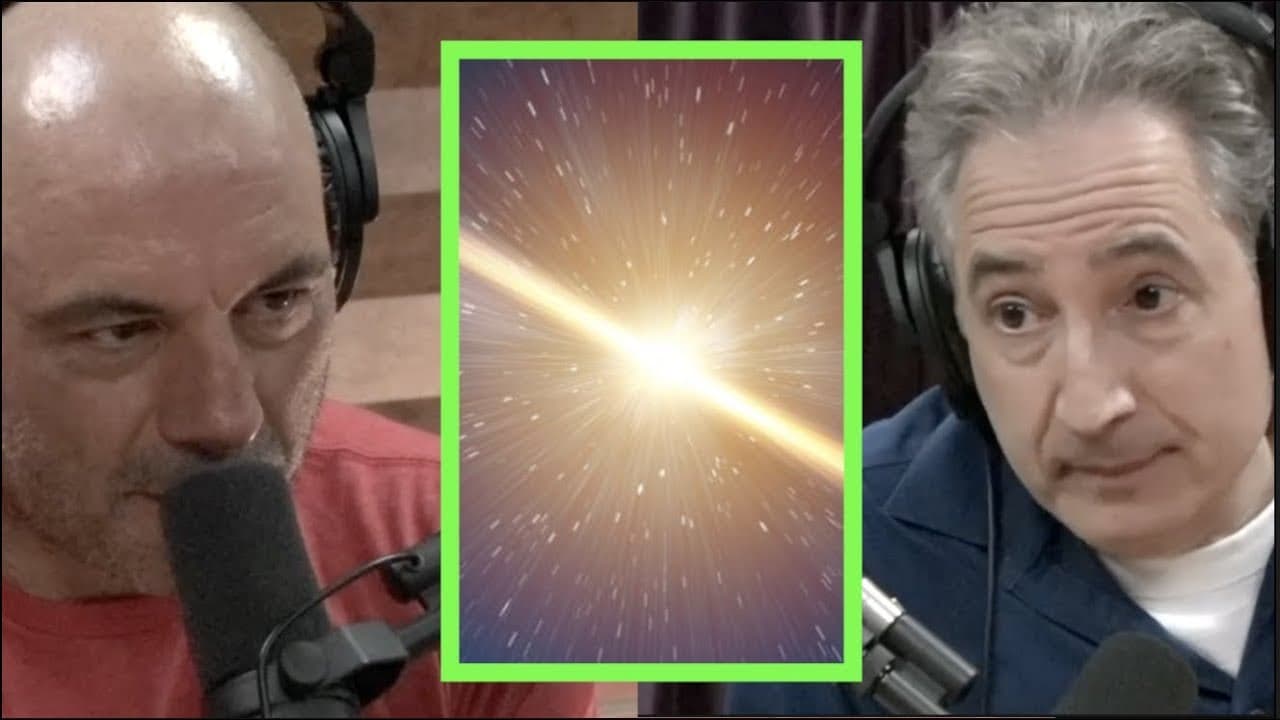
The question of what came before the Big Bang may have no meaning, because the Big Bang could be where time itself began, just as there is no direction further north than the North Pole. Alternatively, our Big Bang may be one of infinitely many events in a far larger, older realm of reality.
Transcript
the Joe Rogan experience here's the thing that I've always wanted to ask someone like you what do you think was happening before the Big Bang yeah it's a it's a it's a deep question and Anna subtle one and there's sort of two ways that I'd like to think about that question one is it could be that the Big Bang was an interesting event but not the fi... Read More
Key Insights
- The Big Bang may not have been the first event in all of reality; it could have sparked only the expansion of our part of space within a grander realm that may extend infinitely far into the past with its own collection of big bangs.
- The question 'what happened before the Big Bang' may not actually mean anything, because the Big Bang could be the place where time itself started, making 'before' as meaningless as going further north than the North Pole.
- Time may be an emergent quality of reality, much like temperature, which is nothing but the average motion of the particles making up an environment and cannot be defined for a single particle.
- Gravity can have two manifestations: the familiar attractive version created by rocky objects like the Earth, and a repulsive version that pushes outward, which Einstein's equations allow when energy is uniformly spread through a region of space.
- The bang of the Big Bang may have been a spark of repulsive gravity operating in a tiny region of space filled with a uniform bath of energy called the inflaton field, pushing everything apart.
- Repulsive gravity is supported by the 1998 observations, which won the 2011 Nobel Prize, showing that distant galaxies are moving away ever more quickly and the expansion of space is accelerating rather than slowing down.
- Dark energy is a uniform bath of energy believed to suffuse space today, like steam filling a Turkish sauna, and its repulsive gravity is the best current explanation for the accelerating expansion of the universe.
- Inflation can grow a region from much less than an atomic diameter to larger than the observable universe in less than a blink of an eye, roughly 10 to the minus 30 or 10 to the minus 35 seconds, showing how powerful repulsive gravity can be.
Install to Summarize YouTube Videos and Get Transcripts
Explore YouTube Video Summarizer or Get YouTube Transcript Extractor
Questions & Answers
Q: What was happening before the Big Bang?
There are two ways to approach this. One possibility is that the Big Bang was not the first event in all of reality but only sparked the expansion of our part of space, sitting within a grander realm that may have existed far longer, experienced its own big bangs, and extended infinitely into the past. The other possibility is that the question does not mean anything, because the Big Bang may be where time itself started, leaving no 'before' to speak of.
Q: Why might the question 'before the Big Bang' have no meaning?
The Big Bang may be the place where time itself began, and you cannot go further back in time than the very origin of time. Hawking illustrated this with the North Pole analogy: as you walk north, people point you further north, but once you reach the North Pole, asking how to go further north is meaningless because that is where north begins. The same spatial metaphor may apply to time at 13.8 billion years ago.
Q: How could time be an emergent quality of reality?
Temperature is nothing but the average motion of the particles making up an environment; fast-moving molecules mean a hot environment, slow ones a cold environment. A single particle cannot be hot or cold because you need a conglomerate of particles to talk about average motion. Time may work the same way: it may only make sense when enough stuff is arranged in the right patterns, so fundamental 'atoms of time' may not yield time as we know it in radically different environments.
Q: What is repulsive gravity and how does it differ from ordinary gravity?
Ordinary gravity is attractive: drop something toward Earth and it moves downward because the Earth and the object pull on each other. Rocky or compact objects like the Earth and Sun always create this attractive variety. However, Einstein's equations also allow gravity to be repulsive, pushing outward instead of pulling inward. This happens not with an isolated rocky object but when energy is uniformly spread through a region of space, which yields repulsive gravity.
Q: What caused the Big Bang according to most physicists?
The idea most physicists and cosmologists currently buy into is that the very early universe, a region smaller than the head of a pin, was filled with a uniform bath of energy called the inflaton field. That uniform energy would have been subject to repulsive gravity, which pushes everything apart and causes it to rush outward. So the bang of the Big Bang may have been a spark of repulsive gravity operating within a tiny region of space.
Q: What evidence supports the idea of repulsive gravity?
The case is circumstantial but strong. Einstein's equations have been tested repeatedly, including the detection of gravitational waves a couple of years ago, ripples in the fabric of space predicted a hundred years earlier. Additionally, observations culminating in 1998, which won the 2011 Nobel Prize, showed that distant galaxies are moving away ever more quickly and the expansion of space is accelerating, best explained by repulsive gravity from a uniform bath of dark energy suffusing space.
Q: Why is the universe's expansion speeding up instead of slowing down?
Since the 1920s everyone assumed the expanding universe would slow over time because gravity pulls things back together, just as an apple thrown upward rises ever slower. But observations in 1998 showed distant galaxies are rushing away faster and faster. The best explanation is repulsive gravity: the universe is believed to be suffused with a uniform bath of energy called dark energy, like steam filling a Turkish sauna, driving the accelerating expansion.
Q: How did a region smaller than a pinhead become the entire cosmos?
One theory holds that the very early universe was a highly chaotic, hot environment with all the fields fluctuating widely. If you wait long enough, on rare occasions the energy happens to flatten out in a region and become uniform, like a patch on boiling water briefly flattening. That uniform energy, plugged into Einstein's equations, causes the region to explosively inflate, growing from less than an atomic diameter to larger than the observable universe in about 10 to the minus 30 to 10 to the minus 35 seconds.
Summary & Key Takeaways
-
There are two ways to think about what happened before the Big Bang. First, it may not have been the first event in reality but only the spark that expanded our part of space within a grander, possibly infinite realm containing many big bangs stretching infinitely into the past.
-
Alternatively, the question itself may be meaningless because the Big Bang could be where time began. Hawking's analogy compares this to the North Pole: just as there is no going further north than the North Pole, there may be no going further back than the origin of time.
-
Time may be emergent like temperature, which is just the average motion of particles. The Big Bang itself may have been caused by repulsive gravity from uniform energy, evidenced by the accelerating expansion of the universe discovered in 1998 and attributed to dark energy.
Read in Other Languages (beta)
Share This Summary 📚
Summarize YouTube Videos and Get Video Transcripts with 1-Click
Try YouTube Summary with ChatGPT & Claude or YouTube Transcript Generator
Explore More Summaries from JRE Clips 📚

Summarize YouTube Videos and Get Video Transcripts with 1-Click
Try YouTube Summary with ChatGPT & Claude or YouTube Transcript Generator