NVIDIA’s New AI: Wow, 8x Better Text To 3D!
TL;DR
NVIDIA’s text-to-3D technique generates detailed 3D geometry from written prompts at 8 times the resolution and twice the speed of the previous DreamFusion method. It can create conventional or imaginative objects, refine outputs through light prompt edits, and personalize scenes using photos of a cat. Read on to understand its capabilities, limitations, planned availability in Picasso and Adobe, and how it has already been surpassed.
Transcript
I am very excited about this paper. So what does it do? Magic, according to the authors! That is, not text to image, where we write a text prompt and get a beautiful photo or painting, but something else: text to 3D. Hmm…now that would be fantastic, I would say it qualifies as magic. We write something and out comes 3D geometry that we ca... Read More
Key Insights
- 💨 The new text-to-3D algorithm offers significantly higher resolution and faster processing than previous techniques.
- 😨 It allows for the creation of imaginative objects, such as a car made out of sushi.
- 🥺 Users can refine the algorithm's results by modifying the prompt, but excessive changes may lead to different scenes.
- ❓ The algorithm has the potential to be widely accessible through NVIDIA's framework and integration into the Adobe suite.
- 👨🔬 Rapid advancements in AI and computer graphics research have already surpassed the capabilities of this text-to-3D technique.
- ⚾ The upcoming episode of Two Minute Papers will introduce a Gaussian splatting-based technique, which surpasses the current algorithm.
Install to Summarize YouTube Videos and Get Transcripts
Explore YouTube Video Summarizer or Get YouTube Transcript Extractor
Questions & Answers
Q: How does NVIDIA’s new text-to-3D technique compare with DreamFusion?
It produces 3D geometry at 8 times higher resolution than the previous method and runs twice as fast. This addresses DreamFusion’s two highlighted problems: coarse results and long processing times.
Q: What does NVIDIA’s text-to-3D AI create from a prompt?
It turns a written prompt into 3D geometry rather than a photo or painting. The resulting geometry can be placed in video games, virtual worlds, teleconferencing experiences, and other applications.
Q: What kinds of 3D objects can the technique generate?
The technique can generate a wide variety of objects, including imaginative combinations. One example is a car made out of sushi.
Q: Can users refine a generated 3D result by editing the prompt?
Yes, users can rewrite parts of the prompt and receive a very similar result. The demonstration works well with a baby bunny, but substantial prompt changes may produce an entirely different scene, so refinement requires a light touch.
Q: Can the AI create a personalized 3D version of a pet?
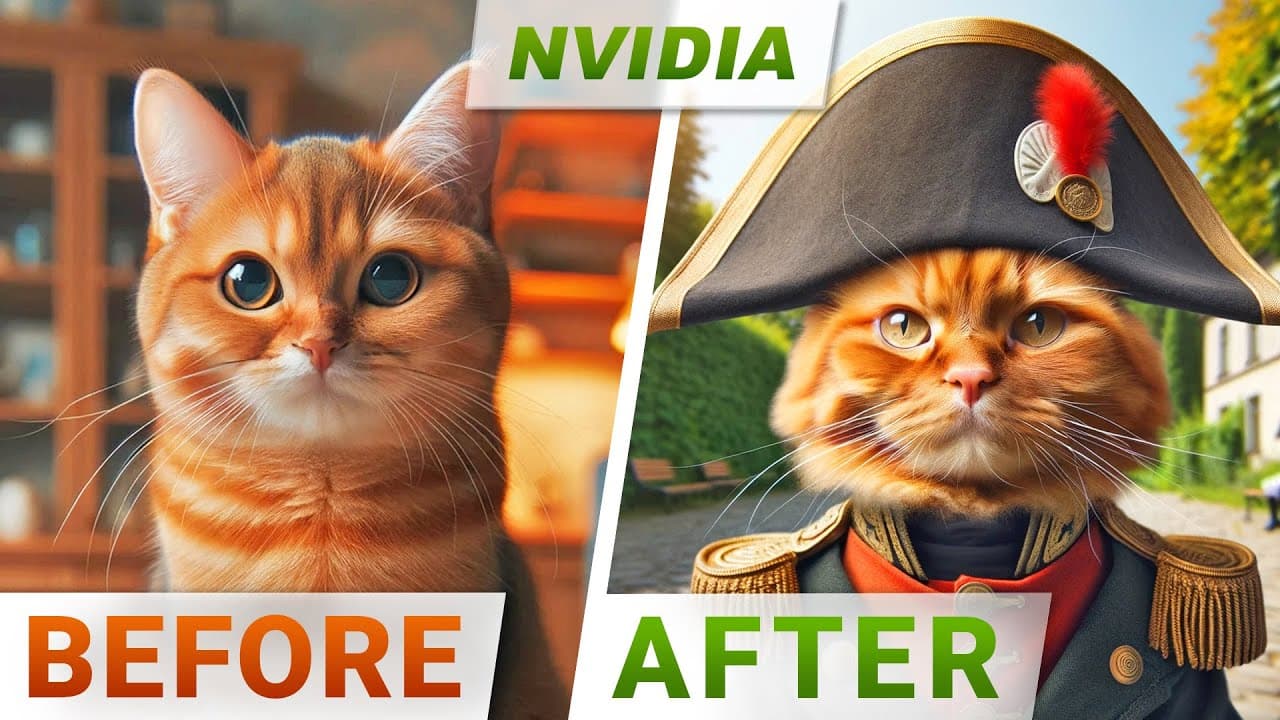
The technique can use a collection of photos of a cat to create a virtual version of that cat. The prompt can place the virtual pet in an imaginative scene, such as riding a bike.
Q: Is the generated geometry ready for triple-A-quality games?
No, the demonstrated geometry does not yet match the level used in high-end triple-A games. The presenter nevertheless emphasizes how rapidly AI and computer graphics research are progressing.
Q: When and where is NVIDIA planning to make the technique available?
NVIDIA is planning to include it in Picasso, its generative AI framework, with wider availability hoped for soon. The presenter also says it will become part of the Adobe suite, while offering no specific release date.
Q: Has this NVIDIA text-to-3D technique already been surpassed?
Yes, the presenter says a better technique already exists. The only detail provided is that it is based on Gaussian splatting and will be covered in the next episode of Two Minute Papers.
Summary & Key Takeaways
-
The new text-to-3D algorithm produces detailed 3D geometry that can be used in video games, virtual worlds, and teleconferencing.
-
It outperforms previous techniques by offering higher resolution, faster processing, and a wider variety of objects, even allowing for imaginative creations like a sushi car.
-
Users can refine results by rewriting parts of the prompt, but excessive modifications may lead to completely different scenes.
Read in Other Languages (beta)
Share This Summary 📚
Summarize YouTube Videos and Get Video Transcripts with 1-Click
Try YouTube Summary with ChatGPT & Claude or YouTube Transcript Generator
Explore More Summaries from Two Minute Papers 📚
Summarize YouTube Videos and Get Video Transcripts with 1-Click
Try YouTube Summary with ChatGPT & Claude or YouTube Transcript Generator