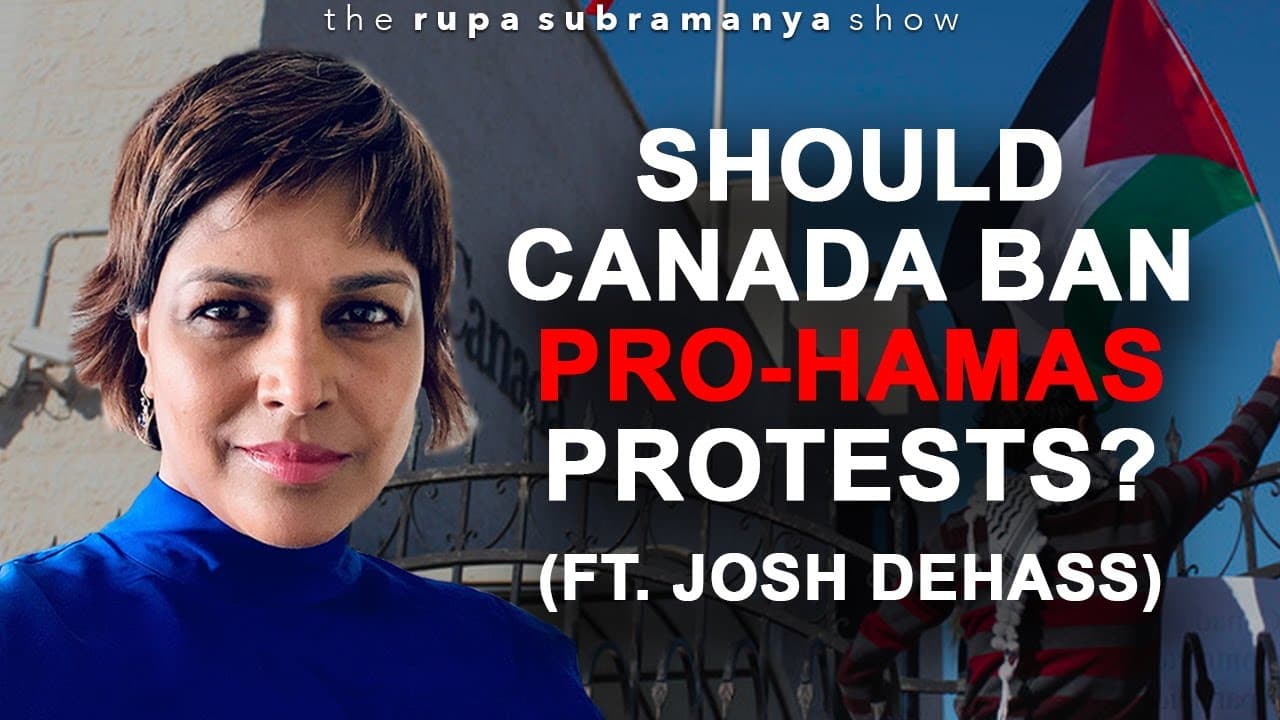
Should Pro-Hamas Protests Be Censored in the West?
TL;DR
Banning pro-Hamas protests in Western nations raises significant free speech concerns. Countries like Germany and France have imposed restrictions citing public safety, igniting debates about the balance between maintaining order and upholding individual rights to expression. The polarization of public opinion on the Israel-Palestine issue deepens the complexity of free speech in democratic societies.
Transcript
welcome to the Rupa submania show everybody I'm your host Rupa submania today we're going to talk about the implications of the highly polarized Global Response to the Israel Palestine crisis and how it relates to debates about freedom of expression we're seeing protests in many major Western cities including right here in Ottawa both in support of... Read More
Key Insights
- 🌐 The Israel-Palestine conflict has ignited significant global protests, reflecting deep divisions in public sentiment across Western nations.
- 🤨 Restrictions on protests raise crucial questions about the preservation of free expression and the balance between public safety and civil liberties.
- 💪 The political landscape in the West is increasingly reactive, as public demonstrations evoke strong societal reactions and government interventions.
- 🥶 Free speech is central to democratic societies, but the definition and limitations of such free expression remain areas of contested debate.
- 😑 Digital legislation, like Bill C-36, risks altering the landscape of free expression in Canada, leading to chilling effects on discourse.
- 🥶 Instances of cancel culture are revealing inconsistencies in the commitment to free speech from various political factions, further complicating public dialogue.
- 😑 Mistreatment of those expressing unpopular or controversial views on campuses challenges the fundamental purpose of diverse academic environments.
Install to Summarize YouTube Videos and Get Transcripts
Explore YouTube Video Summarizer or Get YouTube Transcript Extractor
Questions & Answers
Q: Why are some Western countries banning pro-Palestinian demonstrations?
Countries like Germany and France argue that pro-Palestinian protests may threaten public order and could turn violent. However, such bans raise concerns about governmental overreach and the suppression of peaceful dissent. Critics suggest the bans reflect a troubling trend where dissenting views are silenced, potentially violating fundamental principles of free expression.
Q: How does Canada’s Charter of Rights and Freedoms protect free speech?
The Canadian Charter of Rights and Freedoms guarantees freedom of expression and peaceful assembly. It allows individuals to express opinions, engage in protests, and even distribute materials peacefully, but recognizes reasonable limits may be imposed if justified in a democratic society. This framework intends to preserve democratic discourse while enabling accountability for illegal actions.
Q: How does U.S. free speech protection differ from Canada’s?
In the U.S., the First Amendment provides more robust protection as it states, "Congress shall make no law abridging the freedom of speech," which allows for fewer restrictions. In Canada, limitations can be placed on expression if deemed reasonable, thus leading to a more subjective interpretation of what constitutes protected speech, including laws on hate speech and its enforcement.
Q: What is the potential impact of proposed legislation like Bill C-36?
Bill C-36 has faced criticism for potentially infringing on free speech, as it aims to regulate online communications and introduce penalties for perceived hate speech. The bill could allow anonymous complaints and impose significant fines, stifling open dialogue and creating fear of speaking out on controversial issues, thus undermining democracy.
Q: Why is it problematic to ban rallies or specific symbols, such as the Palestinian flag?
Banning rallies and symbols like the Palestinian flag limits citizens’ ability to express their opinions and could repress dissent. Such actions can create a dangerous precedent where governmental authority curtails the rights of individuals to assemble peacefully and express their views, leading to broader implications for civil liberties and democratic engagement.
Q: How has the notion of "cancel culture" played into these discussions?
Cancel culture emerges as an increasingly controversial issue, where individuals face backlash or punitive actions for expressing unpopular opinions. This concept raises important questions about societal tolerance for divergent views, academic freedom, and how reactions to perceived hate or opposition can stifle necessary conversations in educational settings and beyond.
Q: What conclusions can be drawn from student activism at universities regarding free speech?
Recent student activism on campuses highlights the tension between promoting social justice and maintaining academic freedom. As student protests and declarations in support of the Palestinian cause face backlash, critical discussions arise about the role of universities as spaces for idea exchange and the implications of potential "censorship" by university administrations or donors.
Summary & Key Takeaways
-
The global response to the Israel-Palestine crisis has polarized opinions, leading to protests in various Western cities, including Canada, where opinions diverge sharply between pro-Israel and pro-Palestinian supporters.
-
Governments in Germany and France have banned pro-Palestinian demonstrations, igniting debates about the balance between maintaining public order and protecting individuals' rights to free speech and assembly in democratic societies.
-
The systemic challenges of upholding free expression are heightening as both sides confront censorship, with significant implications for universities and larger societal values, signaling a potential erosion of civil liberties in the name of public safety.
Read in Other Languages (beta)
Share This Summary 📚
Summarize YouTube Videos and Get Video Transcripts with 1-Click
Try YouTube Summary with ChatGPT & Claude or YouTube Transcript Generator
Explore More Summaries from True North 📚
Summarize YouTube Videos and Get Video Transcripts with 1-Click
Try YouTube Summary with ChatGPT & Claude or YouTube Transcript Generator