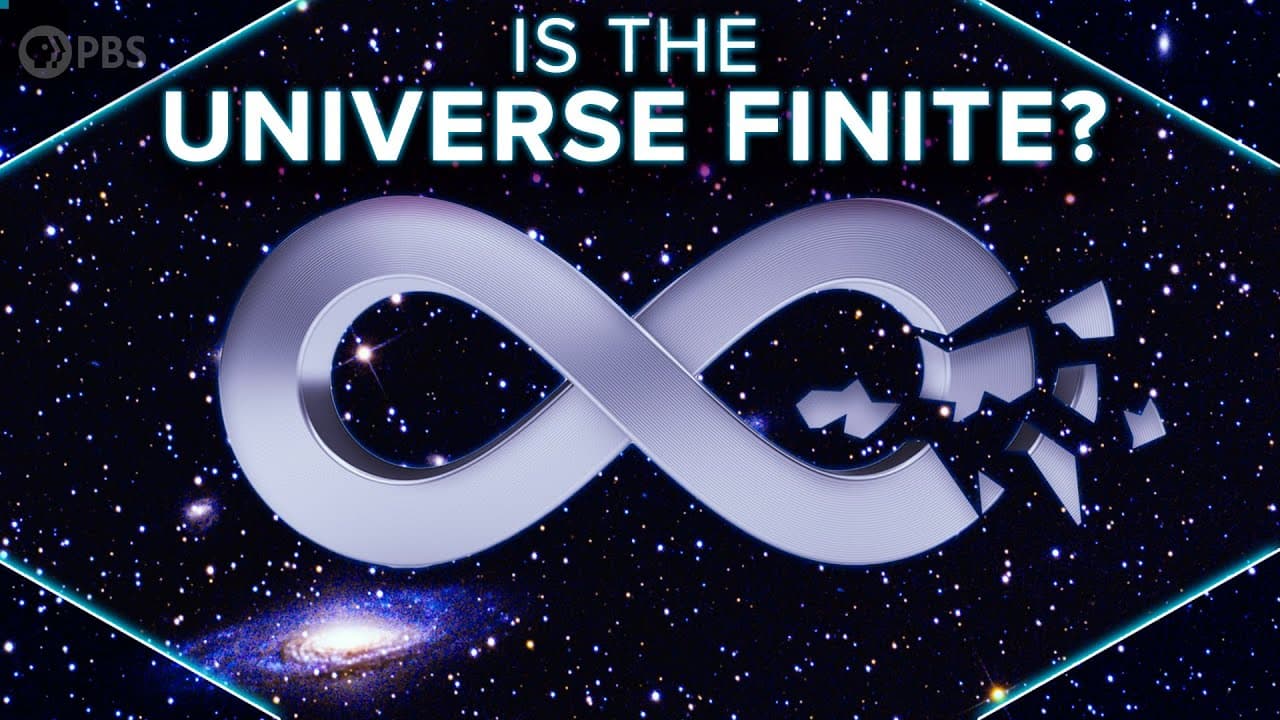
Is the Universe Finite or Infinite?
TL;DR
Recent studies suggest the universe might be finite, challenging the previous belief of an infinite, flat universe. This stems from new evidence in the cosmic microwave background data, indicating positive curvature. However, the findings are debated due to potential data interpretation errors or unknown physics, leaving the question open.
Transcript
Thank you to Brilliant.org for sponsoring PBS Digital Studios. Space is big. You just won't believe how vastly, hugely, mind-bogglingly big it is. Although according to a new paper, it may literally be infinitely smaller than we previously thought. Every time you walk out the door, light from the Big Bang strikes your face, enters your eyes. This i... Read More
Key Insights
- The universe's size may be finite, contradicting the prior belief of an infinite, flat universe.
- Cosmic microwave background (CMB) radiation provides clues about the universe's geometry.
- New analysis of Planck satellite data suggests positive curvature in the universe.
- Positive curvature implies the universe may be a finite hypersphere.
- Gravitational lensing in CMB data indicates higher energy density, suggesting curvature.
- The study's findings have over 99% statistical confidence but are not definitive proof.
- Potential errors in Planck data processing could affect results.
- Future missions may resolve current tensions and confirm or refute these findings.
Install to Summarize YouTube Videos and Get Transcripts
Explore YouTube Video Summarizer or Get YouTube Transcript Extractor
Questions & Answers
Q: How does cosmic microwave background radiation indicate the universe's curvature?
Cosmic microwave background (CMB) radiation, the afterglow of the Big Bang, carries imprinted patterns that reflect the universe's geometry. By analyzing the distribution and size of these patterns, scientists can infer curvature. Recent Planck satellite data suggests more gravitational lensing than expected, indicating higher energy density and potential positive curvature, implying a finite universe.
Q: What is the significance of positive curvature in the universe?
Positive curvature implies the universe is finite and shaped like a hypersphere, where parallel lines would eventually converge. This contrasts with the previously accepted flat universe model, where space extends infinitely. A finite universe challenges current cosmological theories and suggests limits to the universe's size, prompting reevaluation of existing models.
Q: Why is there debate over the universe's curvature findings?
The debate arises from potential errors in data interpretation and the assumptions underlying the models used. While the study claims high statistical confidence, it depends on specific conditions that, if incorrect, could lead to false conclusions. Additionally, discrepancies with other cosmological measurements suggest the need for further investigation to confirm these findings.
Q: What role does gravitational lensing play in understanding the universe's geometry?
Gravitational lensing, caused by massive objects bending light, affects the CMB's power spectrum. The amount of lensing observed can indicate the universe's energy density, influencing its curvature. More lensing than expected suggests higher energy density and positive curvature, implying a finite universe. This role is crucial in interpreting cosmological data and understanding the universe's shape.
Q: How might future missions resolve the current cosmological tensions?
Future missions are expected to provide more precise data and address discrepancies in current measurements. By improving data accuracy and exploring new methodologies, these missions can confirm or refute the findings of finite curvature, potentially uncovering new physics or errors in previous analyses, thereby advancing our understanding of the universe's true nature.
Q: What are the implications of a finite universe for cosmology?
A finite universe would significantly impact cosmological theories, challenging the notion of an infinite, flat universe. It would necessitate revisiting fundamental concepts, such as the universe's expansion and the nature of dark energy. This could lead to new insights into the universe's formation, evolution, and ultimate fate, reshaping our comprehension of cosmological principles.
Q: Could unknown physics explain the universe's geometry discrepancies?
Yes, unknown physics could account for the observed discrepancies. If the universe's expansion rate or dark energy behavior differs from current models, it might explain the unexpected curvature findings. Such hidden physics could provide the missing link needed to reconcile differences between early universe measurements and present-day observations, offering new avenues for exploration.
Q: What challenges do scientists face in determining the universe's geometry?
Scientists face challenges such as data accuracy, model assumptions, and potential unknown variables. The complexity of cosmic phenomena and the limitations of current technology make precise measurements difficult. Additionally, reconciling various data sources and accounting for potential errors or new physics add layers of complexity to understanding the universe's true geometry.
Summary & Key Takeaways
-
Recent analyses of cosmic microwave background data suggest that the universe may have positive curvature, implying it is finite rather than infinite. This challenges the prevailing cosmological model of a flat universe, supported by earlier studies. However, the findings are subject to debate due to potential data inaccuracies or unknown physical phenomena.
-
The Planck satellite data reveals more gravitational lensing than expected, suggesting a higher energy density and possible positive curvature. While the study claims high statistical confidence, the results rely on certain assumptions that, if incorrect, could alter conclusions. The universe’s geometry remains an open question in cosmology.
-
Future investigations and missions are expected to address discrepancies in cosmological data, potentially confirming the finite nature of the universe or uncovering new physics. The study highlights the importance of cautious interpretation in scientific research, acknowledging the complexity and evolving understanding of the cosmos.
Read in Other Languages (beta)
Share This Summary 📚
Summarize YouTube Videos and Get Video Transcripts with 1-Click
Try YouTube Summary with ChatGPT & Claude or YouTube Transcript Generator
Explore More Summaries from PBS Space Time 📚

Summarize YouTube Videos and Get Video Transcripts with 1-Click
Try YouTube Summary with ChatGPT & Claude or YouTube Transcript Generator