Using GPT Agents For Content Creation (Tools & Predictions) ft Nicholas Holland
TL;DR
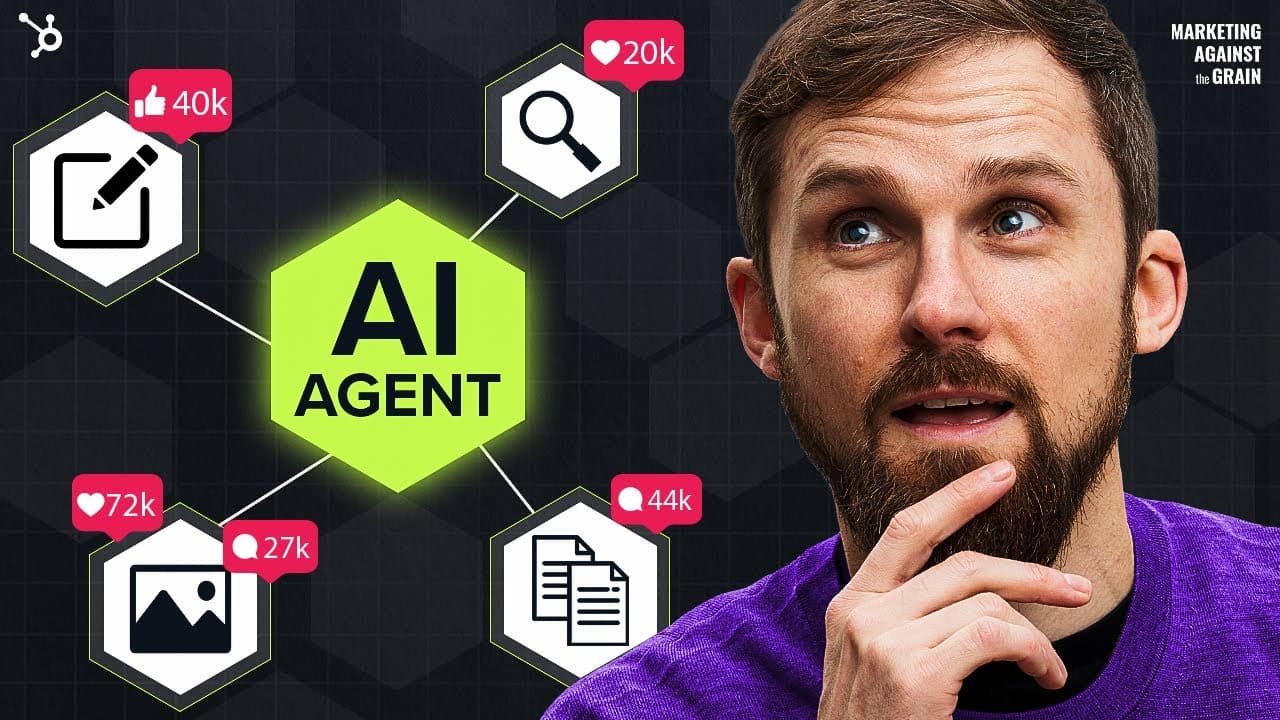
AI agents can support content creation by pursuing defined goals and automating repetitive marketing work while checking in with humans when judgment is needed. Nicholas Holland explains that an agent combines foundational capabilities with a problem of suitable scope, such as publishing, monitoring, and reporting on social media. Read on to understand how goal-oriented agents differ from traditional rule-based software and may reshape marketing work.
Transcript
do you want to know how work will be done in the future the majority of what you're doing today will be done for you by these things called AI agents that is the topic of this show today we are going to get into some of the best examples of AI agents what large companies are releasing over the coming months what is an AI agent and how it is going t... Read More
Key Insights
- AI agents are poised to take over many tasks currently performed by humans, offering automation in various sectors, including marketing and B2B software.
- The concept of AI agents is often misunderstood, with many equating them to science fiction robots, but they are more akin to autonomous software tools performing specific tasks.
- AI agents can be trained to handle complex tasks by being fine-tuned with proprietary data, allowing them to operate autonomously within specific domains.
- The future of work involves AI agents acting as co-pilots, assisting humans by performing menial tasks, thereby allowing people to focus on more strategic and creative activities.
- AI-driven devices, such as the Rabbit AR1, are exploring new user interfaces that eliminate the need for traditional app navigation, relying instead on voice commands and natural language processing.
- The rise of AI agents challenges traditional software purchasing processes, as agents could autonomously evaluate and recommend software based on company needs.
- AI tools have the potential to improve content quality by allowing creators to focus on ideation and editing, while the tools handle repetitive tasks and ensure content is tailored to specific platforms.
- Future AI developments may include personalized AI companions for children, offering interactive and educational experiences tailored to individual preferences and learning styles.
Install to Summarize YouTube Videos and Get Transcripts
Explore YouTube Video Summarizer or Get YouTube Transcript Extractor
Questions & Answers
Q: How can AI agents be used for content creation?
AI agents can handle repetitive content tasks so creators can spend more time on ideation and editing. In social media, an agent could help publish posts, react appropriately, listen and monitor, and report results while asking a human to approve content when needed.
Q: What is an AI agent?
Nicholas Holland describes an agent as an autonomous entity that performs a task in the background. Rather than following only fixed input-output rules, it receives a goal and uses available capabilities and inputs to work toward that goal.
Q: How do AI agents differ from traditional software?
Traditional software is commonly programmed with explicit rules, such as showing a particular screen after a user clicks a navigation item. An AI agent is instead given a goal and can work through relevant inputs without requiring the programmer to specify every input-output path.
Q: Are AI agents fully autonomous?
Autonomy can vary, and the speakers caution that practical agents may still need human checkpoints. For example, a social media agent could prepare posts but ask a person whether they look good before publishing them.
Q: What social media tasks could an AI agent perform?
The episode identifies several tasks within a social media role: staying on brand, publishing posts, reacting to people appropriately, listening and monitoring, and reporting performance. An agent could combine capabilities to pursue these related goals rather than treating each as an isolated rule.
Q: Why does the scope of an AI agent's goal matter?
A narrow goal such as keeping a thermostat at 72 degrees is relatively discrete. A broader goal such as making a house comfortable is more subjective and requires more intuition, illustrating why agents must be matched with problems at the right level of fidelity.
Q: How could AI agents change marketing work?
AI agents could perform many tasks marketers currently handle and operate as co-pilots for repetitive or menial work. This would let people focus more on strategic and creative activities while retaining human review where judgment is important.
Q: What technologies enable more capable AI agents?
The discussion points to large language models and large action models as foundational technologies that let computers do more than follow simple rules. These capabilities allow agents to pursue goals involving more complex and subjective problems.
Summary & Key Takeaways
-
AI agents are becoming integral to the future of work, automating tasks that humans currently perform, especially in marketing and B2B software. These agents are distinct from general AI interfaces like ChatGPT, as they are fine-tuned for specific tasks using proprietary data.
-
The potential of AI agents extends to transforming user interfaces and the way we interact with technology. Devices like the Rabbit AR1 eliminate the need for app navigation, using voice commands to perform tasks, which could redefine how software is used.
-
AI agents also promise to enhance content creation by automating repetitive tasks, allowing creators to focus on ideation and editing. This shift could lead to higher quality content and more effective use of social media and digital marketing strategies.
Read in Other Languages (beta)
Share This Summary 📚
Summarize YouTube Videos and Get Video Transcripts with 1-Click
Try YouTube Summary with ChatGPT & Claude or YouTube Transcript Generator
Explore More Summaries from Marketing Against the Grain 📚

Summarize YouTube Videos and Get Video Transcripts with 1-Click
Try YouTube Summary with ChatGPT & Claude or YouTube Transcript Generator