AI Agents Full Course 2026: How to Master Agentic AI in 2 Hours
TL;DR
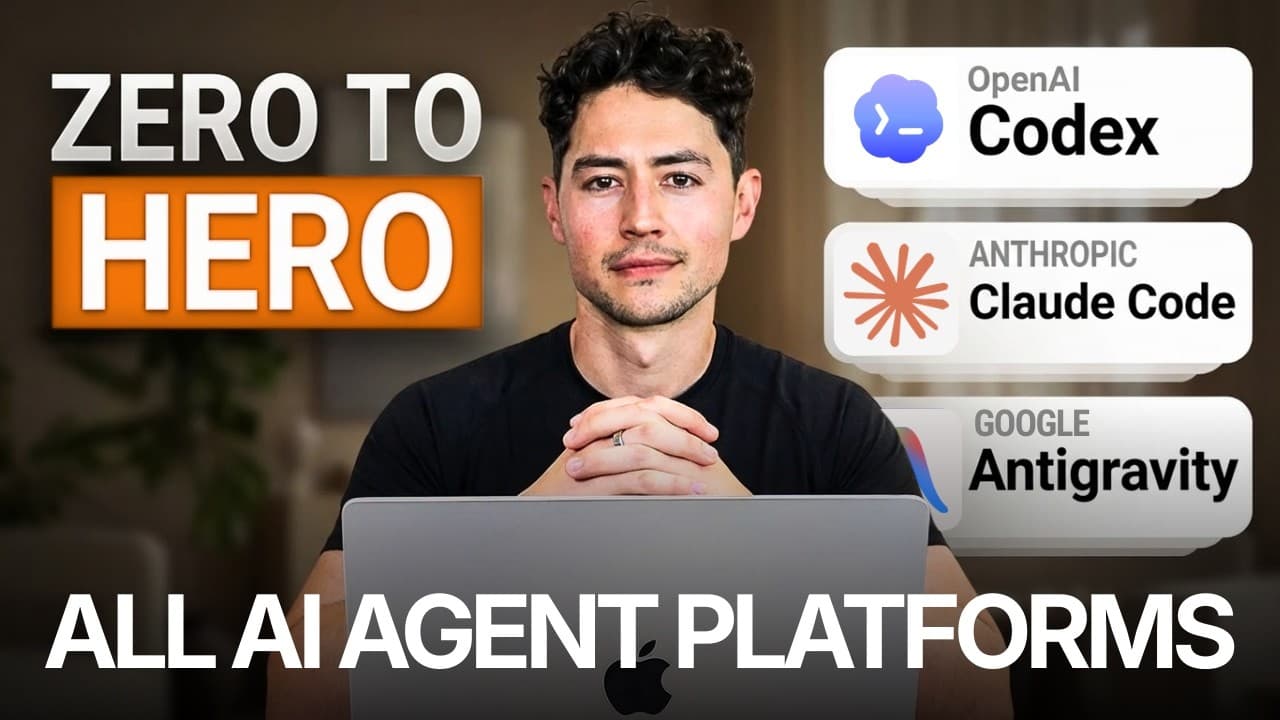
You can learn to use AI agents for personal and business tasks without programming experience by mastering their core loop, prompting techniques, and parallel workflows. The course demonstrates five agents working through separate Chrome browsers and covers Codex, Antigravity, Claude Code, multi-agent orchestration, verification loops, context management, and token pricing. Read on for the course's key concepts and practical applications.
Transcript
Hey, this is the definitive course on AI agents. I currently teach over 2,000 people how to use AI agents in both their personal and business lives and run a business that does over $4 million a year using AI agents. So, you don't need any programming or pre-existing computer experience in order to make this course work for you. I myself don't have... Read More
Key Insights
- AI agents can perform economically valuable tasks by parallelizing work across multiple instances.
- The core AI agent workflow consists of observation, reasoning, and action steps.
- Codex, Claude Code, and Antigravity are the three major AI agent platforms, each with unique strengths.
- Self-modifying prompts allow AI agents to learn from previous interactions, improving future performance.
- Agent skills standardize workflows, ensuring consistent output across different tasks.
- Multi-agent orchestration can leverage the strengths of different AI platforms for complex projects.
- Video-to-action pipelines enable AI agents to learn from video tutorials, expanding their learning capabilities.
- Stochastic multi-agent consensus exploits model randomness to generate diverse and innovative ideas.
Install to Summarize YouTube Videos and Get Transcripts
Explore YouTube Video Summarizer or Get YouTube Transcript Extractor
Questions & Answers
Q: Can you learn AI agents without programming experience?
Yes. The instructor says no programming or pre-existing computer experience is required and notes that he has no formal computer science degree. The course is designed to teach general AI agent concepts rather than require expertise in one platform.
Q: What does the AI Agents Full Course 2026 cover?
It covers the core agent loop, three major agent platforms, foundational prompting techniques, multi-agent orchestration, video-to-action pipelines, agent chat rooms, and verification loops. It also addresses prompt contracts, reverse prompting, context management, output quality, agent optimization, and token pricing.
Q: What is the core AI agent loop?
The core agent loop is a repeated process composed of three major functions. The transcript begins with the observation step, where an agent gathers what it needs before continuing through the loop.
Q: Which AI agent platforms are covered in the course?
The course covers Codex, Antigravity, and Claude Code. The instructor signs up for each platform and discusses what each is currently best or worst at.
Q: What are self-modifying agent instructions?
Self-modifying agent instructions allow an agent to rewrite its own rules. The stated purpose is to minimize the number of errors the agent makes.
Q: How does multi-agent MCP orchestration work?
The course registers Codex, Gemini, and Claude as MCP servers. This setup lets the user manage multiple agents within a single conversation thread.
Q: Why are AI agents useful for parallel work?
AI agents can run multiple instances simultaneously and try multiple approaches repeatedly. The instructor says their speed and ability to parallelize can produce better results even when their accuracy and one-shot performance are lower than a human's.
Q: How are multiple AI agents used for lead outreach?
Claude Code agents open separate Chrome browsers, navigate to website contact fields, and fill in details such as first name, last name, and email address. They add templated outreach that changes according to the recipient, while research and shared chat-room communication coordinate the work.
Summary & Key Takeaways
-
Who: The instructor teaches over 2,000 people to use AI agents in their personal and business lives.
-
Number: The instructor says his AI-agent-powered business does over $4 million a year.
-
Definition: The core agent loop repeatedly moves through three major functions, beginning with observation.
-
Number: The opening demonstration controls five AI agents, each operating its own Chrome browser.
-
Tool: The course covers Codex, Antigravity, and Claude Code as three major AI agent platforms.
-
Definition: Self-modifying agent instructions let an agent rewrite its rules to minimize errors.
-
Tool: Multi-agent MCP orchestration registers Codex, Gemini, and Claude as MCP servers within a single conversation thread.
-
Definition: Video-to-action pipelines teach agents to learn from YouTube videos instead of plain text alone.
-
Definition: Agent chat rooms give agents a centralized place to debate ideas and improve answer quality.
-
Definition: Subagent verification loops have agents review each other's work in real time to catch missed issues.
-
Compare: Agents may be less accurate than humans on a given need, but they can run simultaneous instances and repeatedly try different approaches.
-
Step 1: Learn how agents work under the hood, then combine them through elaborate prompt architecture.
Read in Other Languages (beta)
Share This Summary 📚
Summarize YouTube Videos and Get Video Transcripts with 1-Click
Try YouTube Summary with ChatGPT & Claude or YouTube Transcript Generator
Explore More Summaries from Nick Saraev 📚


Summarize YouTube Videos and Get Video Transcripts with 1-Click
Try YouTube Summary with ChatGPT & Claude or YouTube Transcript Generator