Harvard Food+ Research Symposium: Peter Huybers
TL;DR
Heat waves have a significant impact on corn yields, with higher temperatures above 30 degrees Celsius reducing yields. However, adaptation measures can help mitigate these losses. Furthermore, changes in temperature patterns and the use of sea surface temperature patterns can aid in predicting heat waves.
Transcript
great i'd like to talk about crops and temperature extremes and in particular i'm going to do a more narrow view on that and really talk about corn and heat waves from the perspective of adaptation uh whether or not we should expect heat waves to get hotter and then medium-term forecasting of heat waves this is work that i've done with ethan butler... Read More
Key Insights
- 🥵 Heat waves have a significant impact on corn yields, with higher temperatures reducing yields by up to 20 percent.
- 🥵 Adaptation measures play a vital role in mitigating the yield losses caused by heat waves.
- 😅 Changes in temperature patterns are not consistent across the US, with the corn belt region experiencing substantial cooling during the hottest temperatures of the growing season.
- 🥵 Agricultural intensity and evapotranspiration in the corn belt region contribute to the cooling effect during heat waves.
- 🌊 Sea surface temperature patterns in the mid-latitude Pacific can be used to predict heat waves during the growing season, enabling farmers to make informed decisions about their crops.
- 🌊 40 days prior to a heat wave, the expression of the sea surface temperature pattern can provide odds of a heat wave that are greater than twice the climatology.
Install to Summarize YouTube Videos and Get Transcripts
Explore YouTube Video Summarizer or Get YouTube Transcript Extractor
Questions & Answers
Q: How do heat waves affect corn yields?
Heat waves have a detrimental impact on corn yields, with high temperatures above 30 degrees Celsius reducing yields by up to 20 percent. There is a strong correlation between heat waves and reduced yield, indicating the need to address adaptation measures.
Q: Can adaptation help mitigate yield losses caused by heat waves?
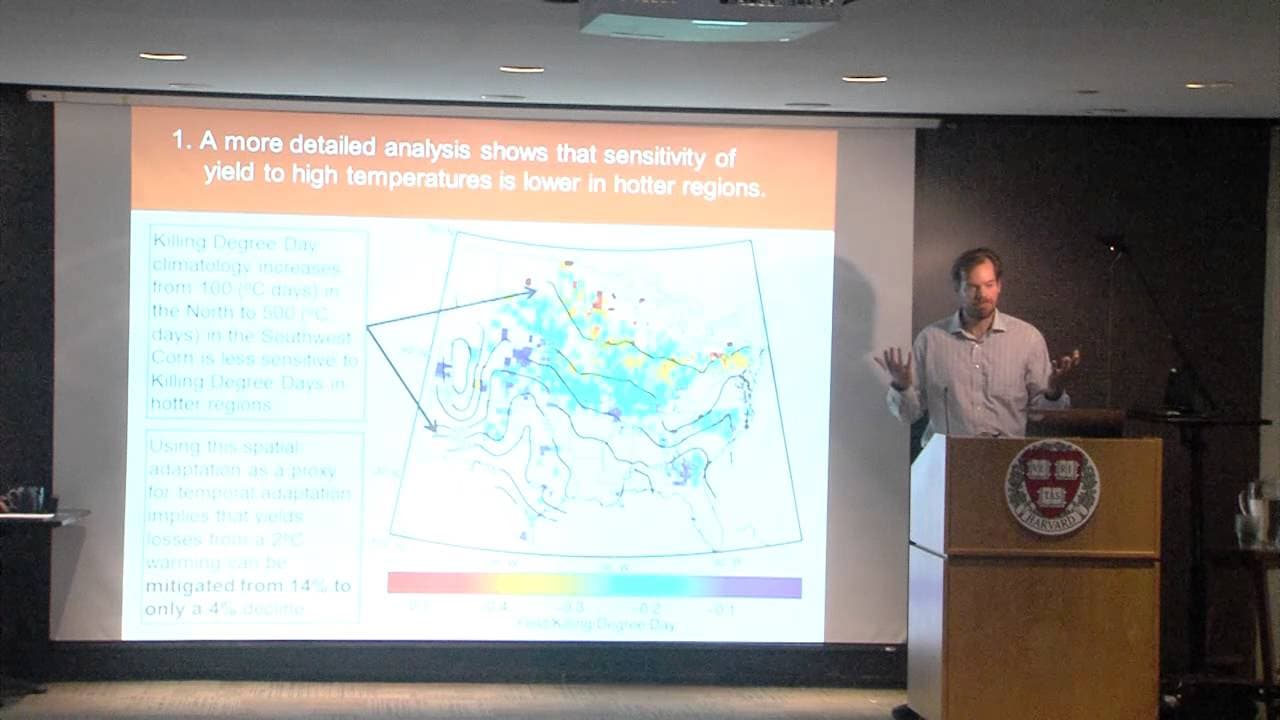
Yes, adaptation measures can help mitigate the yield losses caused by heat waves. By analyzing the sensitivity of corn yield to hot temperatures across different regions, it is possible to estimate the level of adaptation and its impact on reducing yield loss. With adaptation, the decline in yield due to long-term warming can be significantly reduced.
Q: Are changes in temperature patterns consistent across the US?
No, changes in temperature patterns vary across the US. While most areas have seen warming temperatures, the corn belt region has experienced substantial cooling during the hottest temperatures of the growing season. This cooling is attributed to the increased evapotranspiration resulting from greater agricultural intensity.
Q: Can heat waves during the growing season be predicted?
Yes, heat waves during the growing season can be predicted. A sea surface temperature pattern known as a tripole in the mid-latitude Pacific has been found to be associated with heat waves in the eastern US. By monitoring the evolution of this pattern up to 40 days prior, it is possible to predict the likelihood of a heat wave occurring.
Summary & Key Takeaways
-
Corn yields in the US have doubled since 1965, but variability around the trend is significant. Heat waves, indicated by high temperatures above 30 degrees Celsius, explain more than sixty percent of the yield anomalies.
-
Sensitivity of corn yield to hot temperatures varies across regions, with lower sensitivities in the northeast and higher sensitivities in the southwest. This sensitivity can be used as a proxy for the amount of adaptation and its impact on yield loss.
-
While temperatures have been warming over most of the US, the corn belt region has experienced substantial cooling during the hottest temperatures of the growing season. This cooling is attributed to increased evapotranspiration due to greater agricultural intensity in the corn belt.
Read in Other Languages (beta)
Share This Summary 📚
Summarize YouTube Videos and Get Video Transcripts with 1-Click
Try YouTube Summary with ChatGPT & Claude or YouTube Transcript Generator
Explore More Summaries from Harvard University 📚





Summarize YouTube Videos and Get Video Transcripts with 1-Click
Try YouTube Summary with ChatGPT & Claude or YouTube Transcript Generator