How Can AI Tools Improve Teaching in the Classroom?
TL;DR
AI tools like ChatGPT can significantly enhance teaching by streamlining tasks such as drafting professional emails, generating exam questions, and creating grading rubrics. Instead of fearing job displacement, educators can leverage AI to simplify their workloads and improve student engagement, ensuring their roles remain essential in the classroom.
Transcript
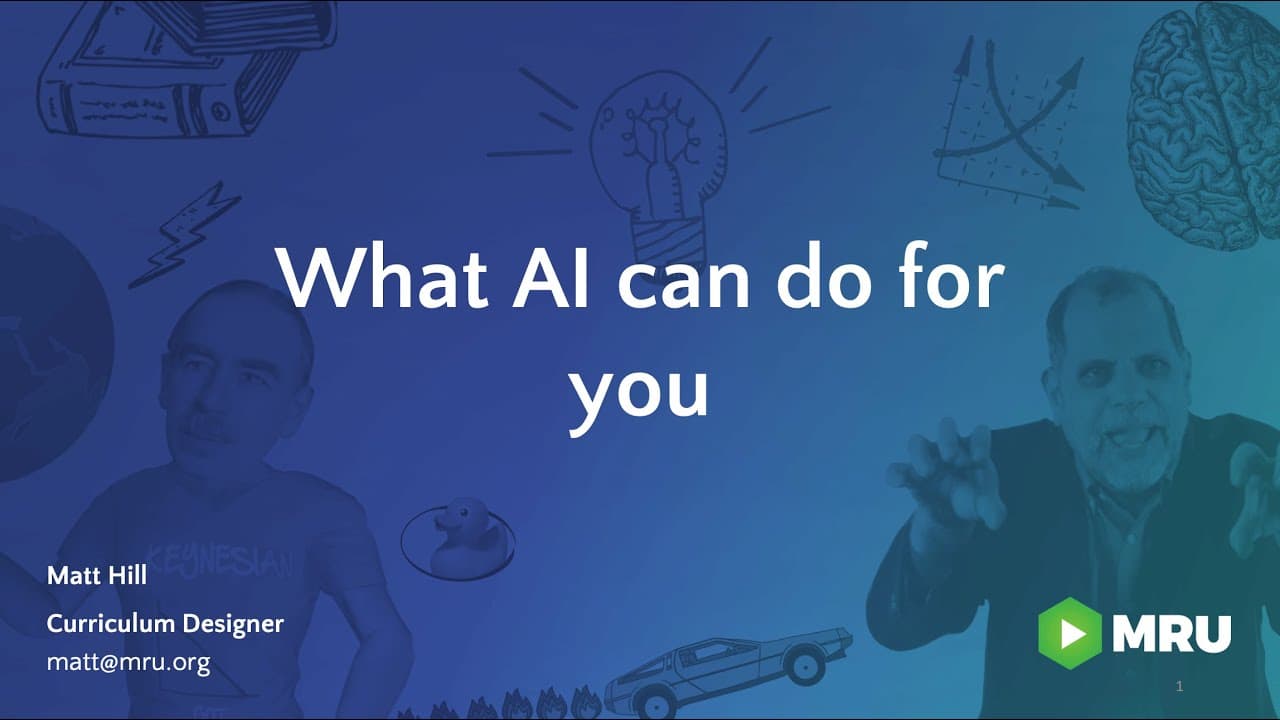
so this is me if you don't know me if you haven't been in in a mru uh training session before so uh uh I work uh for mru mru is a nonprofit um a university Affiliated nonprofit that does free econ resources we have all sorts of econ resources usually these training sessions are sort of showcasing some of those resources how to use them this one's a... Read More
Key Insights
- AI tools such as ChatGPT can be used to perfect emails, making them sound more professional and appropriately toned.
- Teachers can utilize AI for generating exam questions, which provides a starting point for creating assessments.
- AI can assist in creating rubrics and grading student essays, providing feedback and saving time.
- Test preparation can be enhanced by using AI to generate practice questions and review materials for students.
- AI image generators like MidJourney can create visuals for educational materials, enhancing student engagement.
- Despite fears of job displacement, AI is unlikely to replace teachers due to the need for human interaction in education.
- AI tools can help simplify complex concepts for students by rewriting them in more relatable or understandable formats.
- Teachers are encouraged to integrate AI into their teaching practices to make their workloads more manageable.
Install to Summarize YouTube Videos and Get Transcripts
Explore YouTube Video Summarizer or Get YouTube Transcript Extractor
Questions & Answers
Q: How can AI tools like ChatGPT help teachers with email drafting?
AI tools such as ChatGPT can assist teachers in drafting emails by ensuring the tone is professional and appropriate. Teachers can input their emails into ChatGPT and request it to refine the language, making it sound more polished and courteous. This feature is particularly useful for communications with higher-ups or when a specific tone is required.
Q: In what ways can AI assist in creating exam questions?
AI can generate exam questions by providing a starting point for educators. Teachers can ask AI to create multiple-choice questions or other types of assessments on specific topics, such as elasticity in economics. This helps in brainstorming and saves time, though educators should review and modify the questions to ensure accuracy and relevance.
Q: How can AI be used in grading and creating rubrics?
AI can help create rubrics by generating a structured grading guide based on specific criteria provided by the teacher. Once a rubric is established, AI can also aid in grading by evaluating student essays according to the rubric. This process can provide teachers with initial feedback and save time, though final grading should still involve teacher oversight.
Q: What role does AI play in test preparation for students?
AI can enhance test preparation by generating practice questions and review materials. Students can input lecture transcripts or textbook chapters into AI tools, which can then create review questions to aid in studying. This approach helps students engage with the material actively and allows them to test their understanding before exams.
Q: How can AI-generated images be used in education?
AI-generated images can be used to create visuals for educational materials, making lessons more engaging and accessible. Teachers can use AI tools like MidJourney to generate images that illustrate complex concepts or historical events, enhancing the visual appeal of presentations and interactive learning modules.
Q: Will AI replace teachers in the future?
AI is unlikely to replace teachers due to the essential human interaction and mentorship roles that educators play. While AI can automate certain tasks, the need for personal connection, guidance, and the ability to adapt to students' individual needs ensures that teachers will remain an integral part of the educational process.
Q: How can AI simplify complex concepts for students?
AI can simplify complex concepts by rewriting them in more relatable or understandable formats. Teachers can ask AI to explain topics in the style of a popular figure or in simpler language, making it easier for students to grasp difficult subjects. This approach can make learning more enjoyable and accessible.
Q: What are some small ways teachers can integrate AI into their daily tasks?
Teachers can integrate AI into their daily tasks by using it for drafting emails, generating exam questions, creating rubrics, and preparing test materials. These small, manageable uses of AI can save time and reduce the workload, allowing teachers to focus more on direct student interaction and personalized teaching.
Summary & Key Takeaways
-
Professor Matt discusses the integration of AI tools like ChatGPT in educational settings, emphasizing their utility in enhancing teaching tasks such as email drafting and exam question generation.
-
The webinar covers how AI can assist teachers in creating rubrics, grading student work, and preparing students for tests, ultimately making educators' lives easier and more efficient.
-
Despite concerns about job displacement, AI is presented as a tool to complement teachers' work rather than replace it, with a focus on small, manageable ways to incorporate AI into daily tasks.
Read in Other Languages (beta)
Share This Summary 📚
Summarize YouTube Videos and Get Video Transcripts with 1-Click
Try YouTube Summary with ChatGPT & Claude or YouTube Transcript Generator
Explore More Summaries from Marginal Revolution University 📚

Summarize YouTube Videos and Get Video Transcripts with 1-Click
Try YouTube Summary with ChatGPT & Claude or YouTube Transcript Generator