Scientist Exposes Why Your Reality is All a Lie | Donald Hoffman on Conversations with Tom
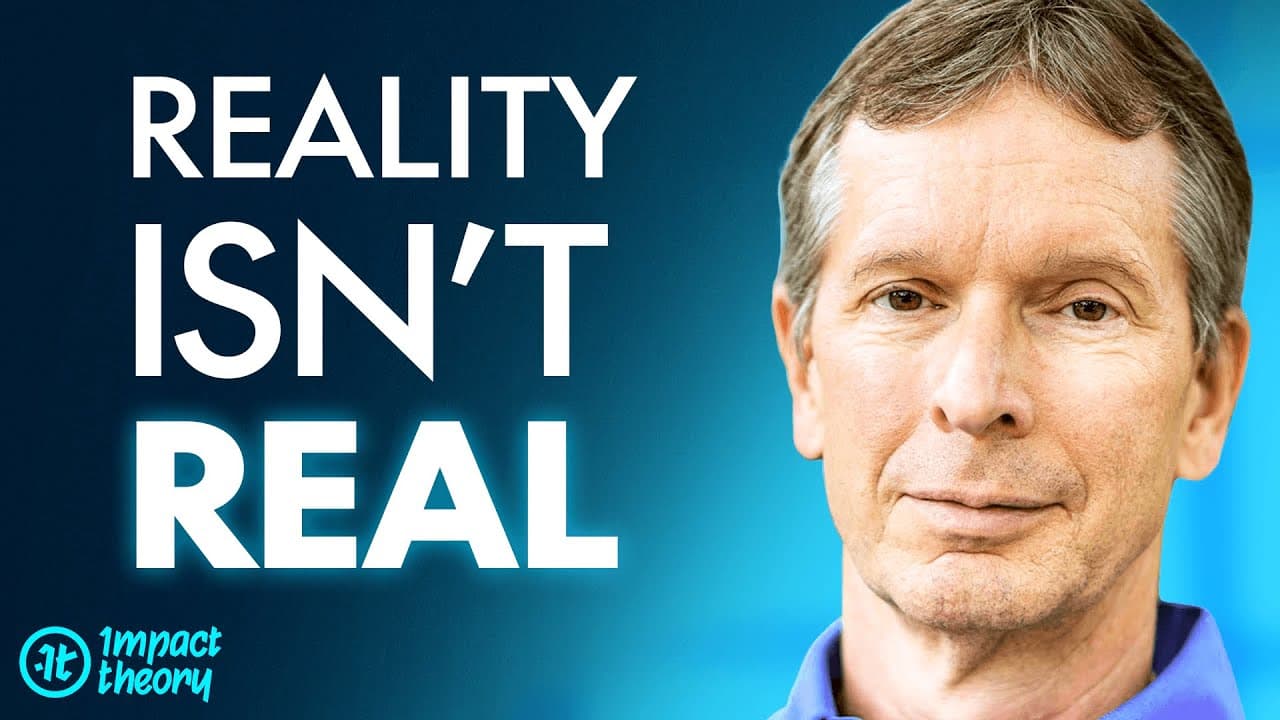
TL;DR
Consciousness is the fundamental aspect of reality, and space-time is merely a virtual reality headset through which conscious beings explore endless possibilities.
Transcript
hey everybody welcome to another episode of conversations with tom i am here for a second round with donald hoffman welcome back thank you very much tom it's great to be here dude i am so excited to spend more time with you i was listening to the first interview that we did which by the way everybody you're going to want to watch that one um to rea... Read More
Key Insights
- 🔨 Consciousness is fundamental, and physical objects are part of a virtual reality visualization tool.
- 👾 Our current perception and understanding of reality are limited by the virtual reality headset called space-time.
- 👶 Consciousness constantly evolves and explores new possibilities, driven by the inexhaustible potential for mathematical and conscious experiences.
Install to Summarize YouTube Videos and Get Transcripts
Explore YouTube Video Summarizer or Get YouTube Transcript Extractor
Questions & Answers
Q: How does Donald Hoffman's view on consciousness differ from the mainstream understanding?
According to Hoffman, most scientists assume that physical objects, like the brain, cause consciousness. However, he argues that our best scientific theories indicate consciousness is fundamental, and physical objects are part of a virtual reality visualization tool.
Q: How does Hoffman's theory explain the limitations of our current perception and understanding of reality?
Hoffman suggests that our current perceptual limitations stem from the virtual reality headset called space-time. Our experiences within space-time are a simplified and manipulated version of the deeper reality consciousness explores.
Q: Can consciousness be replicated in AI or robots?
Hoffman argues that consciousness cannot be replicated in the traditional physicalist framework. However, he suggests that consciousness can exist in a different way, unrelated to physical objects, and exploring this possibility can lead to a new understanding of AI and robots.
Q: How does Girdle's incompleteness theorem support Hoffman's views on consciousness and reality?
Girdle's incompleteness theorem, which states that there are truths that cannot be proven within a specific axiomatic system, aligns with Hoffman's argument that consciousness will never arrive at a final theory of everything. The exploration of new conscious experiences is infinite, just as the exploration of mathematical structure is unbounded.
Summary & Key Takeaways
-
Donald Hoffman challenges the prevailing notion that physical objects cause consciousness and argues that our best scientific theories suggest space-time is not fundamental reality.
-
Hoffman proposes that consciousness is fundamental, and space-time is a virtual reality headset that allows conscious beings to explore different experiences.
-
He suggests that consciousness constantly evolves and explores new possibilities, driven by the endless potential for mathematical and conscious experiences.
-
Girdle's incompleteness theorem supports the idea that consciousness will never arrive at a final theory of everything, as the exploration of new possibilities is never-ending.
Read in Other Languages (beta)
Share This Summary 📚
Summarize YouTube Videos and Get Video Transcripts with 1-Click
Try YouTube Summary with ChatGPT & Claude or YouTube Transcript Generator
Explore More Summaries from Conversations with Tom 📚




Summarize YouTube Videos and Get Video Transcripts with 1-Click
Try YouTube Summary with ChatGPT & Claude or YouTube Transcript Generator