What Are the 4 Stages of Jung's Magnum Opus?
TL;DR
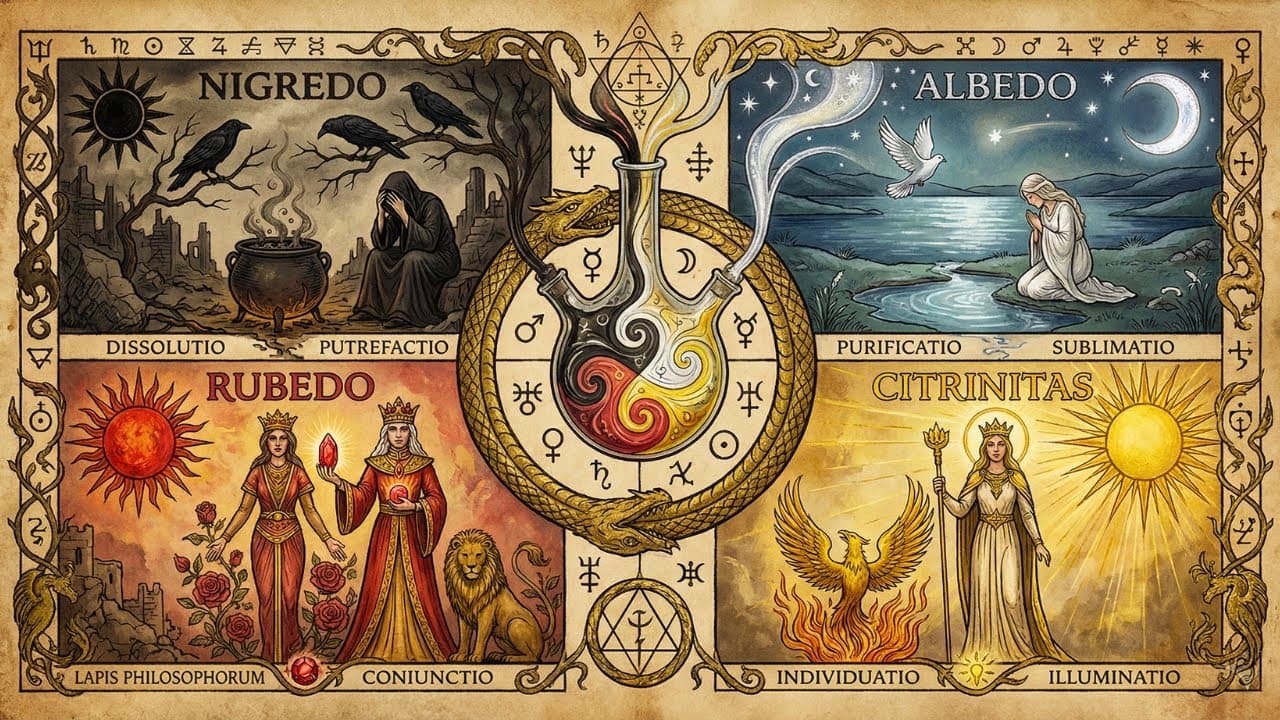
Carl Jung read medieval alchemy as an encoded map of psychological transformation, not chemistry. The Magnum Opus divides into four stages — Nigredo, Albedo, Citrinitas, and Rubedo — describing the dissolution, purification, and reconstitution of the psyche. The base matter is not lead but the unrealized self, transformed through the individuation process toward wholeness.
Transcript
There exists within the western esoteric tradition a peculiar preoccupation with transformation. Not merely the transformation of base metals into gold, but something far more elusive and infinitely more valuable. The alchemists of medieval and Renaissance Europe did not labor in their laboratories solely for material wealth. Their true opus concea... Read More
Key Insights
- The alchemists' true work, hidden beneath cryptic symbolism, was the transformation of the human soul rather than turning base metals into gold. Jung recognized their texts as sophisticated psychological documents rather than the ravings of deluded protochemists.
- The prima materia the alchemists began with was, for Jung, not lead or mercury but the unrealized self — the undifferentiated psyche in its raw, unconscious state that must be dissolved and reconstituted.
- The psyche possesses an inherent drive toward wholeness that Jung called the individuation process. Unlike Freud, Jung saw the unconscious as a creative, purposive force actively producing psychological development, not just a repository of repressed content.
- Archetypes are inherited possibilities for ideas, not inherited ideas themselves. They are structural elements of the collective unconscious that shape how we experience fundamental situations like birth, death, and transformation.
- Nigredo, the blackening, is the initial stage of dissolution corresponding to the encounter with the shadow — the rejected, repressed aspects of ourselves we project onto others, including suppressed positive potentials.
- The Nigredo phase is typically precipitated by a crisis: the collapse of a belief system, the failure of a life strategy, or the eruption of symptoms like depression that can no longer be ignored, loosening the ego's control.
- Transformation requires descent before ascent, dissolution before coagulation, and death before rebirth. The ego must undergo a symbolic death — the death of identification with limited, partial conceptions of oneself.
- Albedo, the whitening, represents purification and the emergence of clarity through washing, distillation, and separation. Symbolized by the moon, it begins the differentiation of ego from unconscious content and develops psychological mindedness.
Install to Summarize YouTube Videos and Get Transcripts
Explore YouTube Video Summarizer or Get YouTube Transcript Extractor
Questions & Answers
Q: What is the Magnum Opus in Jungian alchemy?
The Magnum Opus, or great work, represents the entirety of the alchemical process, traditionally divided into four major stages: Nigredo, Albedo, Citrinitas, and Rubedo. This sequence described the systematic dissolution, purification, and reconstitution of the prima materia. Jung reinterpreted it as psychological rather than chemical: the transformation of the unrealized self, the undifferentiated psyche in its raw unconscious state, toward integration, consciousness, and wholeness.
Q: How did Jung reinterpret alchemy?
Jung recognized that alchemical texts were not the ravings of deluded protochemists but sophisticated psychological documents. He saw the alchemist's laboratory as an external representation of an internal process, with vessels, furnaces, and chemical operations serving as projections of intrapsychic dynamics. Dissolving lead described dissolving calcified ego structures, and the conjunction of sun and moon described the union of conscious and unconscious within the psyche.
Q: What are the four stages of the alchemical Magnum Opus?
The four stages are Nigredo (the blackening), Albedo (the whitening), Citrinitas (the yellowing), and Rubedo (the reddening). According to the description, Nigredo is the descent into darkness and encounter with the shadow, Albedo is purification and emerging clarity, Citrinitas is the dawn of individual purpose and authentic vocation, and Rubedo is the completion of the great work, full individuation, and the realization of the Self.
Q: What is the Nigredo stage in Jungian psychology?
Nigredo, the blackening, represents the initial stage of dissolution and decomposition. In alchemical imagery it is putrefaction, depicted through skeletons, graves, crows, and blackened matter. Psychologically it corresponds to the encounter with the shadow — the aspects of ourselves we have rejected, repressed, or never acknowledged. It is typically precipitated by a crisis such as the collapse of a belief system or the failure of a life strategy.
Q: Why does transformation require destruction first?
The doctrine central to both alchemy and Jungian psychology is that transformation requires descent before ascent, dissolution before coagulation, and death before rebirth. The ego, the center of conscious identity, must undergo a kind of death — not literal, but the death of identification with limited, partial conceptions of oneself. The ego discovers it is not the whole of the psyche but merely a component within a larger system, which is simultaneously humbling and liberating.
Q: What is the shadow in Jung's model?
The shadow comprises those aspects of ourselves we have rejected, repressed, or never consciously acknowledged — the qualities we find unacceptable and consequently project onto others. It contains not only negative qualities but also positive potentials that were suppressed during socialization because they conflicted with the persona, the social mask we construct to navigate the world. Confronting the shadow is the psychological work of the Nigredo phase.
Q: Why do many people never move beyond the Nigredo stage?
Jung noted that many people experience the dissolution of Nigredo but lack the stamina or guidance to continue through to integration. The temptation is to seek quick restoration of the previous equilibrium — a new relationship, throwing oneself into work, or medicating away the discomfort. Those who cannot endure it remain in a state of chronic depression or cynicism, unable to reconstitute themselves. The work requires philosophical patience, sitting with chaos without premature resolution.
Q: What happens during the Albedo stage?
Albedo, the whitening, represents purification and the initial emergence of clarity. Alchemically it involves washing, distillation, and separation — extracting pure essence from corrupted matter — with the moon as its dominant symbol representing reflected light. Psychologically it begins differentiation and objectification: the shadow material that erupted during Nigredo is examined, sorted, and partially integrated as the individual develops psychological mindedness, the capacity to observe oneself and distinguish ego from unconscious content.
Summary & Key Takeaways
-
When Jung encountered alchemical texts during his confrontation with the unconscious after breaking with Freud, he found a language capable of articulating his own inner transformation. He saw alchemy's bizarre symbolism as consistent across authors because it emerged from the collective unconscious itself.
-
The Magnum Opus divides into four stages — Nigredo, Albedo, Citrinitas, and Rubedo — describing the systematic dissolution, purification, and reconstitution of the psyche. These were psychological transformations every person seeking genuine self-knowledge must navigate, demanding the surrender of illusions and identity.
-
Nigredo, the blackening, brings dissolution and the encounter with the shadow, often precipitated by crisis and depression. Albedo, the whitening, follows with purification and clarity, symbolized by the moon, as shadow material is examined, sorted, and partially integrated into conscious awareness.
Read in Other Languages (beta)
Share This Summary 📚
Summarize YouTube Videos and Get Video Transcripts with 1-Click
Try YouTube Summary with ChatGPT & Claude or YouTube Transcript Generator
Explore More Summaries from The Hermetic School 📚
Summarize YouTube Videos and Get Video Transcripts with 1-Click
Try YouTube Summary with ChatGPT & Claude or YouTube Transcript Generator