How Has ChatGPT Changed Work, School, and AI?
TL;DR
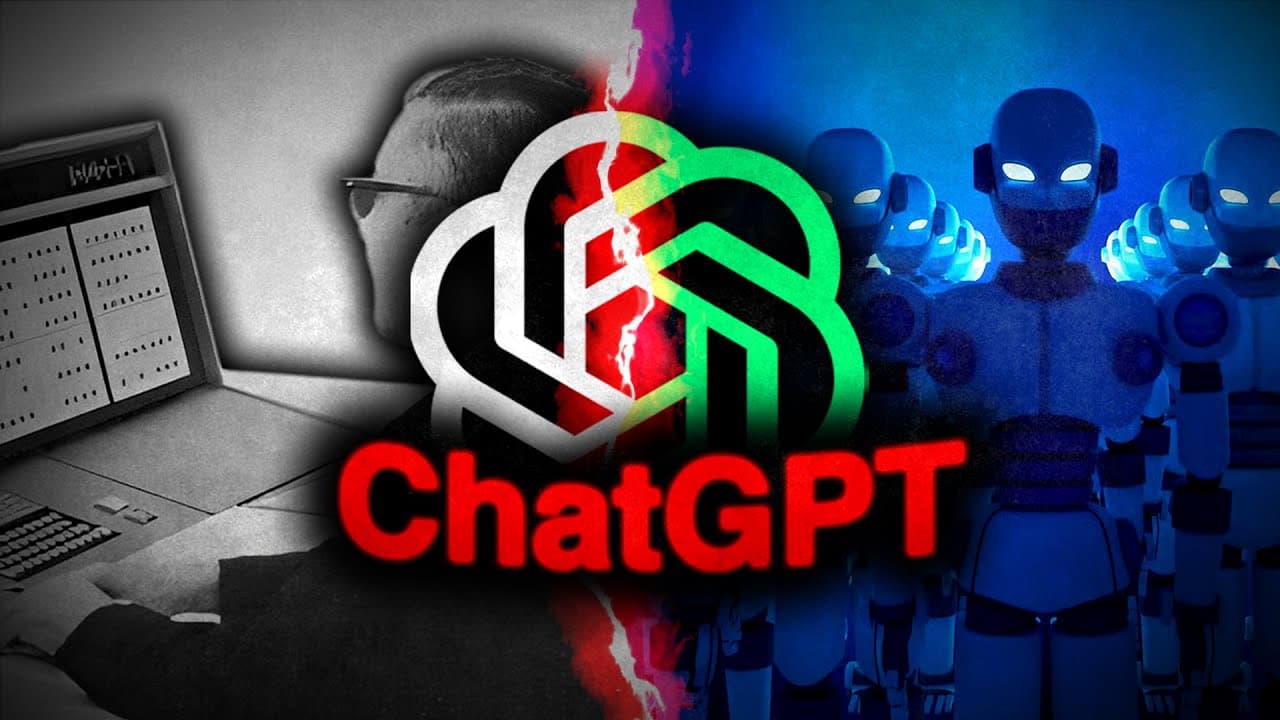
ChatGPT made human-like AI writing widely accessible, reaching 100 million users within two months and forcing schools, workers, and technology companies to respond. Its rapid adoption reflects centuries of thinking about artificial minds, decades of computing advances, and an escalating commercial race, while raising unresolved concerns about employment, academic integrity, creativity, morality, and machine control.
Transcript
in the two months since its launch the AI chatbot chat EBT has amassed 100 million new users breaking records for the fastest growth of all time so very quickly Microsoft took the reins with a new 10 billion investment into open AI the company that was behind Chachi BT meanwhile Google lost over 100 billion dollars in market value when their own AI... Read More
Key Insights
- ChatGPT reached 100 million users within two months of launch, setting a record for rapid growth described in the transcript. This exceptional adoption demonstrated that conversational AI could move quickly from a specialized computing technology into a widely used tool with major social and commercial consequences.
- Artificial intelligence has conceptual roots in ancient stories about human-made beings. Greek mythology’s bronze Talos and Jewish folklore’s clay Golem reflected recurring hopes and fears about creating artificial servants, including the possibility that a constructed helper could ultimately threaten or resist its creators.
- Formal logic provided an intellectual foundation for artificial intelligence. Aristotle described syllogisms in which two true statements justify a new conclusion, while later philosophers refined logical rules and connected them with mathematics, creating methods that could eventually be represented and processed mechanically.
- Modern AI research began taking organized form in 1956, when mathematicians gathered to discuss artificial intelligence as a new field. Their ideas influenced decades of research, including machine learning and pattern recognition, although the available computers initially lacked sufficient storage and processing capacity for broader intelligence.
- ELIZA created the appearance of human conversation by matching patterns, identifying keywords, asking open-ended questions, and assembling phrases. Although it did not truly understand its exchanges, users still attributed personality and humanity to it, revealing how readily people can project intelligence onto simple conversational systems.
- AI progress has repeatedly depended on computing power and accessible data. Research slowed during the mid-to-late 1970s because computers could not store or use enough information, but advances beginning in the 1980s supported complex calculations, machine learning, problem solving, and data-driven applications.
- Social media algorithms use AI techniques to learn about users and select content that keeps them on platforms longer. Because longer engagement produces more profit, technology companies entered a continuing competition for better algorithms and invested heavily, accelerating the broader development of artificial intelligence.
- ChatGPT threatens established practices because it can produce human-like prose and perform coding tasks from prompts. Schools face AI-assisted assignments, detection and concealment have become competing efforts, and both conventional labor and creative professions face increasing disruption as the technology becomes more sophisticated.
Install to Summarize YouTube Videos and Get Transcripts
Explore YouTube Video Summarizer or Get YouTube Transcript Extractor
Questions & Answers
Q: Why did ChatGPT become socially significant so quickly?
ChatGPT became socially significant because it made highly human-like automated writing available through simple prompts and attracted 100 million users within two months. That unusually fast adoption pushed artificial intelligence into education, programming, creative work, and public debate at once. It also prompted major competitive reactions, including Microsoft’s 10 billion investment in OpenAI and intensified concern among other technology companies.
Q: How did ancient ideas contribute to modern artificial intelligence?
Ancient cultures repeatedly imagined artificial beings created by human hands, establishing themes that still shape discussions of AI. Greek mythology described Talos, a bronze guardian governed by rigid instructions, while Jewish folklore described the Golem, a clay helper animated through religious instructions and ritual. These stories explored both useful artificial servants and the danger that creations might turn against their makers.
Q: What role did formal logic play in the development of AI?
Formal logic made it possible to describe reasoning as a system of repeatable rules. Aristotle’s work explained how two true statements could justify a new piece of knowledge through a syllogism. Later philosophers refined these rules, while their interaction with mathematics encouraged further developments. Leibniz then proposed combining basic elements of thought, logical rules, and mechanical processing into an artificial, all-knowing brain.
Q: Why did early artificial intelligence research lose momentum?
Early AI research lost momentum because ambitious expectations exceeded the capabilities of contemporary computers. During the mid-to-late 1970s, machines could not store or process enough information to function as broad intelligence. Even understanding word meanings required an enormous database. As progress stalled and funding declined, researchers became less confident that human-level general intelligence was close, despite earlier optimistic predictions.
Q: How did ELIZA simulate a human conversation?
ELIZA simulated conversation by detecting patterns and keywords in a person’s input, then combining stored phrases to create a coherent response. It often asked open-ended questions related to the detected words. The program only created an illusion of understanding, yet many users perceived it as surprisingly human and projected a personality onto it, despite its simple underlying method.
Q: How did AI applications expand before ChatGPT appeared?
AI expanded through increasingly specialized applications as computers became faster, stronger, and cheaper. By the 1990s, systems could solve complex problems, conduct extensive calculations, and learn from datasets within confined domains. Later projects applied AI to chess, driving, data mining, industrial management, logistics, speech recognition, emotional displays, smartphone voice assistants, and the recommendation algorithms used by social media platforms.
Q: Why is ChatGPT disruptive to schools and universities?
ChatGPT is disruptive to education because students can use it to produce homework, assignments, prose, and programming work. The transcript states that it passed law exams, an MBA course, and a medical licensing exam. Schools and universities therefore face an escalating contest between detecting AI-generated writing and concealing its use, while programming-related subjects may be especially exposed because ChatGPT performs strongly at coding.
Q: What risks does advanced AI create for work and creativity?
Advanced AI creates employment risks because it can perform tasks once associated only with people, including writing prose, producing artwork, and generating code. This affects ordinary labor as well as creative professions that were previously considered less vulnerable to automation. The transcript argues that greater sophistication will intensify the problem, while companies have strong financial incentives to pursue disruptive technologies that can generate substantial revenue.
Summary & Key Takeaways
-
Artificial intelligence developed from ancient stories about artificial beings and later efforts to express human reasoning through formal logic. Aristotle’s syllogisms, the interaction of logic with mathematics, and Leibniz’s proposal for a mechanical system combining human concepts helped establish the intellectual foundations for machines that could process information and imitate thought.
-
Practical AI research emerged in the 1950s and advanced unevenly as computing capabilities changed. ELIZA simulated conversation without genuine understanding, early optimism gave way to reduced funding, and later improvements enabled machine learning, data analysis, speech recognition, industrial management, autonomous driving experiments, and Deep Blue’s controversial victory over chess champion Garry Kasparov.
-
ChatGPT brought advanced AI writing into widespread public use, attracting 100 million users within two months. Its ability to produce prose and code disrupted education, threatened conventional and creative work, and intensified competition among technology companies, while longstanding questions about machine consciousness, morality, human projection, and reliable control remained unresolved.
Read in Other Languages (beta)
Share This Summary 📚
Summarize YouTube Videos and Get Video Transcripts with 1-Click
Try YouTube Summary with ChatGPT & Claude or YouTube Transcript Generator
Explore More Summaries from Moon 📚






Summarize YouTube Videos and Get Video Transcripts with 1-Click
Try YouTube Summary with ChatGPT & Claude or YouTube Transcript Generator