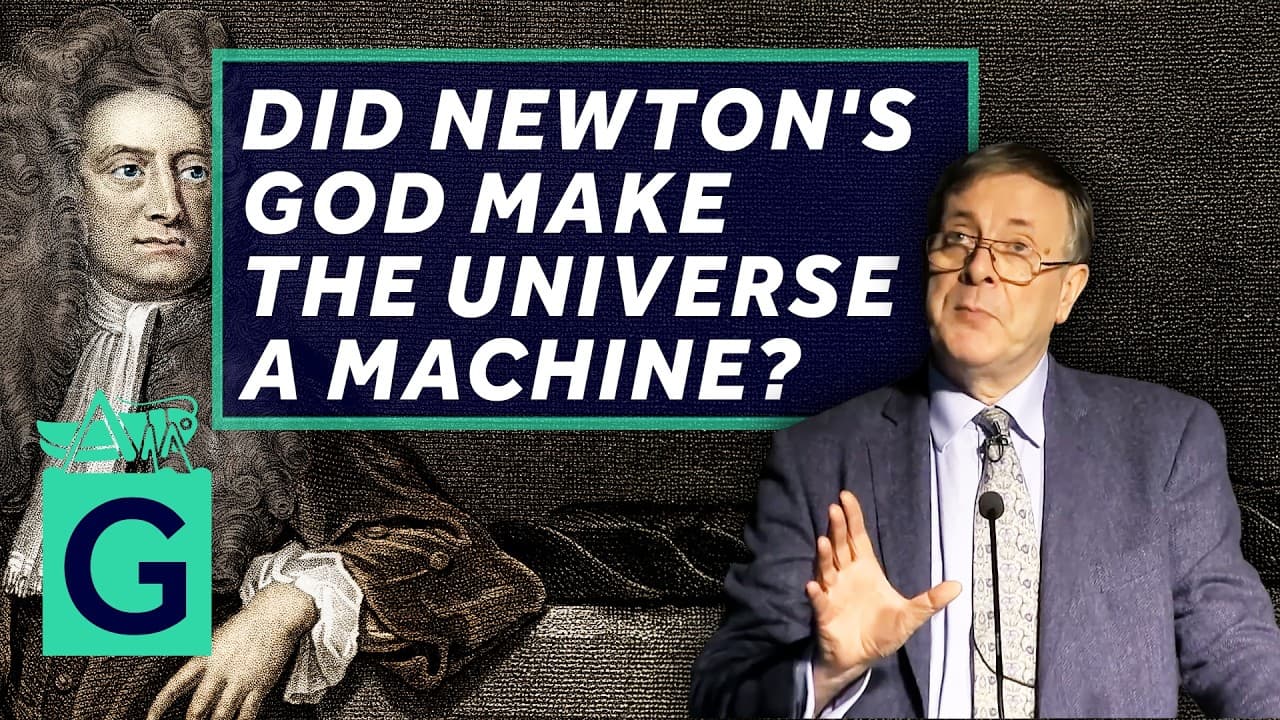
What Is the Clockwork God Concept in Newton's Work?
TL;DR
The clockwork God concept, stemming from Isaac Newton's ideas, portrays the universe as an orderly mechanism governed by fixed laws, suggesting its creation by a divine intelligence. This perspective underpinned the rise of deism, where God is viewed as the creator who does not continuously intervene in the natural order. Newton's insights significantly influenced the relationship between science and religion, prompting debates about the implications of a mechanistic universe.
Transcript
well good afternoon ladies and gentlemen and welcome to this lecture whether you're here in the lecture theatre in London whether you're watching this by video whether you're online and in this lecture which I've entitled a little provocatively the clockwork god I want to try and explore with you a way of thinking about our universe which emphasize... Read More
Key Insights
- 😮 Newton's emphasis on the regularity and order of the universe led to the concept of a clockwork God and the rise of deism.
- 💅 The concept of a clockwork universe resonated with many in Newton's time, as it offered a rational explanation for the order and beauty of the natural world.
- 😮 The rise of natural religion, based on the study of nature as a means of understanding God, was influenced by Newton's ideas.
- 🤨 Critics raised concerns about the neglect of the complexity and beauty of nature in the mechanical model of the universe.
- 🎙️ More videos with Isaac Newton:
Install to Summarize YouTube Videos and Get Transcripts
Explore YouTube Video Summarizer or Get YouTube Transcript Extractor
Questions & Answers
Q: How did Newton's idea of a clockwork universe challenge traditional religious beliefs?
Newton's emphasis on the regularity and order of the universe suggested a self-sustaining machine-like system, which diminished the need for ongoing divine involvement in the natural world. This posed a challenge to traditional religious beliefs that relied on a more personal and engaged notion of God.
Q: How did Newton's ideas influence the rise of deism?
Newton's concept of a clockwork universe, governed by fixed laws and regularity, resonated with the deist belief in a distant and detached God who created the universe but does not interfere with its workings. Deism provided a more rational, naturalistic explanation for the existence and order of the universe.
Q: What were the criticisms of Newton's idea of a clockwork universe?
Critics argued that the mechanical model of the universe neglected the beauty and complexity of nature, reducing it to a mere machine. They also questioned the compatibility of a benevolent God with the existence of suffering and evil in the world.
Q: How did the concept of a clockwork God contribute to the rise of natural religion?
The idea of a clockwork God provided a foundation for natural religion, which emphasized the study of nature as a means of understanding and appreciating God's handiwork. This movement sought to establish a religion based on reason and observation rather than specific doctrines or religious institutions.
Summary & Key Takeaways
-
Newton played a pivotal role in the Scientific Revolution, demonstrating the regularity of the universe and its application to both terrestrial and celestial mechanics.
-
Newton's idea of a clockwork universe, governed by laws and regularity, led to the idea of a divine creator and the rise of deism.
-
The concept of a clockwork God resonated with many in Newton's time, as it offered a framework for understanding the order and beauty of the natural world.
Read in Other Languages (beta)
Share This Summary 📚
Summarize YouTube Videos and Get Video Transcripts with 1-Click
Try YouTube Summary with ChatGPT & Claude or YouTube Transcript Generator
Explore More Summaries from Gresham College 📚


Summarize YouTube Videos and Get Video Transcripts with 1-Click
Try YouTube Summary with ChatGPT & Claude or YouTube Transcript Generator