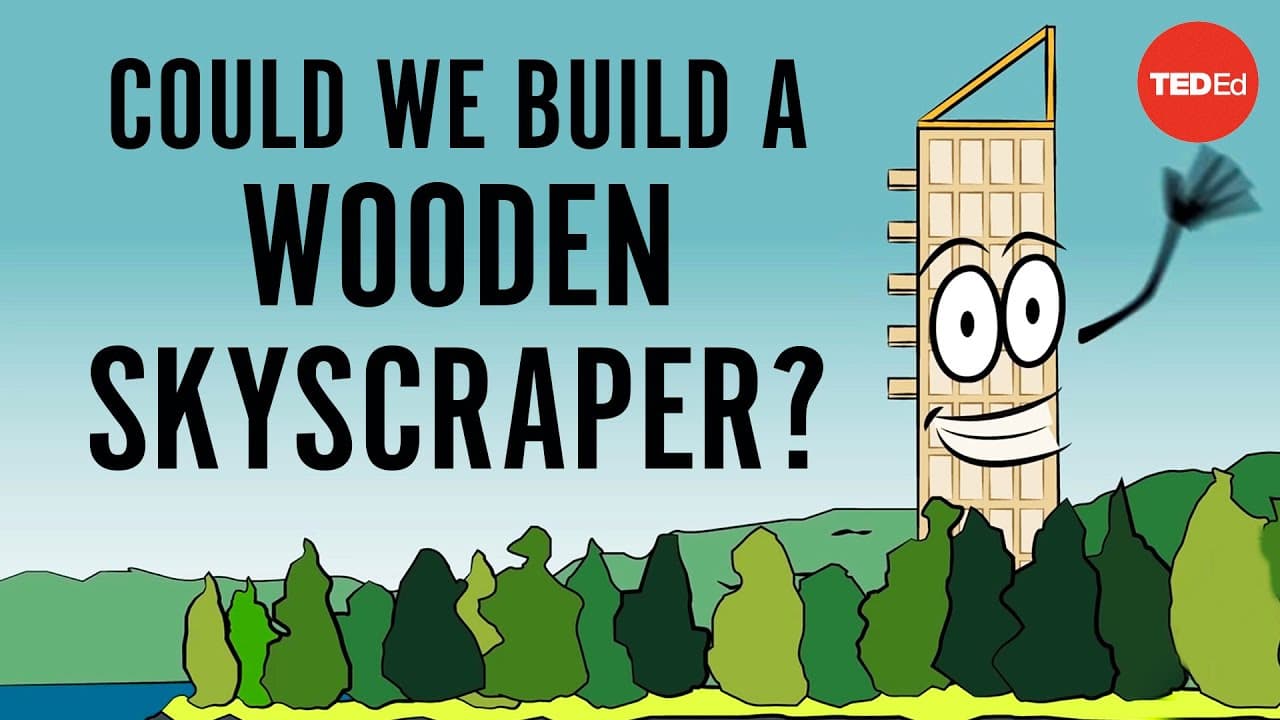
Could we build a wooden skyscraper? - Stefan Al
TL;DR
Mjøstårnet, the world's tallest wooden building, showcases the advancements in cross-laminated timber (CLT) and glue laminated timber (glulam) construction, offering faster, quieter, and more eco-friendly building solutions.
Transcript
Towering 85 meters above the Norwegian countryside, Mjøstårnet cuts a sleek shape in the rural skyline. Housing 18 stories of restaurants, apartments, and hotel rooms, this modern building might seem out of place. But a deeper look reveals it actually blends in quite well among the forested farmlands. This is likely because Mjøstårnet is the worl... Read More
Key Insights
- 🏗️ Mjøstårnet, the tallest wooden building, showcases the viability of using CLT and glulam in constructing skyscrapers.
- 🧔 CLT and glulam overcome the limitations of traditional lumber, providing strength and load-bearing capabilities comparable to concrete and steel.
- 💨 The advantages of CLT and glulam construction include faster construction, reduced waste, lower carbon emissions, and improved resilience to natural disasters.
- ❤️🔥 CLT and glulam buildings offer advantages in fire safety, as charred wood panels can be easily replaced.
- 😘 Timber is a renewable resource that has low thermal conductivity, making wooden buildings more energy-efficient.
- 👷 CLT and glulam construction contributes to a more sustainable construction industry, reducing the reliance on materials with high carbon emissions.
Install to Summarize YouTube Videos and Get Transcripts
Explore YouTube Video Summarizer or Get YouTube Transcript Extractor
Questions & Answers
Q: How does CLT overcome the limitations of traditional lumber in terms of height and strength?
CLT is created by gluing together boards of wood in alternating orientations, allowing it to bear heavy loads and mimic the compressive strength of concrete. This innovation overcomes the vulnerability of traditional lumber to forces applied perpendicular to the wood's fiber growth.
Q: What are the advantages of using CLT and glulam in construction?
CLT and glulam construction provides faster and quieter construction processes, requires smaller cranes and foundations, and offers standardized prefabricated parts. Additionally, these materials are more eco-friendly, as timber is renewable and has a lower carbon footprint compared to concrete and steel.
Q: How do CLT and glulam buildings fare in terms of resilience to natural disasters?
CLT buildings have the advantage of being able to replace cracked wood panels easily, making them more resilient to earthquakes. In the case of fires, the charred outer layer of CLT provides insulation for up to three hours, allowing for safer evacuations.
Q: Can wooden buildings compete with steel and concrete in terms of strength for skyscraper construction?
While purely wooden structures may not have the strength to support skyscrapers over 40 stories, using wood for buildings under 30 stories can still significantly reduce their carbon footprint by more than 25%.
Summary & Key Takeaways
-
Mjøstårnet is the tallest wooden building globally, showcasing the potential of CLT and glulam construction in creating skyscrapers with wood as the primary material.
-
CLT and glulam are engineered forms of wood that mimic the strength of concrete and steel, while offering faster construction, reduced waste, and lower carbon emissions.
-
CLT and glulam buildings are more resilient to natural disasters and offer advantages in terms of fire safety and thermal efficiency.
Read in Other Languages (beta)
Share This Summary 📚
Summarize YouTube Videos and Get Video Transcripts with 1-Click
Try YouTube Summary with ChatGPT & Claude or YouTube Transcript Generator
Explore More Summaries from TED-Ed 📚





Summarize YouTube Videos and Get Video Transcripts with 1-Click
Try YouTube Summary with ChatGPT & Claude or YouTube Transcript Generator