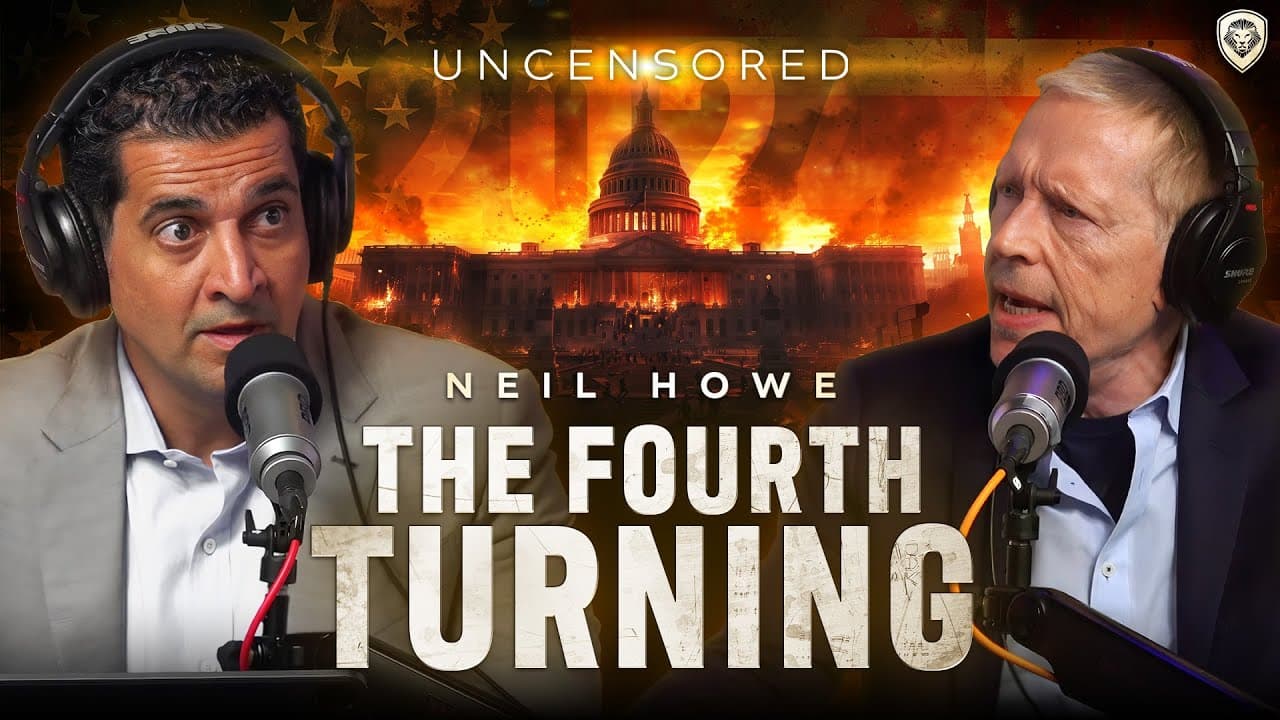
What Is the Fourth Turning and Its Implications for Society?
TL;DR
The Fourth Turning theory posits that major societal changes occur every long human lifetime, driven by crises and conflicts. Historically, these turning points often lead to significant upheaval and the reshaping of values, with predictions suggesting potential conflicts stemming from current societal divides.
Transcript
about once every Long human lifetime we basically reshape our outer world of politics infrastructure and usually in violent organized conflict and the fourth turning is that process in order for that to happen there has to be a very very high level of fear if that event needs to happen for us to get in line where are we at right now we don't realiz... Read More
Key Insights
- 🔁 Societal change is cyclical, with history often repeating patterns observed every few generations.
- ❓ The Fourth Turning theory emphasizes that crises are essential for societal evolution and reshaping of values.
- 😀 Each generational archetype faces unique challenges and influences societal direction differently during crises.
- ❓ Predictive elements of the Fourth Turning have historically aligned with significant societal upheavals, reinforcing the theory.
- 😨 Fear and urgency serve as significant motivators for collective action and community formation during the Fourth Turning.
- 🥺 Historical precedents indicate that societal divides often culminate in conflicts that lead to restructuring of social norms and community values.
- ❓ Faith and community involvement are critical for navigating challenges during the Fourth Turning, promoting cohesion amidst potential conflicts.
Install to Summarize YouTube Videos and Get Transcripts
Explore YouTube Video Summarizer or Get YouTube Transcript Extractor
Questions & Answers
Q: What is the concept of the Fourth Turning about?
The Fourth Turning is a theory that outlines cyclical generational patterns in history, suggesting that societal transformation tends to occur in distinct phases. Each cycle consists of four turnings: a crisis, an awakening, an unraveling, and then a subsequent crisis that often requires a major conflict to reshape societal norms and values.
Q: How do generational archetypes influence societal changes?
Generational archetypes include the Prophet, Nomad, Hero, and Artist, each responding to societal conditions in distinct ways. For instance, the Prophet generation often emerges after crises and leads social movements, while the Nomad generation usually grows up during periods of upheaval and carries a pragmatic approach in midlife. Their experiences shape the values and direction of society during subsequent crises.
Q: What historical examples does the Fourth Turning draw from?
The Fourth Turning draws from American history, citing examples such as the American Revolution, the Civil War, and the Great Depression, all of which were characterized by generational shifts and societal upheaval, reinforcing the theory of cyclical change through conflict.
Q: What predictions did the authors, Neil Howe and William Strauss, make in the Fourth Turning?
Howe and Strauss predicted several significant events that could occur during the current Fourth Turning, including a major economic crisis, a potential pandemic, social division, and civil conflict. They emphasize the importance of understanding these cycles to prepare for the future.
Q: What role does fear play in the Fourth Turning's theory?
Fear is seen as a crucial catalyst for societal change during the Fourth Turning. A high level of fear can drive people to either unite under shared values or, conversely, to embrace division. The anticipation of crises can lead to urgent calls for community and re-establishment of authority.
Q: How do the current societal divides reflect historical patterns of the Fourth Turning?
Current societal divides are reminiscent of historical contexts where polarized factions exist, such as pre-Civil War America. The Fourth Turning theory suggests that these divisions often culminate in crises that demand resolution, typically through conflict or a reshaping of societal frameworks.
Q: How can faith and values influence the outcomes of a Fourth Turning?
Faith and strong community values are pivotal in navigating through a Fourth Turning. As society confronts crises, a renewed focus on shared values, community involvement, and collective action often emerges, steering populations towards cooperation and rebuilding a sense of purpose.
Q: Can a Fourth Turning resolve without conflict?
While the theory underscores conflict as a common result of a Fourth Turning, it posits that significant upheaval can also prompt a unifying response based on shared purpose and values. However, historical patterns indicate that total societal transformation often requires a catalyst, which may be conflict or crisis.
Summary & Key Takeaways
-
The Fourth Turning suggests that every long human lifetime witnesses major societal changes, often emerging from crises and conflicts. These changes can lead to societal upheaval and a reshaping of values.
-
The cyclical nature of history demonstrates that each generation responds differently to these shifts, alternating between collective community strength and individualism in response to past crises.
-
Predictions made in the Fourth Turning indicate a potential for significant conflict in the coming years, driven by increasing societal divides and the historical patterns of crises leading to wars or civil unrest.
Read in Other Languages (beta)
Share This Summary 📚
Summarize YouTube Videos and Get Video Transcripts with 1-Click
Try YouTube Summary with ChatGPT & Claude or YouTube Transcript Generator