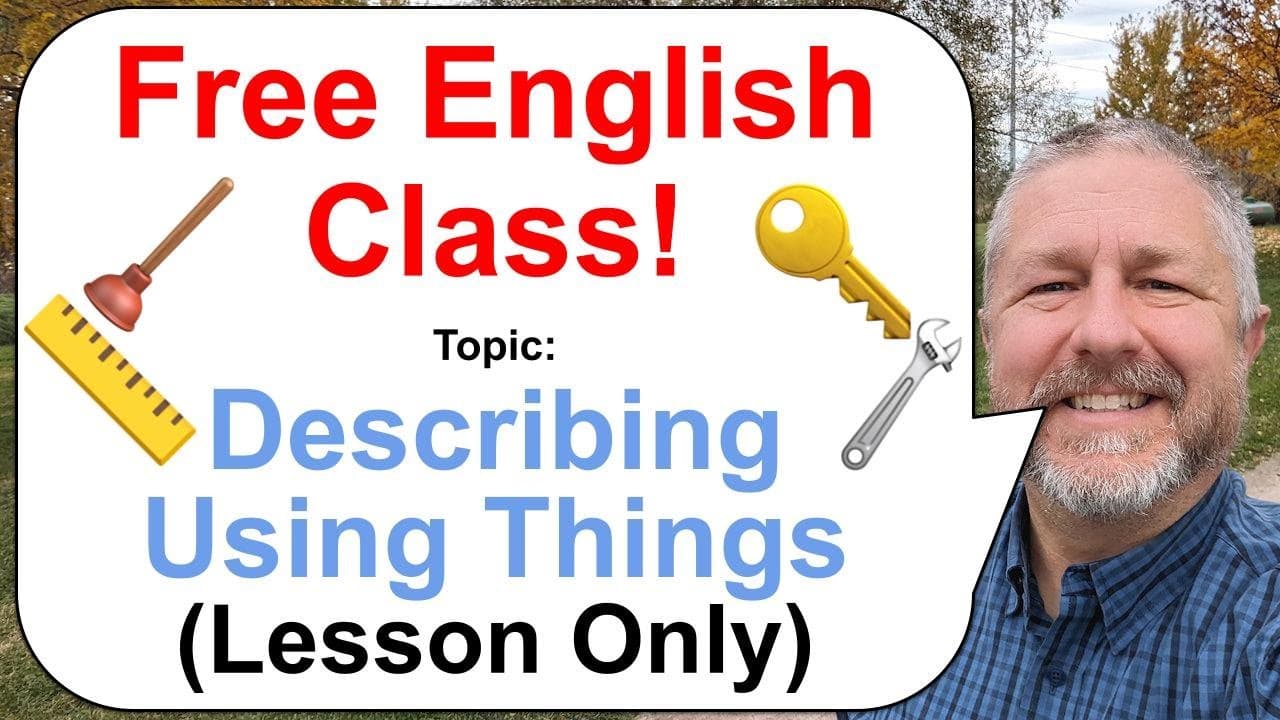
What Verbs Describe Actions Related to Using Objects?
TL;DR
Common verbs for describing actions related to using objects include extend (to lengthen), retract (to pull back), stack (to arrange on top of each other), insert (to place into), and hook up (to connect). Other actions include zip (to close), tighten (to secure), and plunge (to unclog), among many others. Understanding these verbs enhances communication about everyday tasks and object interactions.
Transcript
Well, hello and welcome to this English lesson about using things. I will admit this is a really bad title for a lesson, an English lesson that's filled with some very common words that you do need to know. I just couldn't think about a good title for what to call it. But the other day I ejected a DVD. Yes, is still using a DVD player. I ejected a ... Read More
Key Insights
- 🧡 Different verbs are used to describe actions related to using objects, ranging from extending and retracting to stacking and inserting.
- 😒 Some actions, like folding up, propping up, and winding up, involve arranging or preparing objects for use.
- ❓ Other actions, such as tightening and loosening, involve adjusting or securing objects.
- 🤝 Verbs like zipping, wrapping, and pinning are used when dealing with closures or attachments.
- 🛝 Actions like hooking up, plunging, and sliding are specific to connecting, unclogging, or moving objects.
- 💁 Words like unfolding, collapsing, and sliding refer to changes in size or form of objects.
- 🎞️ Verbs like crumpling and ripping off involve manipulating or removing materials.
Install to Summarize YouTube Videos and Get Transcripts
Explore YouTube Video Summarizer or Get YouTube Transcript Extractor
Questions & Answers
Q: What is the difference between extending and retracting?
Extending refers to bringing something from a packed-up state to an extended or unfolded state, while retracting means returning something to its stored or folded-up position.
Q: In what situations would you use the verb "stack"?
You can use the verb "stack" when putting objects on top of each other or inside each other, such as stacking chairs, plates, cups, bowls, or spoons to save space.
Q: How is "insert" used in everyday life?
"Insert" is commonly used when putting something into another thing, like inserting a key into a lock, inserting the tip of a pen into its cap, or inserting coins into a vending machine.
Q: When should you use the verb "unwind"?
"Unwind" is typically used when something is rolled up or wound, and you want to release or unroll it, such as unwinding a garden hose or unwinding a cord.
Summary & Key Takeaways
-
The lesson discusses verbs that describe actions related to using things, such as extending, retracting, stacking, inserting, crumpling, and ejecting.
-
Other actions include rearranging, clamping, hooking up, ripping off, pinning, folding up, propping up, putting up, taking down, unfurling, collapsing, winding up, spinning, zipping, tightening, loosening, wrapping, plunging, and measuring.
Read in Other Languages (beta)
Share This Summary 📚
Summarize YouTube Videos and Get Video Transcripts with 1-Click
Try YouTube Summary with ChatGPT & Claude or YouTube Transcript Generator
Explore More Summaries from Learn English with Bob the Canadian 📚



Summarize YouTube Videos and Get Video Transcripts with 1-Click
Try YouTube Summary with ChatGPT & Claude or YouTube Transcript Generator