How to Build an AI-Native Company From the Ground Up
TL;DR
Build an AI-native company by making AI the operating system through which every important workflow, decision, and process runs. Capture outcomes in intelligent closed loops, make company activity queryable, and give models as much context as an employee. Teams using this approach have reportedly cut engineering sprint time in half and achieved close to 10 times more work, so read on for the concrete practices behind it.
Transcript
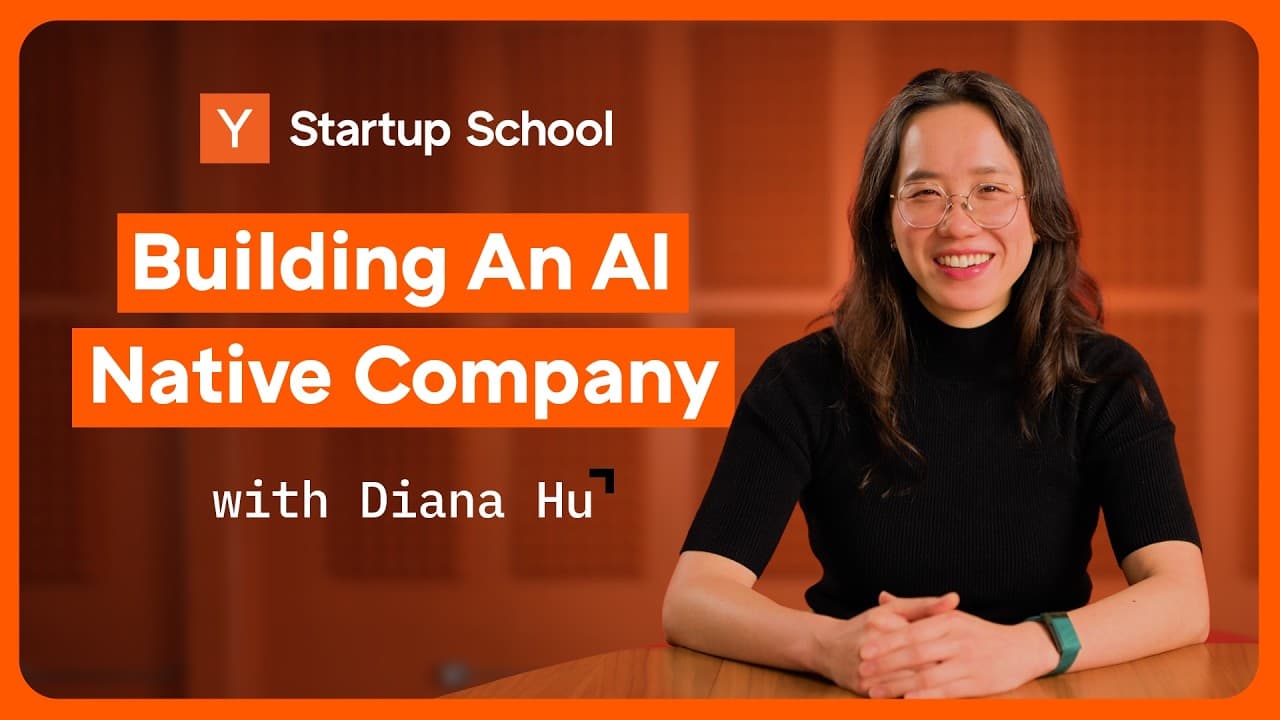
Hi, I'm Diana and I'm a partner at YC. Over the past few months, it's become clear to me that AI is not just going to change how quickly software gets built or what workflows get automated. It's going to fundamentally change the way startup should be run from what roles will exist to what products are possible to build. In this episode, I'm going t... Read More
Key Insights
- AI should be the operating system of your company, not just a tool.
- Closed-loop systems capture and improve processes continuously.
- A queryable organization allows AI to learn and self-improve.
- AI-driven companies can operate with smaller, more efficient teams.
- The classic management hierarchy becomes obsolete with AI.
- Three key roles in AI companies: Individual Contributor, Directly Responsible Individual, and AI Founder.
- Maximizing AI token usage, not headcount, is crucial for efficiency.
- Startups have an advantage in adopting AI due to fewer legacy constraints.
Install to Summarize YouTube Videos and Get Transcripts
Explore YouTube Video Summarizer or Get YouTube Transcript Extractor
Questions & Answers
Q: How do you build an AI-native company from the ground up?
Make AI the operating system of the company rather than adding it as a tool to existing workflows. Route important workflows, decisions, and processes through an intelligent layer that captures outcomes, learns from them, and improves over time.
Q: What is a closed-loop system in an AI-native company?
A closed loop captures information, feeds it back into an intelligent system, and adjusts the process to better meet a stated goal. Unlike an open loop, it continuously monitors outputs, supporting greater correctness and stability.
Q: How can founders make their company queryable by AI?
Every important action should create an artifact that the company’s central intelligence can learn from. The transcript recommends recording meetings with an AI notetaker, minimizing DMs and emails, embedding agents across communication channels, and creating dashboards for revenue, sales, engineering, hiring, and operations.
Q: What context should an AI agent receive for engineering sprint planning?
An agent can use Linear tickets, Slack engineering channels, customer feedback, GitHub activity, plans in Notion or Google Docs, sales calls, and daily standup recordings. With that context, it can assess what shipped, compare results with customer needs, and propose more predictable sprint plans.
Q: What results can queryable engineering workflows produce?
Diana says she has seen teams cut their engineering sprint time in half and get close to 10 times more done in that period. The improvement comes from making status, decisions, outcomes, and customer feedback continuously available to agents instead of relying on lossy manager rollups.
Q: What is an AI software factory?
An AI software factory is a development system in which humans write specifications and tests that define success, while agents generate and iterate on the implementation until the tests pass. Humans decide what to build and judge the result, while producing the code becomes the agents’ responsibility.
Q: How does StrongDM’s AI team use a software factory?
StrongDM’s AI team built a system intended to remove the need for humans to write or review code. Its specifications and scenario-based validations guide agents to write tests and iterate on code until it reaches a probabilistic satisfaction threshold and works.
Q: Why does an AI-native company need a different management structure?
AI loops, queryable operations, and software factories reduce the need for managers and coordinators to route information up and down the organization. The company can instead keep status, decisions, and outcomes continuously captured in an intelligence layer with an up-to-date view of operations.
Summary & Key Takeaways
-
AI should be central to your company's operations, acting as the core system that drives all processes and decisions. By creating closed-loop systems, companies can continuously improve and adapt, leading to more efficient operations and innovation. This approach allows for smaller teams that can achieve more, disrupting traditional management structures.
-
In an AI-driven company, every process should be captured and analyzed by AI, making the organization fully queryable. This setup helps in creating a self-improving system where decisions and outcomes are constantly fed back into the intelligence layer, resulting in a dynamic and responsive company environment.
-
The shift to AI-native companies involves redefining roles and structures, focusing on maximizing AI capabilities rather than expanding headcount. Startups, without legacy systems, can fully embrace AI from the ground up, giving them a competitive edge over larger, established companies struggling with adaptation.
Read in Other Languages (beta)
Share This Summary 📚
Summarize YouTube Videos and Get Video Transcripts with 1-Click
Try YouTube Summary with ChatGPT & Claude or YouTube Transcript Generator
Explore More Summaries from Y Combinator 📚






Summarize YouTube Videos and Get Video Transcripts with 1-Click
Try YouTube Summary with ChatGPT & Claude or YouTube Transcript Generator