Why Do Bank Stocks and Insurance Stocks Look Dead Cheap?
TL;DR
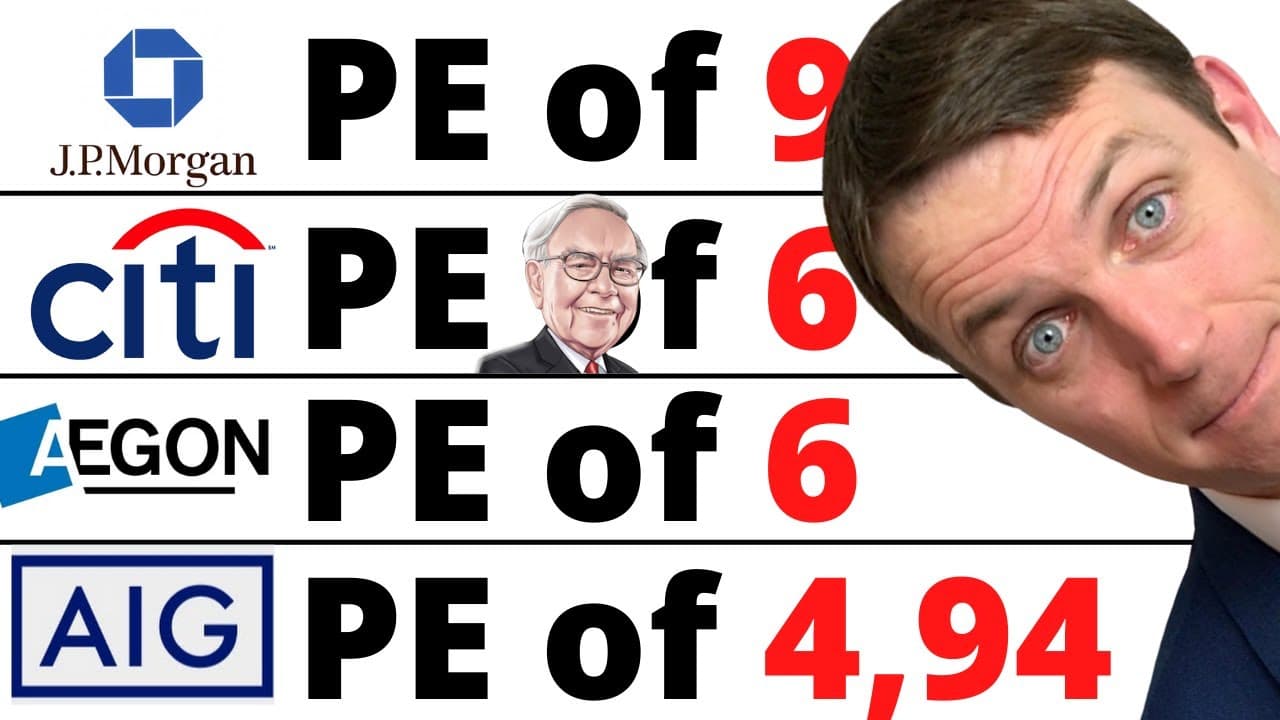
Bank and insurance stocks look cheap because their low valuations reflect risks that are difficult for outside investors to measure. Aegon had a price-to-earnings ratio of 6 and a dividend yield of 3.5 percent, yet its results depended on long-term actuarial and market assumptions. Read on to understand why apparent bargains can carry severe downside.
Transcript
good day fellow investors bank stocks and insurance stocks look cheap at the moment but the fact is that those look cheap always let's discuss why i decided that in my life i will not become a bank and insurance investing specialist and this is also a video that i will put as an answer always because i usually get these comments sven what do you th... Read More
Key Insights
- 😘 Bank and insurance stocks may appear cheap due to low valuations, but this is often a reflection of underlying risks and complexities.
- 🏦 Warren Buffett's success in investing in banks and insurers is attributed to his unique advantages, such as financial resources and industry expertise.
- 🍉 Insurance companies carry risks related to long-term trends, variable annuities, and economic assumptions.
Install to Summarize YouTube Videos and Get Transcripts
Explore YouTube Video Summarizer or Get YouTube Transcript Extractor
Questions & Answers
Q: Why do bank stocks and insurance stocks always look cheap?
Their low price-to-earnings ratios and attractive dividend yields can reflect risks hidden within their assets, liabilities, and assumptions. The speaker argues that outsiders cannot reliably understand all the risk accumulated in their books.
Q: Why was Citigroup trading below tangible book value?
The transcript presents Citigroup as a lower-quality bank whose risks were reflected in its stock price. Although restructuring plans and rebound expectations can make it look attractive, the speaker prefers to avoid that uncertainty.
Q: What does Citigroup's stock history show about low valuations?
Citigroup's stock price was about one-tenth of where it stood in 2007, according to the transcript. Its price-to-earnings ratio was still in the single digits around the earlier period, showing that a low multiple alone did not prevent major losses.
Q: Why did Aegon look like a cheap insurance stock?
Aegon had a price-to-earnings ratio of 6 and a dividend yield of 3.5 percent. Despite those figures, the speaker viewed its complex risks and long-term record as reasons not to invest.
Q: What risks did the speaker identify in Aegon's business?
Aegon's business depended on actuarial estimates, long-term trends, mortgages, variable annuities, and economic assumptions. The speaker said investors cannot know whether those assumptions are correct, especially when conditions change.
Q: How could changing assumptions affect Aegon's variable annuity risk?
The transcript cites a net amount at risk of 3 billion on a portfolio of 75 billion. The speaker asks what would happen if changed assumptions caused that exposure to become 20 billion, illustrating how quickly reported risk could worsen.
Q: Why are market-return assumptions important for insurers?
Aegon's targets used annual gross equity-market return assumptions of 8 percent, 6 percent, and 6.5 percent across regions. The speaker warns that zero percent or negative 10 percent returns could create deep problems for the insurer.
Q: Why does the speaker avoid investing in banks and insurers?
He believes their complexity makes accumulated risks difficult for ordinary investors to understand. Even when impairments are low and valuations appear attractive, changing conditions can expose severe downside, including the possibility that a stock goes to zero.
Summary & Key Takeaways
-
Definition: Cheap bank and insurance stocks combine low valuation multiples or attractive dividends with risks that may already be reflected in their prices.
-
Number: Aegon had a price-to-earnings ratio of 6 and a dividend yield of 3.5 percent.
-
Compare: Citigroup's stock price was about one-tenth of its level in 2007 despite appearing inexpensive.
-
Definition: Aegon's insurance results rely on actuarial calculations, long-term trends, and assumptions that outside investors cannot verify confidently.
-
Number: Aegon reported 3 billion at risk on a portfolio of 75 billion, with the speaker warning it might become 20 billion.
-
Number: Aegon's annual gross equity-market return assumptions included 8 percent, 6 percent, and 6.5 percent.
-
Compare: The speaker contrasts those positive assumptions with possible returns of zero percent or negative 10 percent.
-
Who: Charlie Munger is cited as saying insurers usually go bankrupt every three decades and banks twice in a century.
-
Definition: Variable annuities create complex exposure that insurers may later need to reduce with help from external parties.
-
Tool: Price-to-earnings ratios, dividend yields, tangible book value, and fair-value estimates can signal cheapness but do not reveal every underlying risk.
Read in Other Languages (beta)
Share This Summary 📚
Summarize YouTube Videos and Get Video Transcripts with 1-Click
Try YouTube Summary with ChatGPT & Claude or YouTube Transcript Generator
Explore More Summaries from Value Investing with Sven Carlin, Ph.D. 📚

Summarize YouTube Videos and Get Video Transcripts with 1-Click
Try YouTube Summary with ChatGPT & Claude or YouTube Transcript Generator