What Technology Trends Will Define 2026?
TL;DR
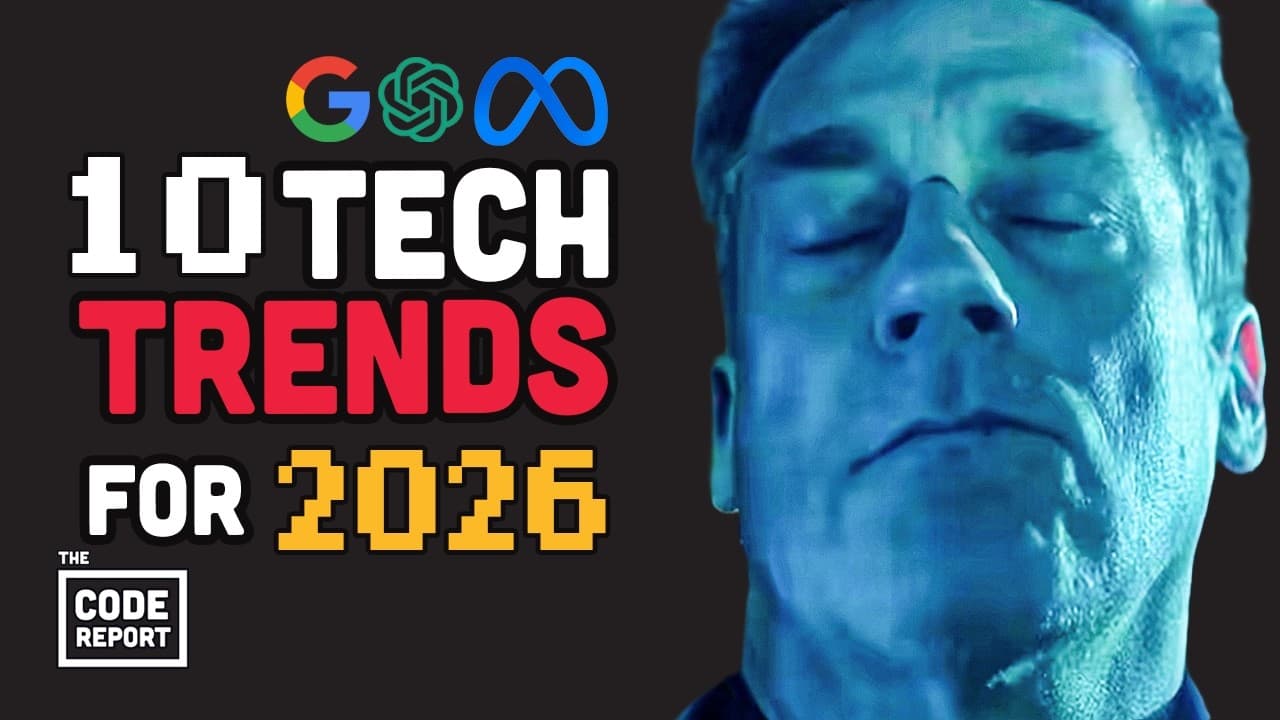
Software engineering jobs are unlikely to disappear in 2026, because AI coding tools still require humans to correct and maintain their output. The major trends to watch are humanoid robots, wearable AI, chip demand, nuclear power, quantum computing, digital identity systems, and evolving JavaScript runtimes and frameworks, while the AI investment cycle may continue until a major wave of public offerings arrives.
Transcript
The year is 2026. Your $3,500 smart fridge has a GPU and displays advertisements. Your boss is an AI. Your girlfriend is a robot. And every startup pitch sounds like Uber, but quantum. Welcome to the future. It's somehow both overengineered and still in beta. But it's time for the annual tradition where I wake up the vat of precogs in my garage and... Read More
Key Insights
- Software development employment is under pressure, but it is not portrayed as disappearing. Job openings have not recovered to their earlier level following the 2023 tech pullback, while the Bureau of Labor Statistics still forecasts 15% software development job growth through 2034.
- AI coding tools are still unable to replace human software engineers, according to the video's assessment. Their unreliable output may instead produce a new category of maintenance work for so-called code janitors, who must inspect, repair, and clean up poorly generated software.
- Large language models are described as having plateaued rather than becoming self-improving intelligence. Even so, current AI systems remain capable enough to threaten some spreadsheet, management, design, and online knowledge-sharing work while sustaining investor attention for at least a few more years.
- A wave of AI-related public offerings could signal that the investment cycle is approaching its end. Most AI companies remain private, while SpaceX, OpenAI, and Anthropic are identified as companies considering public offerings that could rank among the world's largest.
- Humanoid robots are expected to become a major driver of AI attention in 2026. Products from 1X, Figure, and Tesla target household or factory labor, although the technology remains weak and requires substantial teleoperation rather than functioning as fully independent manual labor.
- AI infrastructure demand is concentrating profits among chip designers and fabricators. Nvidia, ARM, and Taiwan Semiconductor benefit from high barriers to entry and demand for linear algebra, while cloud providers face difficulty securing enough electricity to operate expanding fleets of GPUs.
- Nuclear power could gain renewed attention because data centers require growing amounts of electricity. Small modular reactor companies are seeking regulatory approval for self-contained power sources, and Zuckerberg is described as announcing a deal with Oklo for a reactor in Ohio.
- JavaScript tooling is expanding across runtimes and frameworks. Node.js supports TypeScript files through type stripping, Deno includes a module bundler, Bun provides PostgreSQL and Redis support, React has a stable compiler, and Ripple is presented as an emerging technology worth watching in 2026.
Install to Summarize YouTube Videos and Get Transcripts
Explore YouTube Video Summarizer or Get YouTube Transcript Extractor
Questions & Answers
Q: Will AI replace software engineers in 2026?
AI coding tools are not expected to replace human software engineers in 2026, according to the video's assessment. The tools remain unable to produce consistently dependable software without human oversight. Their flawed output may actually create additional maintenance work, including a proposed class of code janitor roles focused on reviewing, repairing, and cleaning up AI-generated code.
Q: What is the outlook for software development jobs?
Software development hiring remains weaker than before the 2023 tech pullback, and job openings on Indeed have not recovered to their earlier level. However, the longer-term picture presented is more positive. The Bureau of Labor Statistics still forecasts 15% software development job growth through 2034, suggesting continued demand despite current hiring pressure and expanding AI coding tools.
Q: Why could the AI investment cycle continue beyond 2026?
The AI investment cycle could remain active for at least a few more years because the underlying technology is still impressive and many prominent AI companies remain privately held. Robotics may provide another source of attention and funding. A future wave of public offerings is presented as a possible sign that venture investors are transferring their holdings to public investors.
Q: How are humanoid robots expected to develop in 2026?
Humanoid robots are expected to begin rolling off assembly lines in 2026, although their current capabilities remain limited and require substantial teleoperation. The Neo robot from 1X targets household tasks such as laundry and dishes, while Figure robots and Tesla Optimus are being promoted as possible replacements for manual labor in factories.
Q: Why are chip companies benefiting from AI demand?
AI systems create intense demand for the linear algebra calculations performed by specialized computing hardware. High barriers to entering chip design and fabrication allow established companies such as Nvidia, ARM, and Taiwan Semiconductor to capture much of the resulting profit. Cloud providers are also struggling to secure enough electricity to operate the Nvidia GPUs required for expanding AI infrastructure.
Q: How could AI data centers increase demand for nuclear power?
AI data centers require large and growing supplies of electricity, creating interest in power sources that can operate continuously. Small modular reactors could potentially provide individual data centers with self-contained generation instead of relying on large areas of intermittent solar or wind facilities. The transcript also cites Zuckerberg's announced deal with Oklo for a reactor in Ohio.
Q: What progress is described in quantum computing?
Quantum computing is portrayed as moving closer to practical applications after major developments in 2025. Google's Willow chip is identified as a notable advancement, followed by a quantum echoes algorithm that measures disturbances at the subatomic scale. The algorithm is described as the first verifiable quantum computation to surpass the capabilities of supercomputers on its assigned task.
Q: What JavaScript technologies should developers watch in 2026?
Developers should watch improvements across Node.js, Deno, Bun, React, and Ripple. Node.js can run TypeScript files through type stripping, while Deno includes its own module bundler. Bun continues improving its speed and offers built-in PostgreSQL and Redis support. React remains dominant and now has a stable compiler, while Ripple is presented as an emerging alternative.
Summary & Key Takeaways
-
Software development remains under pressure after the 2023 tech pullback, and job openings have not returned to their earlier level. However, the Bureau of Labor Statistics forecasts 15% growth through 2034. AI coding tools are portrayed as incapable of replacing engineers and as creators of maintenance work for developers who clean up generated code.
-
AI remains useful despite claims that large language models have plateaued and are not genuinely intelligent. The investment cycle could continue for several years, supported by private companies, potential public offerings, and robotics. Humanoid machines, wearable devices, chips, data center electricity, and small modular nuclear reactors are presented as interconnected areas of investment and experimentation.
-
Quantum computing is beginning to show possible practical value, while digital IDs and central bank-backed currencies raise concerns about centralized access to personal activity. JavaScript development also continues evolving through Node.js TypeScript support, Deno's built-in bundler, Bun's speed and database support, React's stable compiler, and emerging alternatives such as Ripple.
Read in Other Languages (beta)
Share This Summary 📚
Summarize YouTube Videos and Get Video Transcripts with 1-Click
Try YouTube Summary with ChatGPT & Claude or YouTube Transcript Generator
Explore More Summaries from Fireship 📚



Summarize YouTube Videos and Get Video Transcripts with 1-Click
Try YouTube Summary with ChatGPT & Claude or YouTube Transcript Generator