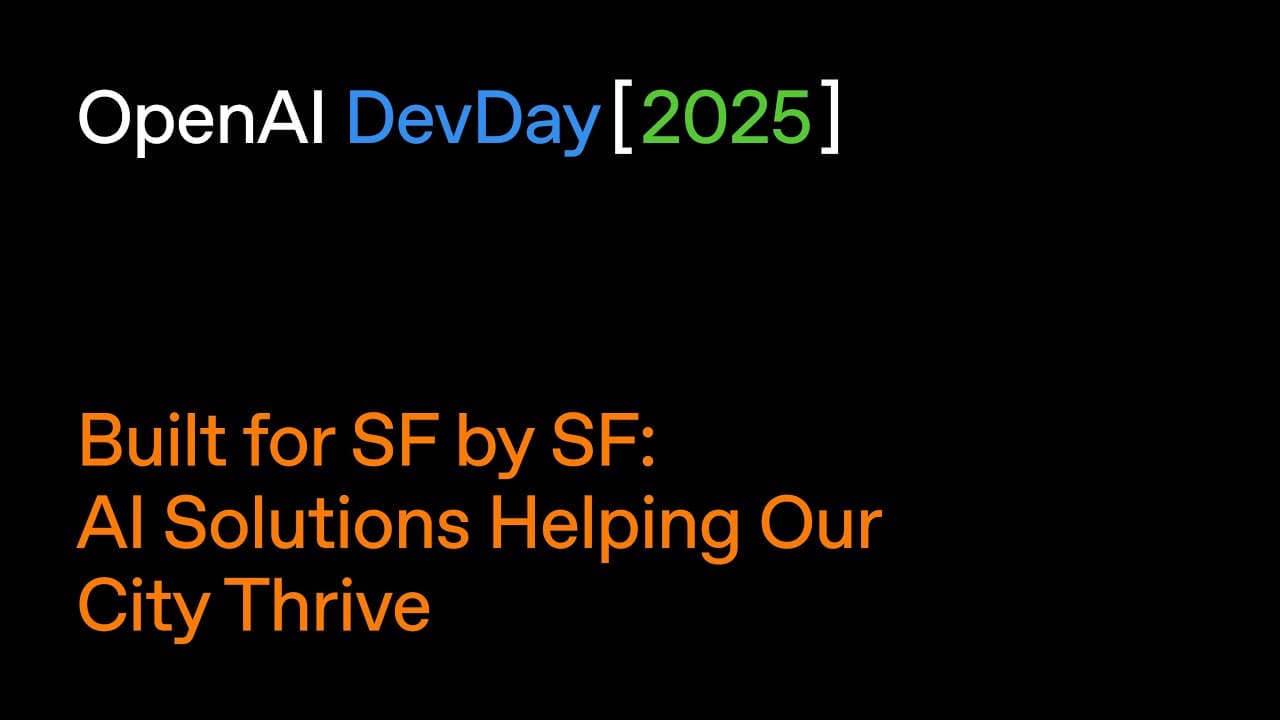
How Is AI Improving San Francisco City Services?
TL;DR
AI can simplify city services by turning a photo and location into a completed 311 report, reducing a 12-step process to two clicks. Solve SF uses an onboard image classifier and GPT 5 to categorize street issues, select the correct city form, assess relevant details, and submit reports, while VoiceReach is presented as a real-time outreach platform for neighborhood street teams.
Transcript
Welcome back to the main stage at OpenAI DevDay. My name is Corey Decro. I'm our Global Head of Events at OpenAI, uh, and I have the great privilege of opening this next session. Um, if you've been with us for a while, we started OpenAI DevDay about three years ago. Uh, it looked very different than it does now, but we're so happy that we get to co... Read More
Key Insights
- Solve SF is a mobile application that streamlines reports about common street issues in San Francisco. A user opens its camera, takes a photograph, and slides to submit, while the application captures the location and handles much of the required classification and form completion.
- The official San Francisco 311 application can require 12 steps to report trash. Patrick McCabe designed Solve SF to reduce issue reporting to two clicks because repeated manual selections could be confusing, prone to error, and discouraging for residents who wanted to file reports frequently.
- GPT 5 is used by Solve SF to analyze uploaded photographs and prepare 311 submissions. Its tasks include selecting the appropriate city form, determining whether graffiti is on public or private property, identifying the affected object, and evaluating whether the content is offensive.
- An onboard image classifier gives Solve SF an immediate understanding of the photographed issue. In the demonstration, the classifier recognized graffiti, while the phone supplied location data and the cloud-based GPT 5 workflow subsequently analyzed and submitted the report within a couple of minutes.
- Solve SF was created by an electrical engineer who did not consider himself a software developer. Patrick McCabe used ChatGPT extensively to write an iOS application in Swift, an Android application in Kotlin, establish an AWS backend, understand YOLO models, and develop features and design ideas.
- Solve SF has generated over 100,000 reports for San Francisco's 311 service. The presentation shows that people use it throughout the city and that municipal responses have included pressure-washing sidewalks, painting over graffiti, and collecting substantial amounts of discarded trash.
- VoiceReach is a real-time outreach platform created by students to unite data, teams, and services. Its stated purpose is to help San Francisco neighborhood street teams respond faster and more intelligently to homelessness, public safety concerns, and drug addiction.
- Civic responsibility is presented as a necessary companion to technological innovation. Mayor Daniel Lurie asks developers to remain connected to neighborhoods, schools, and local institutions, arguing that cooperation among builders, residents, and government can make AI serve people in practical ways.
Install to Summarize YouTube Videos and Get Transcripts
Explore YouTube Video Summarizer or Get YouTube Transcript Extractor
Questions & Answers
Q: How does Solve SF simplify reporting street problems?
Solve SF reduces the reporting workflow from as many as 12 steps in the official San Francisco 311 application to two clicks. A resident opens the camera, photographs graffiti, trash, or another supported street issue, and slides to submit. The application captures location data, uses an onboard classifier to recognize the issue, and sends the image to a cloud workflow that prepares the 311 report.
Q: What does GPT 5 do when Solve SF submits a report?
GPT 5 analyzes the uploaded photograph and completes decisions that residents previously had to make themselves. For a graffiti report, it determines which city form should be used, whether the graffiti is on public or private property, what object has been marked, and whether the content is offensive. It then uses those details to support submission of the report to San Francisco's 311 service.
Q: Why was Solve SF created?
Patrick McCabe created Solve SF after encountering graffiti and trash on long daily walks and reporting those issues through San Francisco's 311 service. He saw that the city often responded by painting over graffiti, collecting trash, and sending a completion photograph. However, the official application's numerous steps made repeated reporting cumbersome, so he sought a faster process that he and other residents would use more often.
Q: How was Solve SF built by someone without a software development background?
Patrick McCabe said he did not consider himself a software developer and normally worked in electrical engineering. Over the course of a year, he relied heavily on ChatGPT to write an iOS application in Swift and an Android application in Kotlin. He also established an AWS backend, learned about training a YOLO model, and continued using ChatGPT for feature concepts and design ideas.
Q: What evidence shows that Solve SF is being used successfully?
Solve SF has generated over 100,000 reports for San Francisco's 311 service, according to the presentation. People are using the application throughout the city, and the examples shown include municipal crews pressure-washing sidewalks, painting over graffiti, and picking up trash. Patrick McCabe also described receiving photographs from the city showing completed work after reports had been addressed.
Q: What is VoiceReach designed to do for San Francisco?
VoiceReach is described as a real-time outreach platform that brings together data, teams, and services. Its purpose is to help San Francisco's neighborhood street teams act faster and more intelligently. Those teams serve on the front line of difficult city challenges identified in the presentation, including homelessness, public safety, and drug addiction. The platform was built by Jason, Bowen, Ronald, and Kai.
Q: How does San Francisco's government support civic AI projects?
Mayor Daniel Lurie describes city government as a partner for builders seeking to improve San Francisco. When questions arose about whether Solve SF could interface with the city's API, his administration worked with the team to find a path forward. He presents this cooperation as part of a broader goal to sustain innovation while producing visible improvements in city services and residents' daily lives.
Q: Why does civic responsibility matter when building AI tools?
Mayor Daniel Lurie argues that technological progress does not depend on government alone and calls on developers to remain connected to their neighborhoods, children's schools, and the institutions that shape San Francisco. His central point is that world-class innovation should be paired with civic responsibility. That combination can help AI improve services, support communities, and demonstrate how technology can serve residents directly.
Summary & Key Takeaways
-
San Francisco Mayor Daniel Lurie presents AI as both a global industry and a practical tool for improving local life. He highlights Solve SF as an example of civic innovation that shortens issue reporting, credits cooperation between developers and city government, and calls on builders to connect technological progress with civic responsibility.
-
Solve SF began after Patrick McCabe repeatedly encountered graffiti and trash during daily walks and saw that 311 reports produced visible results. Finding the official reporting process cumbersome, he used ChatGPT to help build iOS and Android applications, an AWS backend, and an AI-assisted workflow requiring only two clicks.
-
Solve SF uses an onboard classifier to recognize an issue and captures its location before sending the image to the cloud. GPT 5 then analyzes the report, selects the appropriate city form, identifies property and object details, evaluates whether content is offensive, and submits the information to San Francisco's 311 service.
Read in Other Languages (beta)
Share This Summary 📚
Summarize YouTube Videos and Get Video Transcripts with 1-Click
Try YouTube Summary with ChatGPT & Claude or YouTube Transcript Generator
Explore More Summaries from OpenAI 📚



Summarize YouTube Videos and Get Video Transcripts with 1-Click
Try YouTube Summary with ChatGPT & Claude or YouTube Transcript Generator