What Evidence Suggests Advanced Ancient Technology Exists?

TL;DR
Advanced ancient artifacts like vases and statues display machining precision and techniques that challenge the established timeline of human history. These artifacts show complex geometric patterns and high-quality finishes that are unlikely to have been achieved with the primitive tools thought to be available at the time. This suggests that human civilization may have been more advanced earlier than previously believed.
Transcript
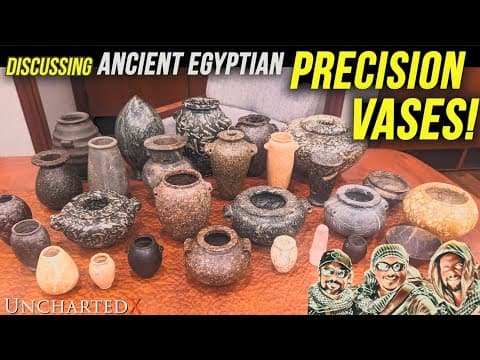
foreign welcome back to Uncharted X this is Ben and I hope you are all well this video is the recording of my live presentation at the cosmic Summit held in Asheville earlier in 2023 I get into the premise for what I've been calling the tale of two industries and dive into the work around the recent vase scanning project I've done several videos on... Read More
Key Insights
- 🗽 Ancient artifacts, such as vases and statues, display precision in machining and manufacturing that contradicts the standard model of history.
- 😒 The use of hard stones and advanced techniques suggest that human civilization may have been more advanced earlier than currently believed.
- 💡 The existence of inheritance and imitation complicates the interpretation of these artifacts and challenges the idea of a linear progression of civilization.
Install to Summarize YouTube Videos and Get Transcripts
Explore YouTube Video Summarizer or Get YouTube Transcript Extractor
Questions & Answers
Q: How do the vases and statues challenge the standard model of history?
The precision in machining and manufacturing techniques seen in these ancient artifacts contradicts the belief that only primitive tools were used during the time periods to which they are attributed.
Q: What evidence supports the existence of advanced technology during pre-dynastic times?
The presence of overcuts, symmetry, and polish on the artifacts suggests the use of advanced tools that were not available during those time periods. Additionally, the use of hard stones for these artifacts, which are difficult to work with, further supports the existence of advanced technology.
Q: How do the findings from the analysis of the vases and statues challenge the mainstream timeline of human civilization?
The advanced technology used to create these artifacts suggests that human civilization may have been more advanced earlier than previously believed, challenging the idea of a linear progression of civilization.
Q: How does the existence of inheritance and imitation complicate the interpretation of these artifacts?
The reuse of artifacts, imitation of advanced techniques, and inheritance of technological knowledge make it difficult to attribute the artifacts solely to a specific time period or culture.
Summary & Key Takeaways
-
The existence of advanced ancient artifacts, such as vases and statues, challenges the standard model of history, which suggests a linear progression of human civilization.
-
The vases and statues show precision in machining and manufacturing techniques that are beyond the capabilities of the time periods to which they are attributed.
-
The presence of overcuts, symmetry, and polish on the artifacts suggests the use of advanced tools and technology, contradicting the narrative that only primitive tools were available.
Read in Other Languages (beta)
Share This Summary 📚
Summarize YouTube Videos and Get Video Transcripts with 1-Click
Try YouTube Summary with ChatGPT & Claude or YouTube Transcript Generator
Explore More Summaries from UnchartedX 📚



Summarize YouTube Videos and Get Video Transcripts with 1-Click
Try YouTube Summary with ChatGPT & Claude or YouTube Transcript Generator