The 100 Year Flood Is Not What You Think It Is (Maybe)
TL;DR
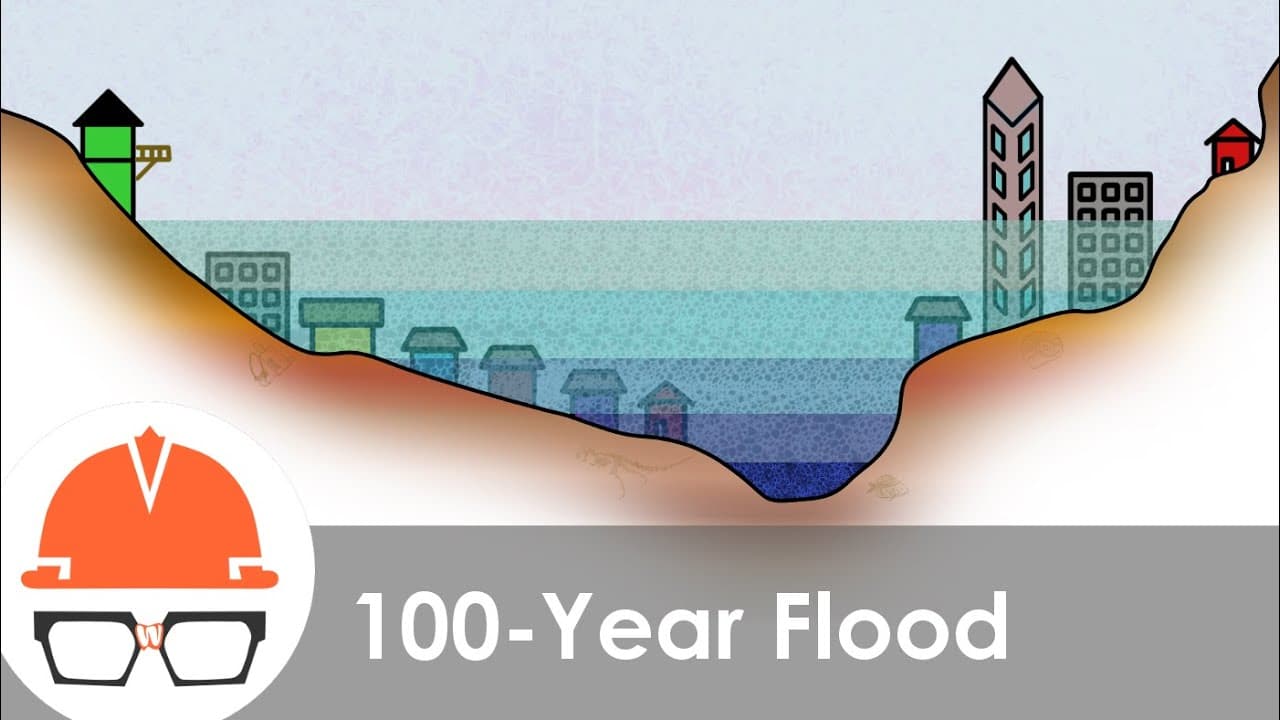
The 100-year flood is a misunderstood statistical concept in hydrology.
Transcript
Hey, I'm Grady today in practical engineering we're talking about hydrology We all know the water cycle We've seen this classic image with the green earth and the blue water and the arrows and the smiley face on the Sun So you probably already know that the majority of the rain that falls from the sky ends up washing along the ground following grav... Read More
Key Insights
- Flooding is the top natural disaster in the US, causing significant financial damage annually, highlighting the importance of understanding flood risks.
- The 100-year flood is a statistical concept indicating a 1% chance of a specific flood magnitude occurring in any given year.
- Return periods like the 100-year flood can be misleading, suggesting predictability that does not exist in natural events.
- Floodplain maps are crucial for understanding areas at risk, developed using data from stream and rainfall gages.
- Engineering hydrology combines statistical analysis and engineering principles to predict flood risks and manage water resources.
- Stream gages measure stream depth to estimate flow, while rainfall gages help calculate potential peak flows using the rational method.
- Hydrologic modeling involves complex calculations to predict runoff and flow patterns, often using computer software for accuracy.
- Civil engineers play a vital role in characterizing water variability to inform infrastructure development and risk management.
Install to Summarize YouTube Videos and Get Transcripts
Explore YouTube Video Summarizer or Get YouTube Transcript Extractor
Questions & Answers
Q: What is the 100-year flood?
The 100-year flood is a statistical term used in hydrology to describe a flood event that has a 1% chance of occurring in any given year. It does not mean that such a flood happens once every hundred years but rather that each year has a 1% probability of experiencing a flood of that magnitude.
Q: How are floodplain maps developed?
Floodplain maps are developed using data from stream and rainfall gages. Hydrologists use statistical models to analyze peak flow data and predict flood risks. The maps indicate areas with a 1% annual chance of flooding, helping inform urban planning and risk management strategies.
Q: What role do stream gages play in hydrology?
Stream gages are crucial in hydrology as they measure the depth of streams, which is then converted to flow rate data. This information helps hydrologists estimate flood magnitudes and frequencies, contributing to the development of floodplain maps and informing water resource management practices.
Q: How is rainfall data used in hydrology?
Rainfall data is used in hydrology to estimate potential peak flows in streams through methods like the rational method. This involves calculating the volumetric inflow to a watershed and converting it to stream flow, considering factors like soil absorption and evaporation, to predict flood risks.
Q: Why is the concept of return period misleading?
The concept of return period is misleading because it implies that natural events like floods occur on a predictable schedule. In reality, each year has an independent probability of experiencing a flood of a certain magnitude, regardless of past occurrences, making predictions based on return periods unreliable.
Q: What is the rational method in hydrology?
The rational method is a simplistic approach in hydrology used to estimate peak flow rates from rainfall data. It calculates the volumetric inflow to a watershed and equates it to stream outflow, accounting for factors like soil absorption, to predict potential flood magnitudes, though it is not highly precise.
Q: What challenges do engineers face in hydrology?
Engineers face challenges in hydrology due to the variability and unpredictability of rainfall and streamflow. Accurate flood risk assessment requires complex modeling and data analysis, often involving computer software, to simulate runoff and flow patterns for informed infrastructure planning and risk management.
Q: How does hydrology influence urban development?
Hydrology significantly influences urban development by providing data on flood risks and water resource management. Engineers use hydrologic models and floodplain maps to inform infrastructure design, ensuring that developments are resilient to flooding and that water resources are managed sustainably, protecting communities and investments.
Summary & Key Takeaways
-
Flooding is a significant natural disaster in the US, necessitating accurate risk characterization by civil engineers. The 100-year flood concept, often misunderstood, represents a 1% annual probability of a certain flood magnitude. Engineers use statistical hydrology to develop floodplain maps and manage water resources effectively.
-
The 100-year flood is a crucial concept in hydrology, indicating a 1% chance of occurrence annually. Misunderstandings arise from the term 'return period,' which suggests predictability. Engineers rely on stream and rainfall data to estimate flood risks and create floodplain maps for informed decision-making.
-
Engineering hydrology integrates statistical analysis with engineering principles to manage water resources and predict flood risks. Stream and rainfall gages provide essential data for modeling peak flows. Complex hydrologic models simulate runoff and flow patterns, aiding in infrastructure planning and risk mitigation.
Read in Other Languages (beta)
Share This Summary 📚
Summarize YouTube Videos and Get Video Transcripts with 1-Click
Try YouTube Summary with ChatGPT & Claude or YouTube Transcript Generator
Explore More Summaries from Practical Engineering 📚


Summarize YouTube Videos and Get Video Transcripts with 1-Click
Try YouTube Summary with ChatGPT & Claude or YouTube Transcript Generator